‘American Shaolin’
Pursuing the kung fu dream
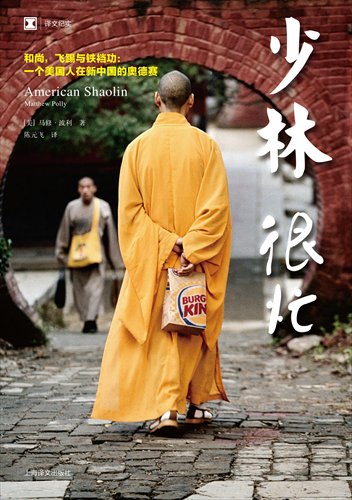
Cover to the Chinese version of American Shaolin Photo: Courtesy of the Shanghai Translation Publishing House
While some Chinese people were going abroad to the US to pursue their American dreams in the early 1990s, an American man was heading over to China to realize his dream of becoming an expert at kung fu. In 1992, 21-year-old Matthew Polly came to China for the first time, soon after he decided to suspend his junior year at Princeton University to study kung fu at the Shaolin Temple, a major center for martial arts in China.
Hoping to build his body up so that he would no longer have to live in fear of the bullies at school, Polly persuaded his parents, who strongly opposed his idea, to head to China, a place which at the time still repelled many foreigners with its reputation for poverty and seclusion.
"When I was a boy, I loved Bruce Lee's movie, Enter the Dragon, where he played a Shaolin monk. In all the kung fu movies I watched the Shaolin monks were the best fighters in the world," said Polly. "And when I was in college at Princeton University, a Chinese professor told me that the Shaolin Temple was real. I thought it was just a myth. That's when I decided I had to go the temple to fulfill my boyhood dream," he told the Global Times in an e-mail interview.
In 2007, Polly published American Shaolin, a record of his three years of study at the Shaolin Temple as well as his observations on the country then. Now, seven years later, a Chinese version of this book has been released by the Shanghai Translation Publishing House, allowing Chinese readers to not just get a glimpse at a foreigner's odyssey in a totally different culture, but most importantly, offering a look at the overall social environment and changing attitudes of people in China during the early 1990s from a foreigner's perspective.
Unexpected Shaolin
Already widely known in the West through various kung fu films and stars like Bruce Lee and Jackie Chan, the Shaolin Temple, located in the Songshan Mountain range in Henan Province, was a very mysterious, sacred and secluded place in the minds of many foreigners. However, after flying dozens of hours from Kansas to Beijing, then more hours by train and bus to finally arrive at the temple, Polly was completely shocked by what he saw.
"I expected it to be like how it was portrayed in the movies. This was before the Internet. There was no way to learn about the real Shaolin Temple back then," said Polly. "I expected it to be a calm and peaceful monastery. Instead it was very touristy, very commercial."
Established during the Northern Wei Dynasty (386-534), the temple has experienced several ups and downs in its history, the latest being during the 1920s-40s when many buildings and Buddhist texts were ruined during the chaos brought about by the wars among different warlords and the later War of Resistance against Japanese Aggression (1937-45).
In 1982, to recover its place as a holy land for Buddhism in China, the government implemented a large-scale restoration effort, followed by the establishment of various scenic spots, not long after numerous commercial shops and hotels sprung up around it.
The commercial environment around the temple has become so intense, that news about tourist traps, fake monks and conflicts between the Shaolin Temple and the local government on how profits from commercial operations should be distributed have never ceased.
While certainly disappointed at first, Polly was reassured when he met with the monks. "As people they were wonderful and their martial arts amazing. Better than the movies. It was because of them I stayed," he wrote.
Commercialization
Polly was amazed by the monks' kung fu performances, paying $1,300 for his first month tuition to become an official Shaolin disciple. During his three years of kung fu training he grew from a bag of bones (as depicted in his book) to a kung fu master who took 2nd place in a kickboxing tournament held by the local government.
During his time at the temple, he witnessed various conflicting behavior among the monks in the temple, as they were actually a miniature representation of an era caught between tradition and the irresistible trend of opening up.
For example, although Buddhists, the monks were actually not that free to focus on the practice of Buddhism. Although the surround commercial scenic spots and businesses were able to profit off of the Shaolin Temple, the unclear rules and messy management that positioned the temple as a non-profit organization meant that the temple say little of this profit. As such, to make a living and support the temple, they had to give kung fu performances or sell kung fu related products, which detracted from their studies.
"The commercial operations are both good and bad. The temple needs the money but it also needs peace and quiet. It is difficult to balance the two," wrote Polly.
This chaos, directly led to landmark changes led by the temple's abbot Shi Yongxin, who became a controversial figure after leading a series of commercial projects aimed at expanding the reputation of the Shaolin Temple, such as investing in Shaolin-related films and establishing a company to protect the intellectual property rights of the temple.
"He is a strong leader who has made many changes to the temple. The last time I was there (2003), the temple was much more prosperous than before. When I was at the temple, it was very bitter. The monks did not have enough food to eat. So overall it is better now," said Matthew.
Enduring spirit
Establishing a clear line between the practice of Buddhism and market operations under the Shaolin brand, Shi Yongxin has focused on supporting the temple by using its brand and intellectual property, which is seen as better preserving the spirit of the temple.
Polly's book, which was a best-seller when it hit bookshelves in the US, was also written at the encouragement of Shi Yongxin. "Abbot Yongxin heard that I wanted to become a writer. He encouraged me to help spread the spirit of the Shaolin Temple to the West through my writing," wrote Matthew. "If he had not said that, I would not have written American Shaolin, he changed my life."
In Polly's eyes, no matter where or how Shaolin may change, the true spirit of the temple has remained unchanged, even during the chaotic early 1990s. "For over a thousand years the Shaolin monks have practiced kung fu and Buddhism in the same place. Not to be too mystical, but sometimes you can feel their spirit when you are there. It is a very powerful place."