Xinjiangwancheng Station
Get back to nature at the end of metro Line 10
Editor's note
This year is the 21st anniversary of the opening of the Shanghai metro. The subway has facilitated more than 13 billion journeys during its 21 years, and half of Shanghai citizens cite the metro as their favored mode of transport. To commemorate the anniversary, each week the Global Times will take an in-depth look at one metro station and its surroundings. In the case of downtown stations, we will focus on points of interest within walking distance; while for suburban areas, we will cast our net a little wider.
Xinjiangwancheng (or New Jiangwan Town) Station on the very northern tip of metro Line 10 is nestled in a world of its own tranquility, and is surrounded by a range of entertainment, leisure and cultural facilities.
The history of Jiangwan area can be traced back to the Song Dynasty (960-1279) when it served as an important hub for trade and commerce. The new town, featuring a vast pristine wetland and a quiet neighborhood, is renowned as the only ecological "emerald" in urban Shanghai.
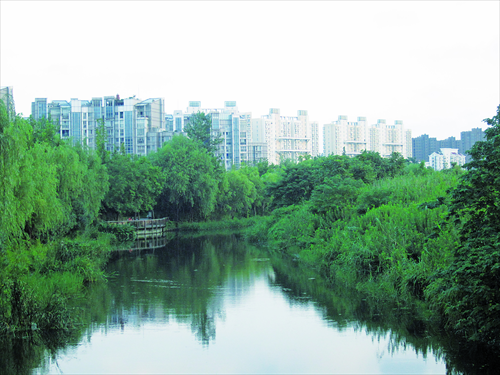
Jiangwan Wetland Park is the biggest wetland in urban Shanghai. Photos: Yang Fan/GT
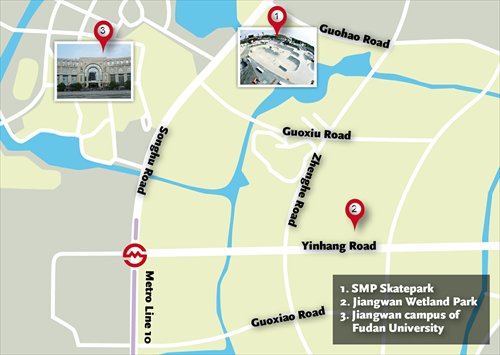
map
To the northwest of the station stands the new campus of Fudan University, to the north is Jiangwan Park, and to the southeast an increasing number of residential buildings. Life around Xinjiangwancheng Station is quite slow and laid-back, with pajama-clad local residents strolling the streets in a leisurely fashion.
SMP Skatepark
Covering an area of about 13,000 square meters, SMP Skatepark (2100 Songhu Road, 6052-8680) has a place in the Guinness Book of World Records as the world's largest extreme sports park. It is divided into three areas, namely the Bowl Area, the Street Plaza Area and the Competition Area.
The park features the world's longest U-shaped vert ramp, which is 52 meters in length, and a 360-degree full pipe connecting two big bowls of 5 meters in depth. To get between the two bowls, skaters and bikers need to pass through the pipe.
The park's facilities cater to the needs of people at all levels, from beginners to world-class athletes. Each month it holds extreme sports activities like skateboarding and BMX competitions, at which enthusiasts gather to pit themselves against each other by performing awe-inspiring stunts. The next event at the pump track will be on September 6.
"I was attracted to the park because it's the best in the world. Extreme sports represent a creative lifestyle. There are always new challenges ahead," said Gui Fuyao, a 22-year-old native of Jiangxi Province who moved to Shanghai out of his love for skateboarding.
"There are no boundaries in extreme sports. The park was built to pass on the spirit of pushing one's limits," said Lu Zhiwei, marketing manager of the park.
Admission is 30 yuan ($4.87) per person. Regular visitors can buy annual memberships. Training courses are offered on weekends. The park opens from 9 am to 7 pm daily. For more information on its upcoming events, visit smpskatepark.cn.
Jiangwan Wetland Park
Lying near the Huangpu River estuary in the city's northeast fringe, Jiangwan Wetland Park (880 Yinhang Road) is the biggest wetland in urban Shanghai. It features a massive green expanse crisscrossed by streams winding through a sea of reeds that stretches as far as the eye can see.
The park used to be a military airport, originally built by the Japanese army in the 1930s. After it was shut down in 1994, the area was completely cut off from the outside, leaving much of the land untouched.
Not until the late 1990s was it recognized as having developed as a precious natural habitat for plants, birds, fish and animals, leading it to be dubbed the "green lungs of Shanghai."
However, with numerous real estate developers flooding into the area, the wetland has gradually been damaged. Some people worry the wetland will soon disappear, along with some of the rare and endangered species that can be observed here such as lesser coucals and shrikes.
Local residents claim there has been a large decrease in the population of birds due to rampant unchecked industrial exploitation. "In the past, we could see large numbers of migrant birds flocking together, but now many of them have disappeared," a resident who lives nearby told the Global Times.
Signs are dotted around the park warning that fishing and swimming are prohibited for safety and ecological concerns. With neither enclosing walls nor a gate, the park is open to the public and easily accessed at multiple points on all sides. Visitors planning to spend the whole day there should take their own food and drink, as eateries are hard to find.
Jiangwan campus
Covering a total area of 1.07 square kilometers, Jiangwan campus (2005 Songhu Road, 6564-2222) of Fudan University houses the School of Law, the School of Life Science, the College of Foreign Language and Literature, and the School of Social Development and Public Policy.
Stepping into the campus, you will be surrounded by lush green trees and quickly find yourself immersed in a scholarly ambiance.
Lee Shau Kee Library is one of the most important landmarks on campus. It is a five-story European-style building donated by Lee Shau Kee, member of the board of trustees of Fudan University.
The library has a collection of 620,000 items and a seating capacity of 1,800.
As well as regular reading rooms, the library also has a "books for sharing" room, with volumes donated by students of the university.
Other main buildings on campus include the Leo KoGuan Law Building, the Advanced Material Building, and the Institute of Developmental Biology and Molecular Science.