Dancing queens
The attraction behind China’s outdoor dance craze
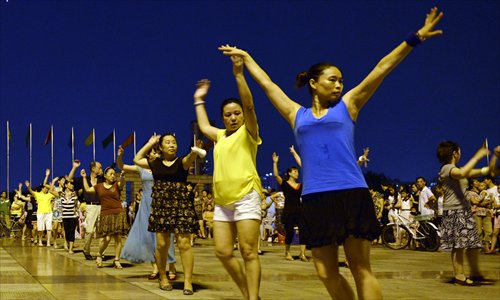
A dance group gets together at a public park in Shenzhen, Guangdong Province, for some evening dancing on August 3. Photo: CFP
Some researchers say that China's guangchangwu, an activity in which people gather together in public places such as squares and plazas and dance the night away, can be traced back to ancient collective sacrifices, while others consider the newer yangge folk dance movement of the 1940s in Yan'an, Shaanxi Province, as a better starting point behind the popularity of today's outdoor dance craze.
Most people aged around or over 50 in China experienced a time during the Cultural Revolution (1966-76) when everyone across the country was gathering together in public spaces to perform zhongziwu, or the "loyalty dance," everyone standing side by side, dressed the same and synchronizing their moves in a neighborhood-wide large scale performance. For many people, taking part in some kind of performance at school or work has become a common memory shared by many middle-aged people in the country.
Perhaps this is why so many middle-aged and elderly citizens in China enjoy taking part in group activities so much. Growing up studying and working in a collective group, singing and dancing together is a nostalgic way for them to pursue the days of their youth.
Social networking
These activities in which people gather together to dance can be either formal or informal. Some groups are organized by local communities as a sport activity for senior citizens, while some groups spontaneously form all on their own. The monthly membership fee for joining a guangchangwu group is usually very cheap, less than 50 yuan ($8) for the most part. Some groups dance in the same place everyday, while some places are shared by different groups that take turns dancing during different days of the week.
Middle-aged people who find themselves needing a break from being cramped up all day with their spouse or find themselves being gradually alienated by their children are able to find something in common with others who gather in public parks and plazas. Housewives and retired folk also get a chance to socialize and make friends in these groups. You can see them getting together in the mornings before lunch, or in the evenings after supper. Some groups gather according to taste in music, with groups dedicated to jazz, disco and even the newest pop sensations.
It's not all about dance. With groups ranging in size from the usual 25 people to larger groups of more than 200, guangchangwu makes for the perfect chance to broaden one's social circle. As people come together they soon find common topics to talk about, spouses, children and grandchildren, the price of vegetables or the latest neighborhood gossip. Some even use this time for more serious matters, like trying to find a job for a nephew, setting up their son with a nice girlfriend, or for some widowers who are tired of being alone, rekindle the flames of romance.
One of us
Huang, 53, shared how she came to be a lover of guangchangwu with the Global Times. One of her neighbors had invited her to have a try, and so she began dancing on the far edge of the group. However, her position made it difficult to see the lead dancer everyone models their moves on. "The lead dancer came over to me and asked whether I wanted to join them, and if she could help me correct my moves. She was very kind-hearted. I was very shy when I was dancing at the edge, but once I joined them and had a fixed position in the group, I felt like I had become one of them."
A fixed position is very important when it comes to a feeling of participation. Once you have one you are no longer a passenger or witness but a member of the group. Generally speaking, while group members tend to come and go, as some leave to join another group for a time and late-comers come in to take their place, the positions closest to the lead dancer or dance teacher are commonly taken by senior group members.
Clothing and accessories are also items that make a group feel close-knit. In some folk dance groups where hand held fans are part of the dance routine, groups will buy the same colored fans to differentiate them from other groups. Handkerchiefs and skirts for belly dancing are also often used. These specialized items also help identify one as a "serious dancer," which helps instill pride within the group as a whole.
This can lead to some interesting business opportunities. According to a report from news outlet Chutian Jinbao, one entrepreneur Zhang Qiang, managed to earn more than 10 million yuan ($1.6 million) a year by changing his family sports wear store from a wholesale store aimed at young people to an online store targeting a middle-aged demographic. According to Zhang a large amount of his revenue comes from members of these dance groups. "When one of them wears nice clothes, her fellow dancers want to wear it too. When everybody is wearing the same type of clothing, it creates a strong team atmosphere," said Zhang.
Leading role
For many groups, their leader is the dance leader that everyone bases their moves off of, while in some other groups, the leaders are the ones who have the right to reserve a dance area or have the ability to help the group take part in some performances or competitions.
The lead dancer holds special position in a group, but not every lead dancer is the leader of the group. Many lead dancers are retired music teachers or dancers with stage experience. They choreograph moves themselves or study moves from videos and then demonstrate these moves for other members to learn.
As guangchangwu becomes more popular and more types of professional dancers are needed, some younger professional dancers (some even in their 20s) have started to become full-time dance teachers. These teachers are hired by group organizers for around 2,000 to 3,000 yuan a month and usually spend their time teaching different groups throughout the day.
The China Square Dance Association, an organization founded in 2012, even offers certification courses for dance teachers and organizes nationwide competitions to gather China's thousands of dance groups together.