A Piece of Heaven
A visit to Vatican City
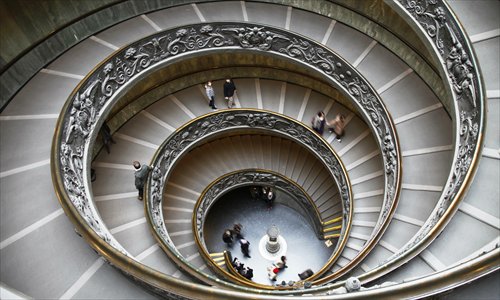
Interior of St. Peter's Basilica Photo: CFP
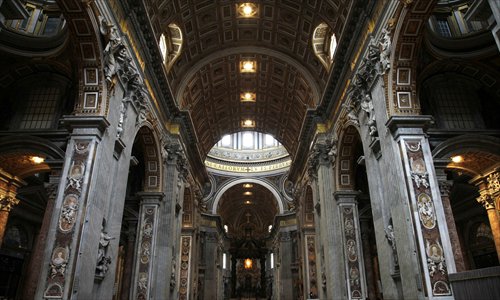
Interior of St. Peter's Basilica Photo: CFP
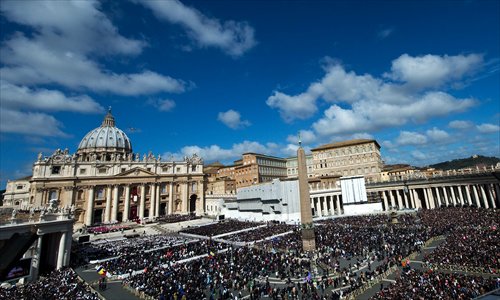
View of St. Peter's Square Photo: CFP
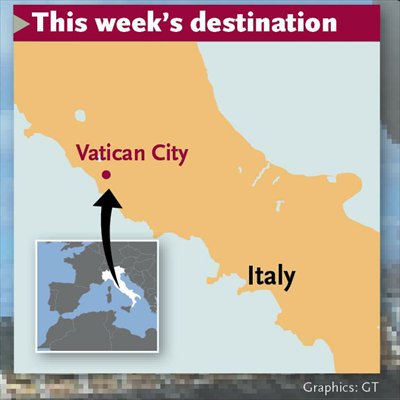
This week's destination
On the day I set out for Vatican City in late June, my flight from Nice to Rome was cancelled thanks to the French air traffic controllers' strike.
Fortunately, as the saying goes "All roads lead to Rome," so I managed to get a ride from Nice to the nearest town in Italy, get on the train to Genoa and then take a night train to Rome. When I finally arrived in Rome around 5:30 the next morning, the only thing I wanted to do was lie down on a bed and relax for the entire day.
However, tired as I was, I felt all my effort had paid off when I finally stood in front of Vatican City, immediately stricken by its awe-inspiring architecture and religious atmosphere.
Center of Christianity
Vatican City, also called the Holy See, is the seat of the Catholic Church and the focus of the faith of around 800 million Catholics. Gaining independence from Italy on February 11, 1929, Vatican City is the smallest Sovereign State on earth and has less than 1,000 citizens. However, that doesn't mean the city is empty, as there are many dignitaries, priests, nuns, guards, and 3,000 lay workers that live outside the Vatican and come there every day.
The city is only 44 square kilometers, three fifths the size of the Forbidden City in Beijing, or to be more visual, the size of just 40 soccer fields. But size does not keep it from having many of the trappings of a nation state. There is a post office, a daily newspaper, a world famous library, a pharmacy, a radio station, an army in charge of security and even a soccer team composed of the Swiss Guard, who all hold dual citizenship.
It all started with Saint Peter, the first pope. The location of St. Peter's Basilica in Vatican City is very symbolic as it was the site where St. Peter died a martyr and was later buried in 64 AD. As St. Peter is considered the first pope, it made perfect sense for the papacy to build the principal shrine of the Catholic Church here. The current church later replaced the old 4th century church over St. Peter's tomb. The whole construction took 120 years, lasting from 1506 to 1626.
Almost 2,000 years after the time of St. Peter, the Vatican consists of a complex of buildings and gardens built around the basilica that still bears his name.
The dome of St. Peter's Basilica is the most eye-catching feature of the Vatican I saw as I approached. Its dome is still the biggest self-supported brick structure in the world, and as the tallest dome in the world, it has a total height of 136.57 meters from the floor of the basilica to the top of the external cross.
Joining the long winding queue along St. Peter's Square means you have entered the territory of Vatican City. The wait in line wasn't boring in the least because there was so much to see. At the center of St. Peter's Square stands an Egyptian obelisk of red granite, 41 meters tall including the bronze lion pedestal it stands on.
The semi-circular colonnades on each side define St. Peter's Square. They were designed by Gian Lorenzo Bernini, one of the world's greatest baroque sculptors. Together they symbolize "the maternal arms of Mother Church." The colonnades are composed of four rows of columns with 284 Doric columns and 88 pilasters. Each column is 20 meters high and 1.6 meters wide. On top these you can find a total of 140 statues created by Bernini and his students. They depict popes, martyrs, evangelists and other religious figures.
The Pope holds general audience in St. Peter's square on a weekly basis. Every Wednesday, the pope arrives at 10:30 am to bless the up to 30,000 visitors from a balcony or platform, except in winter, when he speaks in the Aula Paolo VI Auditorium next to the square. I imagined it must be a spectacular scene when the Pope makes the speech. On special occasions such as the election of a new pope or on Easter, almost 400,000 people can fill the square.
As I followed the line and got closer to the Basilica, I saw the Swiss Guard in their colorful uniforms. They are responsible for the safety of the pope. It is commonly believed that their colorful uniform was designed by Michelangelo. The colors are the traditional Medici blue, red and yellow, matched nicely with white collar and gloves. The Swiss Guard have guarded Vatican City since 1506, and are the last remaining legacy of a tradition that dates back to Renaissance Europe. The 130 members of the Swiss Guard must be Roman Catholic Swiss nationals, unmarried, between 19 and 30 years of age, high school graduates and at least 174cm tall. They must have also have completed Swiss military service.
The line was much faster than I expected. After an airport style security check, I stood right in front of the global center of the Catholic Church.
Palace of art
Every year Vatican City buzzes with tens of thousands of Catholic pilgrims searching for spirituality. However the city isn't exclusively for Catholics, and many other people come for tourism and artistic reasons.
It really is a place you have to see for yourself. The moment I entered St. Peter's Basilica, it was as if the din of the world faded away and all I could hear was the song of the sculptures, the paintings and the architecture.
The Baroque style interior is lavishly decorated. It's dazzlingly resplendent and magnificent with gold geometric patterns, glorious paintings and many sculptured decorations. There are also several sculptures in side chapels.
After entering the church, in the first chapel on the right was Michelangelo's famous sculpture Pietà. It shows the Virgin Mary holding the body of her son Jesus on her lap after the Crucifixion. A bullet-proof glass wall was built to protect the sculpture after it was attacked by a mentally disturbed person in 1972.
Walking toward the dome, I could see a statue of St. Peter. One foot of the statue had been largely worn away by pilgrims kissing and rubbing for blessings over the centuries.
With a long axis that focuses attention on the altar, the brightest spot was the 30-meter-tall St. Peter's Baldachin, the bronze canopy built over the High Altar underneath the dome. It was designed by Bernini and is one of the great works of the Baroque period and remains the largest bronze sculpture in the world. There were four large statues in the piers near the High Altar. Saint Helena holds the True Cross which she found in Jerusalem, Saint Longinus carries the spear that pierced the side of Jesus, Saint Andrew carries the cross on which he was crucified, and Saint Veronica carries the veil that she used to wipe the face of Jesus, when he was carrying his cross.
In the far end of the Basilica, was the shining throne of St. Peter, also by Bernini. The throne houses a chair claimed to have been used by St. Peter himself.
There is much to explore inside the church if you have plenty of time. But I couldn't wait to see another famous building in the Vatican - the Sistine Chapel in the Vatican Museum. It is also part of the Apostolic Palace, the official residence of the Pope. It is also used for official ceremonies such as electing a successor after the death of a pope.
The Sistine Chapel is renowned for its famous painted interior spaces. The paintings on the walls and on the ceiling are widely considered to be the peak of Renaissance art. The walls are adorned with frescoes by Raphael, Bernini, Botticelli and others. The majestic ceiling frescoes by Michelangelo are some of the great masterpieces in the history of art. The nine central panels show the Book of Genesis, from the creation of the world to mankind's fall from God's grace, to the flood and the subsequent rebirth of mankind with the family of Noah. It took the artist four years to paint these ceiling frescoes. The ceiling had to be worked on piece by piece as frescoes require an artist to paint while the plaster is still damp.
Altogether the city was filled to the brim with sights to see and places to visit. As I headed back to my room that nice, I couldn't help wonder if I truly had found a little piece of heaven.
Rules of thumb
1. Entrance to St. Peter's Basilica is free, but visitors are advised to be properly dressed. Trousers or not-too-short dresses are allowed. Shoulders and knees should be covered. The Basilica is open daily April to September from 9 am-7 pm and October to March 9 am-6 pm.
2. Don't worry if there is a long line. It's only for security checks and it moves quickly. The line is shorter in the mornings.
3. You need to buy a ticket to enter the Vatican Museum. Make a reservation for entrance tickets ahead of time on the museum's website to avoid long lines.
4. If you want to see the Pope, you can either see a usual blessing from his apartment at noon on Sundays, or you can go to the more formal Wednesday appearance.