But Always
Bland romance from first-time director makes time stand still
Thanks to a fundamentally ridiculous plot and wooden acting, But Always is a film about romance that fails to appear romantic in any sense, and sees first-time director and screenwriter Zou Xian prove to be a hopeless storyteller.
The film stars Beijing-born actress Gao Yuanyuan as An Ran, and Hong Kong actor Nicholas Tse as Zhao Yongyuan. It follows their friendship as children in the 1970s and their eventual romance. The two are separated, only to be reunited in New York in 2001.
An and Zhao love each other throughout their lives - a fact that we are reminded about for 106 minutes of mind-bleeding tedium that really does feel like it lasts "for a lifetime," which also happens to be the meaning of it's Chinese name Yi Sheng Yi Shi.
Zou creates a series of twists and turns to find ways into An and Zhao's relationship. This in itself if understandable. Yet, she does it in a careless manner. Apparently, Zou decided that her story is going to emphasize the fleetingness of all happy moments.

Scenes from But Always Photos: CFP
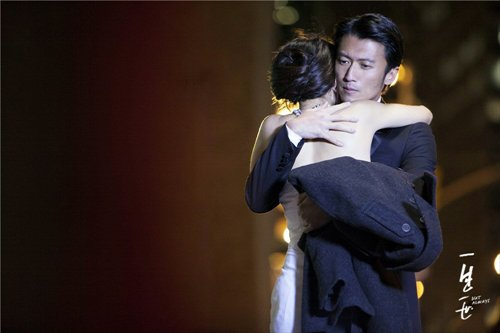
Scenes from But Always Photos: CFP
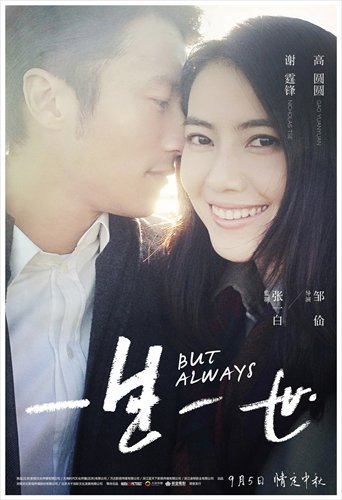
The couple are hardly together in a romantic sense for more than a few days of the decades that the film drags us through. This is what our poor protagonist An calls "fate" more than half way through the trauma, but the audience is all too aware that "fate" is just Zou pounding at a number of contrived and ungrounded incidents.
The film is at its weakest when the cliché of an utterly avoidable but devastating misunderstanding between the two protagonists leads to a long separation.
Naturally, whenever a web of misunderstanding is spun, the audience is eager to see how it will be unspun. So it is intensely frustrating when the street-vendor-turned-millionaire Zhao never makes an effort to explain the central misunderstanding of the film, and An, after a display of coldness, humiliation and anger, throws herself at Zhao without any further qualms.
Perhaps Zou wants to insert the all-too-familiar message "love is blind" here. But if so, a major part of the drama and tension is rendered meaningless. This is inexcusable.
Other obstacles that manage to set the pair apart include a manic-depressive ex-boyfriend, who is a desolate painter who lives up to the kind of stereotyping you would expect from this film.
When the incident that makes the story an eventual tragedy turns out to be the September 11 attacks on the World Trade Center in New York in 2001, we could be lenient and say Zou just wants to make her film historically and socially relevant and, one more time, an illustration of "fate."
However, after all the unconvincing plots and stiff dialogues, the supposedly powerful scene is out of place at best.
True, a large part of the audience did not expect to see anything more than a mediocrity in the first place, but were drawn by the pairing of the Beijing actress and the Hong Kong actor.
The two might have passed from their prime in terms of physical appearance, but they are still affecting on-screen, if a little static. The cameras tail a melancholic and beautiful Gao through the streets of Beijing and New York, and linger generously on Tse's well-toned figure.
But the leads do not save the film, partly because the script is unsalvageable, but also because their acting skills - which were never more than second-rate - are merely agreeable, even to the most die-hard of fans. Each of them joined the film business as amateurs and, after years of trying, they still lag far behind their better-trained peers. Gao continues to be bland, and Tse is as self-conscious as ever.
In sum, the film is a fiasco. It certainly leaves one with no interest in seeing what the director and scriptwriter plans to produce next, and with wonders about whether the two leads will master their craft before they are stripped of their pleasing looks.
Everyone's a critic
Muzi
26, designer
"After the setting turns to New York, the plot becomes unreasonable and sort of a farce. However, the use of background music is timely and great - it flows with the story line and it moved me from time to time. The female protagonist's last line epitomizes how unconditional true love is, and I found it very moving."
Ms Zhang
38, consultant
"I guess this film would be enjoyable for young students and the like, whose conception of romance might be similar to that of the film's. Some scenes, like when they are caught in a rain, are nice to watch. But for me, the story is very irrational and anything but real."
Sam
28, bank clerk
"The film is shot beautifully, but not in a cinematic sense. You feel like you are watching a very long music video or advertisement. Most of the plot is so predictable and I am sure I heard some of the lines elsewhere. When the 9/11 attacks scene took me by surprise, I felt even more uncomfortable."