Expressive overview
Series of parallel exhibitions helps visitors piece together story of neo-expressionism
The China Art Museum (CAM) is holding a number of exhibitions in parallel that all explore the neo-expressionism movement in painting.
Neo-expressionism emerged in Germany in the 1960s and expanded to other European countries and then the whole world. The movement advocates the return of painting to freedom of expression.
Wild Heart is the title of the exhibition of German neo-expressionism at the museum, which lasts until October 7. It is primarily made up of works by Anselm Kiefer, Markus Lüpertz and Jörg Immendorff.
"The title is really wonderful," said Beate Reifenscheid, director of the Ludwig Museum in Cologne, Germany and curator of the show.
In Reifenscheid's opinion, a prominent feature of neo-expressionism is that it's wild in the sense that it is uncontrolled, spontaneous and independent of political ideology.
Dazzling: Exhibition of Italian Expressive Arts in the Second Half of the 20th Century (until October 7) features works from the "three C's" of Italian neo-expressionism - Francesco Clemente, Sandro Chia and Enzo Cucchi.
Together, the exhibitions of German and Italian works contain over 200 pieces.
There are also three exhibitions looking at Chinese neo-expressionism: Chinese New Expressionism: Special Invitation Exhibition 1980-2014 (until October 17), General Transformation, Profound Significance: 10 Samples of 20th Century Chinese Art (until October 17) and Painting of Being-there: Art Exhibition of 20 Years' Chinese Figurative Expressionism (Until October 19). Works on show include those of Xu Jiang, the current director of the China Academy of Art in Hangzhou who studied in Germany during the 1980s, and painter Mao Xuhui from Sichuan Province.
It is the first time China has seen such a large-scale group of exhibitions looking at neo-expressionism and providing a platform to compare European and Chinese forms of the movement.
Complete expressive freedom
Zhang Ting, curator of the Chinese exhibitions, told the Global Times that, just like rock stars on the stage, neo-expressionist artists like to express their true selves on the canvas in as lively a manner as possible, no matter which country they come from.
"They usually don't limit their work to any painting rule, style, skill, color, or material," Zhang said. "But they all have a strong desire to return to painting as their only form of emotional outlet."
Vincenzo Sanfo, curator of the Italian exhibition, told the Global Times that the meeting point between Italian and German neo-expressionism lies in their return to painting as a form of expression "without rules and limits and in complete expressive freedom."
The curators agree that neo-expressionism's burning desire to return to painting as a form of pure emotional expression is closely related to the time at which the movement emerged.
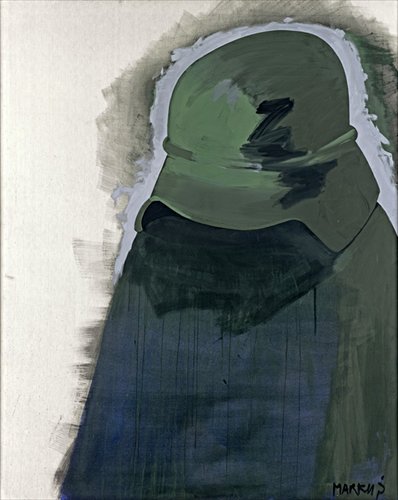
part of the Helmet series by German artist Markus Lüpertz Photos: Courtesy of China Art Museum
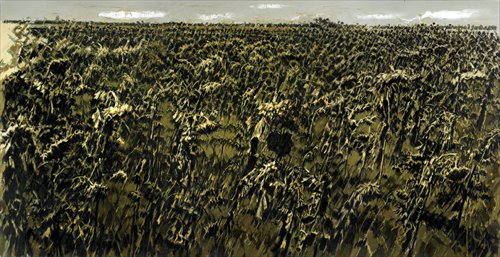
Sunflower Wall by Chinese artist Xu Jiang
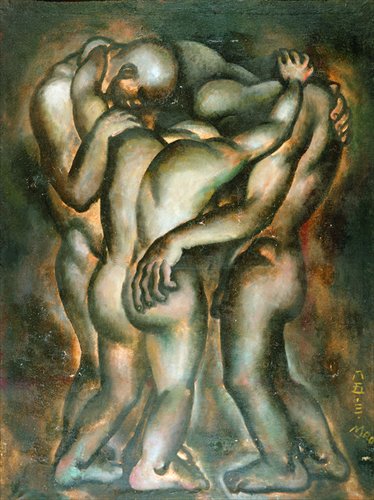
Dance by Chinese artist Mao Xuhui
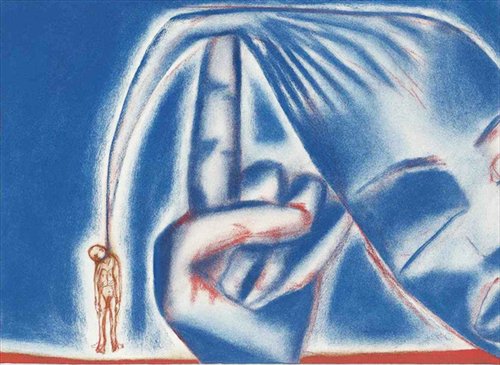
Parable by Italian artist Francesco Clemente
Reifenscheid told the Global Times that neo-expressionism rose after World War II. "During the Nazi terror, all kinds of abstract and expressive art was banned and announced as 'degenerate art.'
"As a reaction to this politically dictated art, artists remembered their roots." These roots included expressionism, an art movement that emerged at the beginning of the 20th century, also in Germany.
Neo-expressionism really took off in the 1960s, which were years of big social changes across the world as well as being the height of the Cold War.
Reifenscheid said the German neo-expressionism works do not answer directly to political problems and crises, and that they look at "the life within the city. Its darkness, its solitude, it sub-cultures."
She added that, "You only have to look at Markus Lüpertz's Helmet series, where he chose the military helmet as an expression of strong, almost stressing times. Also, you can focus on Karl-Horst Hödicke's work about the Berlin Wall. The divided city is obviously one of the major themes of most Berlin paintings during the 1960s."
Reifenscheid emphasized six works by Anselm Kiefer, which are all large-scale paintings that incorporate misshapen rusted wires and waves of plaster. Reifenscheid said the paintings are heavily influenced by the historical context of Germany at the time they were created.
"Kiefer never gets tired of reminding society about the historical dimension of World War II, of the holocaust, the loss of parts of the cultural identity," Reifenscheid said.
New creativity
As well as social and political issues, the German and Italian neo-expressionist painters also explore other subjects such as the erotic relationships and aspects of everyday life.
However, in Sanfo's opinion, the paintings from the two countries have different styles, which visitors will be able to recognize when visiting the exhibitions.
Sanfo told the Global Times that Italian art is connected with Renaissance drawing and finely-detailed artwork, while German art is more linked to the power of color and the motion of the act of painting, so that sometimes it looks rougher and less sophisticated.
According to Zhang, in the 1980s, European neo-expressionism began to influence artists in China. In the boom of culture that followed the Cultural Revolution (1966-76), Chinese artists took inspiration from neo-expressionism to secure their own identity and develop creatively.
Opening hours: 10 am to 6 pm (closed on Monday)
Venue: China Art Museum
中华艺术宫
Address: 205 Shangnan Road
上南路205号
Admission: 20 yuan ($2.34) for German and Italian exhibitions, free for all others
Call 400-921-9021 for details