Sound design
Japanese architect talks about philosophy behind new Shanghai Symphony Hall
The traditional Japanese aesthetic known as the hisureba hana, or hidden flower, says "that which is hidden is often the most beautiful."
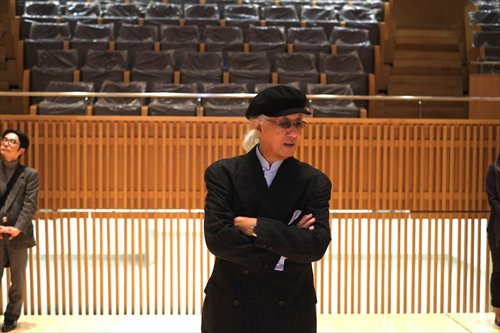
Arata Isozaki (pictured below), the 83-year old Japanese architect behind the new Shanghai Symphony Hall (SSH), hopes the venue can be a hisureba hana in the heart of everyone who enters it.

Architectural renderings of the Shanghai Symphony Hall Photos: Courtesy of SSH

Architectural renderings of the Shanghai Symphony Hall Photos: Courtesy of SSH
As one of the world's most sought-after architects, Isozaki has designed many buildings in China since he first visited the country in 1978.
Most of the buildings he has designed are culture, art and performance venues, including the Art Museum of China Central Academy of Fine Arts in Beijing, Zendai Himalayas Center in Shanghai and concert halls in various Chinese cities, including Shenzhen, Harbin.
"I believe that such venues can reveal the temperament of a city," Isozaki said. "When I'm designing a building, I don't think of it as an isolated structure, but as an inseparable part of its surroundings and the city as a whole."
Fitting in
The new Isozaki-designed SSH is on Fuxing Road Middle, and is the new home of the Shanghai Symphony Orchestra, which used to be based on Hunan Road.
Covering an area of 19,950 square meters in the former French concession, the building unexpectedly fits in with the surrounding historical residential neighborhood.
The external walls are composed of terra-cotta bricks of muted red, grey, brown and yellow, which are easy on the eye.
The 18-meter-high building's huge saddle-shaped top shelters two concert halls, which are flanked by separate entrance and exit halls. The main hall can accommodate an audience of up to 1,200, while the chamber hall can seat 400.
An outdoor square with a strip of greenery that is almost 100 meters long separates the building from the road, and brings the charm of a classical Chinese garden where people can relax. According to Isozaki, the green space also serves the practical function of deadening traffic noise.
Another potential source of noise pollution is metro Line 10, which passes beneath the building. To counter the noise, the building has 300 vibration isolators set 16 meters underground.
A great musical instrument
"For me, designing a concert hall is more like creating a great musical instrument than a building," Isozaki said. "The most important thing is not the building's external appearance, but its internal function. This can't be seen by the audience, but they can definitely feel it."
Isozaki therefore invited Japanese acoustician Yasuhisa Toyota, who has taken charge of over 50 major projects worldwide, to aid him throughout the design and construction stages.
According to Isozaki, there are two basic design models for the internal structure of a concert hall. One is the shoebox style, in which the stage sits at one end of a rectangular auditorium. The other is the vineyard structure, in which the seats rise in a tiered fashion and surround the stage. The SSH's main hall combines both, while the chamber hall uses the shoebox-style structure.
In the main concert hall, six large parabolic reflector boards on the wall and ceiling provide the best acoustics for almost every auditorium seat. They can also double as projector screens. The boards' surfaces are covered by weaved bamboo that is the same color as the floor, helping to create a unified, peaceful atmosphere.
The stage floor is made of Hokkaido cypress from Japan, which enhances the onstage sound for the performers.
"All musicians on the stage hear their own sound fed back from the acoustics in the concert hall. This allows them to better control how they play. This means the hall becomes one of the instruments for musicians playing there," Toyota said.
The chamber hall uses the same materials as its larger neighbor, and its stage has 12 platforms that can be raised in various configurations to meet the demands of different performances.
On September 6, world-renowned Chinese pianist Lang Lang performed in the main hall. After the performance, he told local media that the hall could be ranked among the top three in the world in terms of acoustics.
Different by design
It is difficult to see any similarity between the appearance of the SSH and the Zendai Himalayas Center in Pudong New Area, although both were designed by Isozaki. The center is a multifunctional culture and business complex that has a museum, a performance venue, a shopping mall and a hotel. Unlike SSH, it is very prominent among its surroundings.
The lower part of the building's exterior is covered in shapes that give the appearance of an "inorganic forest" that grows into the structure, creating a sense of freedom and movement around the area.
Isozaki said he also considered the surrounding environment and the function of the center while creating the design. As it is surrounded by large, bold buildings and open spaces, like the Expo site and the Shanghai New International Expo Centre, he wanted something that would declare itself and attract attention.
"But for the SSH, I hope people can unconsciously forget the space, and feel the music more," Isozaki said.