What we should do about the hutong
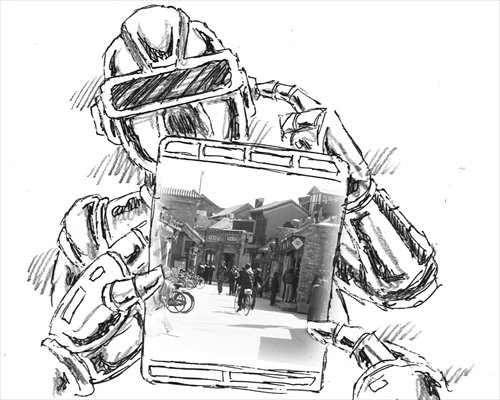
Illustration: Peter C. Espina/GT
We are at a crossroads as to what we should do with Beijing's culturally iconic hutong alleys.
Last weekend, I was walking across the square in Gulou where the Drum and Bell Towers lie. I was shocked by the degree of reconstruction I witnessed. On every side of the square, hutong blocks extending at least 10 meters had been demolished.
On the one hand, the firm responsible for Beijing's well-known SOHO Galaxy building received the prestigious Royal Institute of British Architects International Award in 2013. On the other, the construction of the complex came at the expense of Beijing's iconic hutong alleys, a point made note of by The Beijing Cultural Heritage Protection Center.
I think the hutong should be conserved. Renovation is a beautiful way to preserve the memory of the past.
One of the arguments that are frequently made in favor of demolishing the hutong courtyards is that they are not equipped with basic amenities like heating or flush toilets. I agree that the quality of many siheyuan is poor to say the least - many live in small rooms, in buildings that lack insulation and are consequently freezing cold in the winter. I also agree that people who live in the hutong have just as much right to improve their quality of life as anyone.
But I believe that there are solutions to these problems, without getting rid of the hutong buildings altogether. These buildings are all unique, and over time, the hutong alleys have developed into a labyrinth in which every family modifies and tailors its house to suit its own needs. The unique quality of the hutong homes is not simply that it is situated in a narrow alley, but the chaotic nature of the buildings themselves. Without this seemingly ramshackle aspect, the attraction of these areas would disappear.
To simply tear these buildings down, and rebuild them in the semblance of the old ones is not sufficient. Just look at Qianmen. Though the buildings look the same, many would argue that something important and authentic has been irrevocably lost.
I propose a simple but effective solution, based on an existing system.
Whenever an old hutong plot becomes available, the government should buy it. The property should be assessed, to decide whether it is possible to restore, or must be demolished.
In those cases where the original building must be demolished, a competition should be held for architects as to what will be built in its place, with specific rules regarding quality and context.
Beijing would benefit from creativity from all around the world and secure experimental and fresh ideas. Through the competition, designers, including students, would get the opportunity to gain experience and generate a professional resume. The winner of the competition would get to build their design and have the privilege of taking part in shaping Beijing. Of course, the authorities would need to ensure the building is maintained and that there is a fair percentage of all ages and groups represented in the residents who subsequently move in to the buildings.
In this way, we can preserve the qualities of diversity and small scale development. The inside of the Second Ring Road in Beijing would become a true experimental playground, and become distinct in a way that looks toward the future, rather than the past.
This article was published on the Global Times Metropolitan section Two Cents page, a space for reader submissions, including opinion, humor and satire. The ideas expressed are those of the author alone, and do not represent the position of the Global Times.