Weddings on water
Expat brides and grooms enjoy a taste of tradition
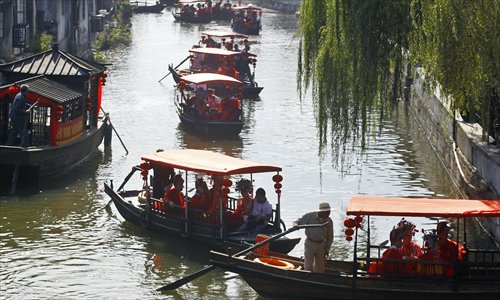
Wooden riverboats carrying wedding groups glide along a waterway in Fengjing town. Photo: Yang Hui/GT
Ten small wooden boats glided along the river as fireworks echoed around them. Clad in ornate red Chinese wedding costumes, 20 couples, mostly foreigners, waved cheerfully to the people on the banks as they cruised past.
This was Sunday in Fengjing town in Jinshan district, where a special group wedding ceremony was celebrated in the traditional local style. Brides and grooms from 15 countries took part in - half of the couples were Chinese men or Chinese women marrying foreigners and the other half were expatriates.
This was the 10th year that the town had staged a group wedding, said Wang Wei, a wedding ceremony official. Previously most participants were Shanghainese couples. "This year we made it specifically for foreign couples, as nowadays expats are more interested and involved in traditional Chinese culture and customs."
That was why Aqil Zidan, 22, chose to experience this wedding ceremony with his bride. The young Indian came to China in 2013 and is studying at Nantong University in Jiangsu Province. There he met and fell in love with Saara Nakale, a 21-year-old Namibian. One of Zidan's Chinese friends suggested they get married in this traditional ceremony and the couple agreed.
For the day Zidan wore a long gown, a red hat with two "wings," and an artificial flower the size of a football. For Zidan it was very strange attire. "My hat is very heavy but my wife's is much heavier," he said, indicating Nakale's hat which was decorated with pearls and pompons. This was a fengguan (a phoenix crown). "They are heavy but very beautiful."
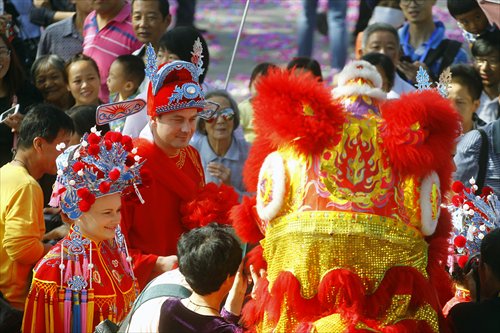
A lion dance welcomes one of the wedding couples. Photo: Yang Hui/GT
Red veils
At about 10:30 am, after getting off the boats and walking in a procession through the small streets of the town, the brides and grooms were led to an outdoor stage. One by one, they went to the center of the stage aided by a woman dressed as meipo (a woman matchmaker) and a man dressed as yuelao (the god of matchmaking in Chinese mythology). To applause and cheers, the grooms slowly raised red veils from their brides' faces. Later the couples hung "lovelocks" on a plastic heart-shaped tree.
Director Wang explained that Chinese people believed that by hanging "lovelocks" during the wedding, couples will stick with each other and live happy lives forever.
For 30-year-old Chinese woman, Xiong Yan, the wedding day was a surprise and a delight. "I had always dreamed of a traditional Chinese wedding ceremony," she said. "I am really excited today to be wearing such a beautiful red wedding dress."
Xiong's husband, Cervinka Ales from the Czech Republic, had signed them up for this ceremony some months beforehand but he did not tell her. "I know that she loves traditional things a lot, so I planned to give her a surprise," he smiled.
Like Xiong, Tang Liyuan, from Northeast China's Heilongjiang Province, is a lover of traditional Chinese culture and she was enjoying her second wedding on Sunday. In October last year, she had had a wedding with her Ecuadorian husband, Klaus Tugendhat, in her hometown. "I prepared it myself and added elements of Heilongjiang wedding customs."
She said in many places in northeastern China, the groom's parents placed a saddle on the doorstep of the house. On her wedding day, the bride enters the home by walking over the saddle - "In Chinese the word for saddle sounds like the word for peace."
On Sunday, Tang had another wedding, experiencing again the happiest "day" of her life. "The wedding ceremony in Shanghai is very different to the one in my hometown - last year I didn't have to wear a heavy fengguan but both weddings are interesting and typically Chinese."
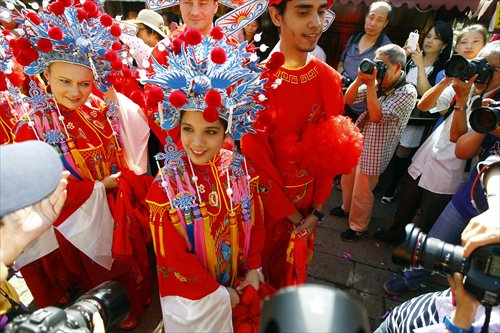
Happy couples walk in procession through Fengjing town streets. Photo: Yang Hui/GT
A name puzzle
Some of the expat brides and grooms were puzzled by the names of the Chinese wedding dishes. The names of the "eight dishes" - the wedding banquet for the 20 couples - each had a special meaning.
The first course, braised pork leg with soy sauce, was called "rising up, step by step." Wang said this wished the couples an infinitely bright future. The last course of braised eggs in sauce was called "from generation to generation."
As well as the "eight dishes" each couple drank a small bowl of lotus seeds soup - older Chinese believe that by eating lotus seeds, newlyweds will produce babies early.
In Fengjing town there is a private wedding museum, which has more than 300 exhibits including a 100-year-old carved wooden wedding bed and some exquisite wedding dresses.
In the old days in China on her wedding day a bride would be sat in a sedan chair and carried to her husband's home. But in Fengjing, a water town, brides were taken to their new homes in boats.
Shen Liang, the owner of the museum explained that the groom's boat had to be moored to the southeast of the bride's home. "This was believed to bring fortune and prosperity to the couple."
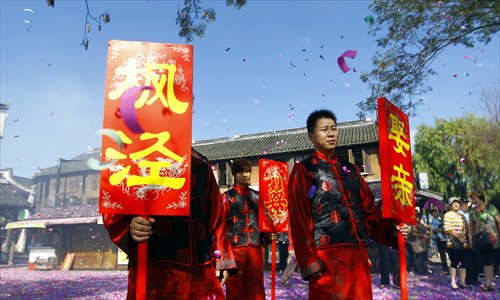
Wedding ceremony officials wait for the couples to arrive. Photo: Yang Hui/GT
Betrothal gifts
Shen has lived and worked in Fengjing for more than 40 years and said, traditionally, one or two months before the wedding day, the would-be husband would send pinli (betrothal gifts) to the girl's home. The pinli usually contained money, wine and plenty of food including pork legs and sweets. The girl's parents had to prepare a substantial dowry for their daughter. "In the old days, the bigger the dowry that a bride took to the groom's home, the better she would be treated by her husband's family."
Shen said that when he was 10 years old, on the night before his cousin was married, he was asked to sleep in the wedding bed. Locals believed that if a little boy slept in the wedding bed the night before a couple married, the owners of the bed would live a happy life together.
These old customs were very popular in the Ming (1368-1644) and Qing (1644-1911) dynasties, and the first half of the 20th century as well. After the People's Republic of China was established in 1949, many old customs were prohibited or held to be superstitions. When China's opening-up policies were introduced in the late 1970s, traditional wedding customs began to be reinstated.
"Nowadays the grooms in this town tend to go to the bride's home by car instead of boat," Shen told the Global Times. "But the traditional wedding customs, with their history and cultural links, still prove popular with locals and now expats."