Floral pleasure
Add a little fragrance to your food with these flower-based dishes
While flowers are mainly thought of as a feast for the eyes, they can also be used as ingredients in food for our bellies.
Popular edible flowers include rose, lily, peony, magnolia and cherry blossom.
Flower power came to Chinese cookery over 2,000 years ago. An official during the Shang Dynasty (C.1600-1046BC) named Yi Yin is said to have been an expert in flower-based cuisine.
China's only female emperor, Wu Zetian (624-705) of the Tang Dynasty (618-907), is said to have consumed flower-made cakes in order to improver her complexion.
Eating flowers later became a part of the refined lifestyle of the scholar.
The Global Times has gathered together some simple, healthy flower recipes from popular local restaurants that you can use to freshen up your diet.
Loving sweetness
Autumn is the season of the sweet osmanthus. The blossoms grow in small bunches and give off a rich, heady perfume. As a symbol of love and romance, the plant is often used for decoration at traditional Chinese weddings.
Famous dishes include osmanthus duck, osmanthus rice cake, glutinous rice balls with osmanthus in fermented rice wine, and steamed osmanthus-scented lotus root stuffed with glutinous rice.
Traditional Chinese medicine (TCM) claims that osmanthus tea can relieve coughing, nourish the spleen, enhance the appetite and rid the body of toxins.
Osmanthus-flavored pork braised in brown sauce
Ingredients: 700 grams streaky pork, 50 grams dried string beans, six quail eggs, 1 gram dried osmanthus flowers, 15 grains of red yeast rice, 15 grams oil, 50 grams cooking wine, 5 grams dark soy sauce, 10 grams light soy sauce, 50 grams crystal sugar, 5 grams star anise, 5 grams chopped spring onion, 10 grams sliced ginger
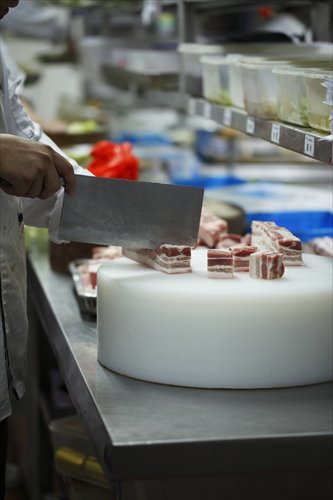
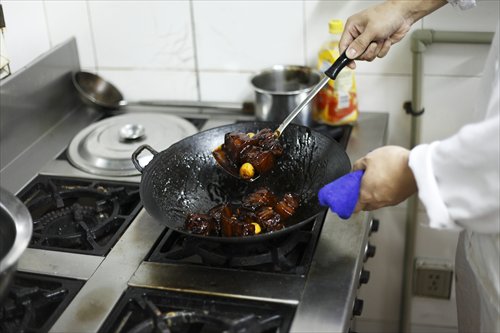
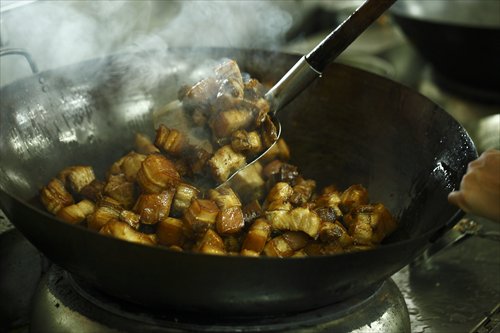
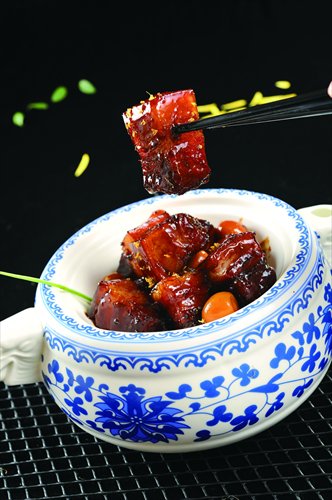
The process for making osmanthus-flavored pork braised in brown sauce Photos: Courtesy of the restaurants
Preparation:
Wash the pork and dice into 4-centimeter cubes
Soak the string beans in warm water for 1 hour
Boil the eggs and peel off the shells
Wrap the star anise, red yeast rice, spring onion and ginger with gauze
Cook the oil on high heat until medium hot, add the pork, keep stir-frying until they become golden yellow
Add water to submerge the pork, add the gauze wrap, cooking wine, dark soy sauce and light soy sauce
Cook over high heat with lid on
When water starts to boil, turn to low heat and braise for 1 hour
Remove the gauze wrap, and add the string beans and eggs
Turn heat to high, and cook until the sauce becomes red and sticky
Sprinkle the flowers on top and serve
The recipe was provided by Mao Jiaming, chef of Mai Sheng Li Yaohua Branch (4/F, 488 Yaohua Road, 2023-2779).
Purity and fragrance
The name "jasmine" is said to have been derived from the Persian word "yasmin," which means "God's gift." The original version of Chinese folk song "Jasmine Flower" emerged in the Qing Dynasty (1644-1911). It enjoys enduring popularity due to its melodious tune in praise of the flower's purity and fragrance.
In 1924, the world-renowned Italian composer Giacomo Puccini (1858-1924) incorporated the tune into his opera Turandot, adding a distinctive Chinese flavor to the story.
Jasmine flowers are a prized tea ingredient with healing and refreshing properties. The petals coated with paste can be fried into a dish that increases one's appetite. The extracted essence of the flower is often used to make perfumes.
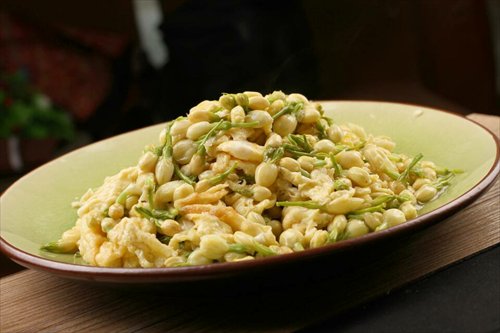
Scrambled egg with jasmine flowers
Ingredients: 200 grams fresh jasmines, 50 grams egg, 7 grams oil, 4 grams salt
Preparation:
Wash the flowers and scald them in boiling water for 30 minutes to get rid of their bitterness
Scoop out the flowers and drain away the water
Beat the eggs in a bowl
Warm the oil
Pour in the egg liquid and stir-fry on medium-high heat for one minute
Throw in the flowers and stir-fry evenly
Add salt and serve
The recipe was provided by Li Kai, chef of Simple Cook, (Room 112, No.16, Lane 1500 Lianhua Road South, 3412-1070).
Chrysanthemum feast
As a symbol of nobility and integrity, the chrysanthemum is among the "Four Gentlemen" commonly referred to in traditional Chinese art (the other three being the plum blossom, the orchid and bamboo).
"I drink the dripping dew of magnolia in the morning, and eat the fallen petals of chrysanthemum at night," wrote Qu Yuan, an upright minister who implied his desire to remain untainted by corruption in his famous poem Li Sao, or The Lament, during the Warring States Period (475BC-221BC).
Chrysanthemum was first used as a food in China in the 15th century BC.
Chrysanthemum wine, which is regarded as being auspicious, is usually consumed during China's Double Ninth Festival to dispel ill fortune and bring about good luck.
The flower tastes good when embedded in sweet cookies and its slight bitterness helps cut through grease.
Modern research has found it is of high medicinal value, as it can help cure dizziness, sooth the stomach, dispel internal heat, improve hearing and eyesight, prevent and treat hypertension, and contribute to weight loss.
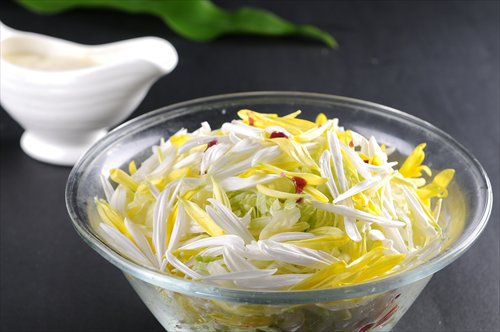
Wild chrysanthemum salad
Ingredients: 120 grams lettuce, 1 white wild chrysanthemum, 1 yellow wild chrysanthemum, 1 tablespoon blueberry sauce, 200 grams salad cream
Preparation:
Wash and shred the lettuce, and put it in a big bowl
Wash the chrysanthemum, shred the petals into pieces, and put them in the bowl
Add blueberry sauce and salad cream
Mix all the ingredients and serve
The recipe was provided by Zhou Tao, head of Share Way Yishan Branch (455 Yishan Road, 6029-3082).
Tips:
Make sure the flowers you choose are indeed edible, as some may contain toxic substances.
Do not eat flowers bought from the florist' as they may have been sprayed with pesticides.
Cook flower dishes with a relatively plain flavor to set off the flower's fragrance.
Avoid overcooking due to the petals' delicacy.
Do not eat flowers if you suffer from pollen allergies.