HOME >> METRO SHANGHAI
Shanghai's golden people
By Zhao Yashan Source:Global Times Published: 2014-10-12 18:28:05
Different approaches but these expats make a difference
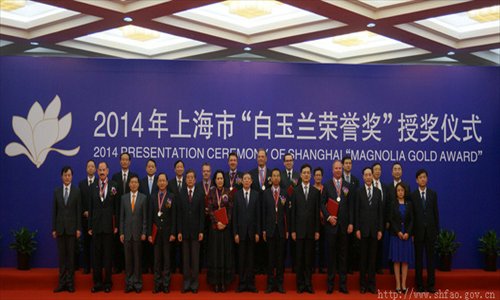
Magnolia Gold Award winners and Shanghai municipal government officials pose for a group photo at the presentation ceremony. Photos: Courtesy of the foreign affairs office of Shanghai municipal government
Expats have played and continue to play important roles in Shanghai's cultural, financial and social life. Since 1989 the city government has handed out Magnolia awards every year to foreigners who have contributed to the city's development - 50 Magnolia Silver Awards were handed out in September and on September 30 nine foreigners were given Magnolia Gold Awards - an expat is entitled to a golden award two years after being presented with a silver award.
The range of careers, countries and contributions is as varied as Shanghai itself. The Global Times talked to three of this year's Magnolia Gold Award winners to find out what makes them tick and what they think of the city.
Jan Van der Borght, from Belgium, is the representative of the port of Antwerp in Shanghai - Antwerp and Shanghai have been sister cities for 30 years. "I am not your average expat," Van der Borght said. Most, expats choose to surround themselves with their own familiar cultures when they come to Shanghai. But when he landed in Shanghai in January 2008, he set up house in a Chinese compound with no foreigners nearby. During his first year he avoided contact with other foreigners as much as possible.
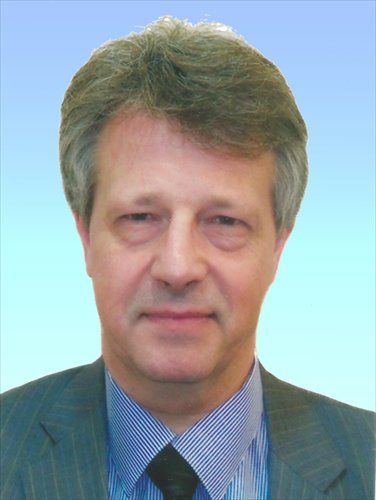
Jan Van der Borght Representative of the port of Antwerp, General Manager of EurBridge, Guest Professor at Shanghai Maritime University
Making an effort
"I didn't live in an expat ghetto. When I decided to live here, I felt I should, at least, make an effort to become a member of the local community."
It was challenging and sometimes amusing at the beginning - like the time he tried to buy toilet paper in a shop but didn't know the word for it and couldn't find any to show the assistant what he wanted.
His persistence paid off. He told the Global Times that after a while, a local Chinese family adopted him for Chinese New Year and he spent a week with them in the countryside, eating, sleeping, drinking, playing mahjong and card games and letting off fireworks.
He has also attended a Chinese funeral - "this is unusual for an expat. It was a warming experience and gave me an inside look at a Chinese family."
He regards himself still as a guest to the city. He thinks Shanghai has treated him very well and this makes him feel responsible. "So I have to give something back to the society of which I have become a member."
In a unique way of linking his feelings of obligation and his career Van der Borght arranged to bring from the MAS Museum in Antwerp, Belgium four valuable antique Chinese ship models. It took him five years to negotiate the deal and persuade the authorities in Antwerp to agree to send the models to the China Maritime Museum in Shanghai. As a result of his work the two museums have now signed an agreement to work together in the future. He said the relationship was beneficial for both sides and more exhibits would be arriving in Shanghai for students and research fellows to study and learn from.
He is a guest professor of the Shanghai Maritime University and said he found Shanghai students less assertive than their counterparts in Europe. He told the Global Times that his students here rarely interrupted him during his lectures but would wait until he stopped speaking before approaching him with well-considered questions. "The advantage is that after a lecture, they come up with precise questions and they know exactly what they want to ask."
Van der Borght is also the general manager of EurBridge Ltd, which offers consulting services to Chinese and Western companies wanting to expand overseas. If he was back in Europe he said, he would only be able to deal with one business but Shanghai's vigorous economy and city life have taught him to be open-minded and think outside the box. "This is really typically Chinese. In Europe, people are very satisfied with a nine-to-five job."
Shanghai's many 24-hour convenience stores are a complete contrast to the shops in Antwerp which usually close at 6 pm, he said. Back home once he forgot where he was and tried to find an open shop after he had finished work at 8 pm. "I have to change my mind-set when I am back home," he said.
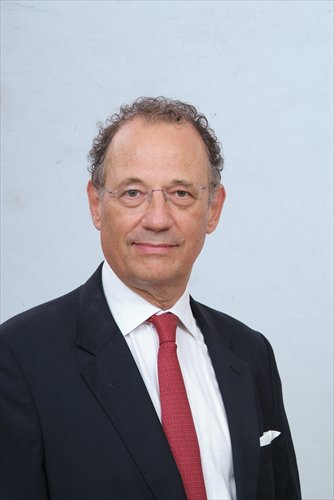
Henk B. Nieuwenhuys Executive Consultant with Vestone Capital
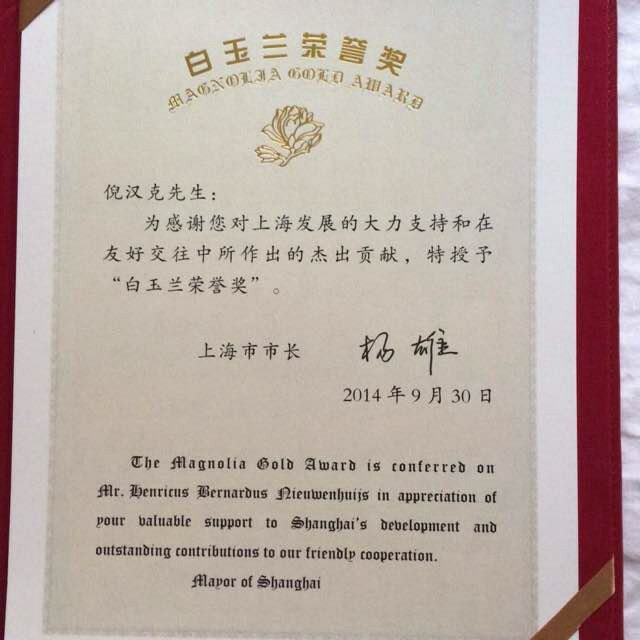
Award certificate to Henk B. Nieuwenhuys
A porcelain collector
Henk B. Nieuwenhuys, from the Netherlands, came into the spotlight in 2008 after he donated his family's porcelain collection to the Shanghai Museum. The collection featured 97 pieces of antique Chinese porcelain created during the Emperor Wanli's reign in the Ming Dynasty (1368-1644). All the collected pieces were made for overseas trading.
"It is a very, very special feeling to donate something that is dear to you," Nieuwenhuys said.
The collection was started by his grandfather, Ben van Hees in the late 1920s. In those days in Europe there was very little known abroad about Chinese porcelain. Few knew how to date pieces properly. "People like my grandfather bought the porcelain because they liked it, not for financial reasons," Nieuwenhuys said. As a small boy he was intrigued by the designs and wondered why the men on these vases and plates wore dresses and had their hair tied in ponytails.
Nieuwenhuys inherited the blue-and-white porcelain collection from his father when he passed away in 1991. He later on expanded the collection himself by more than 40 percent by buying items at auctions. Sometimes he was cheated in deals but he continued to buy items. "I am an opportunist and never think long about it if I see a piece of porcelain I like and think would be a nice addition."
Some time ago, Nieuwenhuys sold his house and had to decide what to do with his collection. He had three options. He could have sold it but, as a true collector, this went against his principles.
Disliked a split
He could have handed the collection down to his two children as his grandfather and father had done. "But my two children are not interested in the collection and they are clever enough to make their own lives." Also he disliked the idea that if he gave the collection to his children it would have to be split in two.
He was living in the Netherlands at the time and he could have also donated the collection to one of the Dutch museums. However, he explained, many Dutch museums already have collections of Chinese porcelain and his collection would not have been displayed properly. "A Dutch museum would say thank you and put them in the basement," he said. He wanted the collection to be kept together and displayed to the public.
Like the F1 racing star Michael Schumacher, Nieuwenhuys had a skiing accident in the French Alps (although his accident occurred in 2006). However the accident put him into a coma for three weeks and he woke up in the same hospital Schumacher would be later treated in. Doctors then advised him his eyesight was seriously impaired. He would no longer be able to work on the 300 e-mails he used to read every day.
When he recovered he packed up his goods in the Netherlands and came to China to establish a business here. As a businessman he often thinks about giving things back to the community - he has helped raise money to build a school in Nepal. "Offering children a better education is the first step for a better life. That same is true in China." For two years he has also been giving financial support to two students in Soochow University in Jiangsu Province. "I don't know their names but I know their parents," he said. He met the parents when he was conducting business in Jiangyin, Jiangsu Province and they then asked him for help.
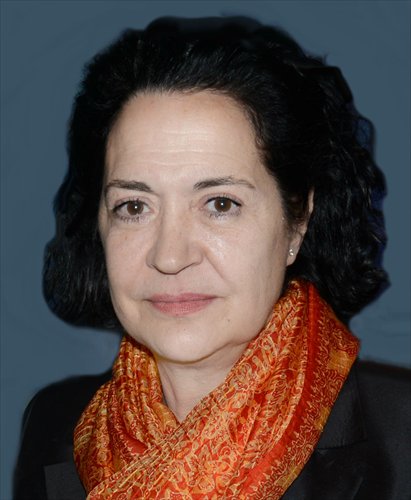
María Cruz Alonso Antolín Counselor with the Shanghai International Culture Association
Pushing for China
Ten years ago MarÍa Cruz Alonso AntolÍn worked for an intellectual property rights company in Spain. When her company suggested opening an office in Indonesia, Alonso AntolÍn pushed for an office in China and when that was agreed she persuaded her company to establish the office in Shanghai, not Beijing.
"Shanghai is a very open city with interesting people and it has a lot of foreign architecture and many museums," Alonso AntolÍn explained. She came to China in 2002 and, as a Spanish counsellor for the Shanghai International Culture Association and an international expert at the Shanghai Academy of Social Sciences, has made many good friends here.
As part of her copyright work she recalled that when she was first here there were many street vendors offering pirated CDs and DVDs but now there are not so many. "I think the local government has done a great job and they've done what they should do," she said.
"But it takes time. You cannot completely crack down on it." She said China was too big a country to eliminate pirate traders completely but there was still room for improvement.
In the Chinese media, Alonso AntolÍn made news for her work in bringing to Shanghai the largest-ever exhibition of contemporary Cuban art. The exhibition, Rolling, They Meet, featured 112 works of paintings, photos, sculptures, installations and videos from 94 Cuban artists and attracted crowds of visitors - a key moment in enhancing the relationship between the twin cities of Santiago de Cuba and Shanghai.
Alonso AntolÍn said this was the first time Cuban art had been exhibited in China but organizing the exhibition was no easy task. Because the Internet is restricted and difficult in Cuba, communicating about the exhibition was complicated and time-consuming - sometimes she was on the phone for nearly 24 hours a day. "I did this for free and didn't want anything - I did it because I love China and I love Shanghai," she explained.
Art abroad
Years of experience in arranging exhibitions have helped Alonso AntolÍn build a large network of contacts across China. As well as bringing Spanish and Western art to China, she also helped organize exhibitions of Chinese art abroad. A display of calligraphy from the Jiangsu Library that she was involved in is running in Madrid this month.
The only woman to pick up a Magnolia Gold Award this year, Alonso AntolÍn said the award also belongs to her husband who supports her work for charity and culture. And she will also share it with her translator.
After contributing to art for years, Alonso AntolÍn believes that tickets for cultural and artistic events in the city should be affordable. "A 1,000 yuan ($162.95) ticket for a show is expensive even for a foreigner." Although some museums offer free admission she would like to see more affordable tickets made available for young people.
She loves the city but she does not love the traffic here. "Drivers should have more respect for pedestrians crossing on green lights," she said.
Posted in: Metro Shanghai, City Panorama