Trashy imagery
Vik Muniz takes unconventional materials, including trash, to create beguilingly thoughtful images
For Brazilian artist Vik Muniz, anything can become art, be it sugar, soil, ketchup, or even junk, as long as one makes it meaningful. Muniz is known for arranging unconventional materials to reproduce iconic images from art history and other sources, which he then photographs. Many of these photos can be seen at an exhibition called Pictures of Anything, currently being held at Long Museum.
The exhibition features Muniz's photos created during the last 25 years, each prefaced with the phrase Pictures of. These include Pictures of Wire, Pictures of Ink, Pictures of Magazines and Pictures of Garbage.
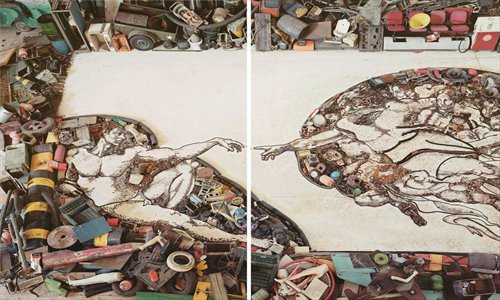
Vik Muniz's painting The Creation of Adam, After Michelangelo made of junk Photos: Courtesy of the venue
The materials he uses have a contextual link to the original images. For example, in his Sugar Children series, Muniz uses sugar to reproduce photos of children whose families were working on sugar plantations on the Caribbean island of St. Kitts. He photographed the children, sprinkled sugar on some black paper, arranged the sugar crystals to outline the children's portraits and finally rephotographed the results. The sugar alludes to the history of colonialism and exploitation.
Apart from using quotidian objects, Muniz employs numerous small diamond particles to create his Picture of Diamonds series. It consists of portraits of Hollywood stars such as Marilyn Monroe and Elizabeth Taylor. His photographic documentation of the diamond arrangements helps eternalize the fleeting beauty of the legends.
"For me, diamonds and garbage are equally interesting materials when it comes to making a picture. They both are loaded with references and impressions. They speak about value and our relation to transient and seemingly eternal things," Muniz said.
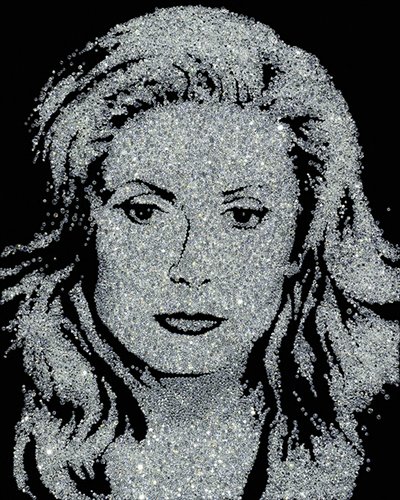
Catherine Deneuve made of diamonds
However, not all the materials he uses are pliant or easy to handle. In his Pictures of Chocolate series, chocolate syrup is his medium. "Because it dries quickly, losing its luster and becoming increasingly unmanageable, the medium forced me to work quickly," Muniz said. The longest he could work with the syrup before it began to solidify was an hour, and he would often rehearse the creation process several times to find the fastest way to execute the painting.
Muniz also uses canonical works as prototypes. He thinks doing this is an important way to "infuse those already exhausted images with a renewed interest and meaning." Such works on show include his large-scale photographic renditions of famous paintings by Andy Warhol, Pablo Picasso, Leonardo da Vinci and Michelangelo Merisi da Caravaggio.
"In my work, I like to use what is familiar, both as subject and material," he said. "When the viewer is confronted with the artful combination of these two things that he feels very familiar with, he has the impression of seeing something for the first time."
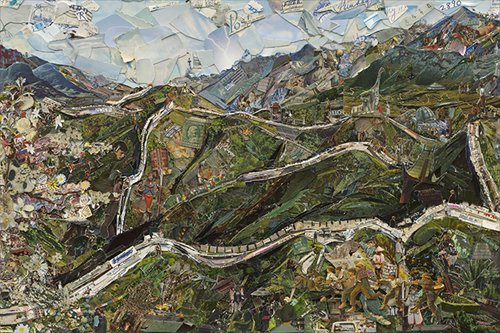
The Great Wall made of magazines
Viewed from a distance, Muniz's photos bear much resemblance to the original works. Yet when drawing closer to the surface, the images are broken down into a disorderly array of the substance from which they are made, prompting the viewer to examine the symbolic meanings of the mundane materials.
Also on show at the exhibition is a documentary film titled Waste Land, which follows the artist's collaboration with a group of trash pickers in Jardim Gramacho, one of the world's largest garbage dumps, located on the outskirts of Rio de Janeiro.
There are around 2,500 pickers at the dump, who make their living sorting through some 200 tons of materials each day. They then sell what they collect to local processors.
Muniz spent three years working with the pickers, using the collected trash to create portraits of these marginalized individuals. He took photos of the collectors and projected the blown-up images onto the floor of his studio. The pickers then covered the images with salvage from the dump before Muniz photographed the resulting image. The film won the 2010 Sundance Audience Award for Best Film and was nominated for an Academy Award in 2011.
Muniz grew up poor in the outskirts of Sao Paulo. He said he loves the fact that coming from poverty in a third world country allowed him to experience a vast social, cultural and economic spectrum of life, and that he feels very lucky for that.
"Without life experience, curiosity, attentiveness and especially without gratitude and kindness for all, there can't be any art," he said.
Date: Until November 23, 10 am to 6 pm (closed Mondays)
Venue: Long Museum (West Bund)
龙美术馆西岸馆
Address: 3398 Longteng Avenue
龙腾大道3398号
Admission: 50 yuan ($8.18)
Call 6422-7636 for details