Filigree finesse
Time-honored craft continues its splendor, despite challenges to survival
The time-honored brand Lao Feng Xiang plays a leading role in the Chinese jewelry industry, with a reputation for producing first-class filigree craftsmanship.
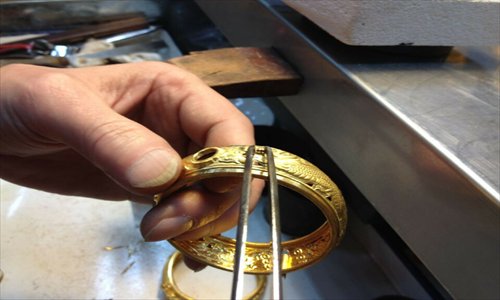
Filigree is the practice of soldering together gold and silver to make delicate patterns that can be ornamental or wearable.
The origin of filigree art in China dates back to the Shang Dynasty (1600BC-1046BC). Until the late Qing Dynasty (1644-1911), filigree artwork was only appreciated by the higher echelons of society. However, through social changes, ordinary people were able to start buying filigree items for household display, collection and gifts.
Certain themes have been enduringly popular, such as the qilin (a mythical creature similar to a unicorn), dragon, tortoise and phoenix, all welcomed for their associations with auspiciousness and luck in Chinese culture. While these remain popular, modern imagery has also gained traction.
Lao Feng Xiang
The first Lao Feng Xiang outlet opened in Shanghai 166 years ago. In its first few decades, employees of Lao Feng Xiang were all-round filigree professionals. They would pass on their skills to young apprentices.
Wang Ensheng, marketing manager at Lao Feng Xiang, told the Global Times that he learned his filigree skills from a fourth-generation inheritor. According to Wang, it takes an average of 10 years for an apprentice to become qualified as a skilled filigree craftsperson and master both the physical and artistic aspects of the craft.
Zhu Jingsong is a sixth-generation inheritor of the craft, and has been practicing it for more than 20 years. His career started out at Shanghai Industry Middle School, where he studied courses including filigree art theories for a year, and was apprenticed in practical skills for another three years. He was named a "Shanghai Master of Arts and Crafts" in 2009.
"Many people think the prices we ask for our pieces are too high when considering the quantities of gold used," he said. "However, a large amount of time and craftsmanship are needed for each piece. As well as the artistry, there are also the complicated techniques that are involved. It's the latter that are most responsible for pushing up the prices. "
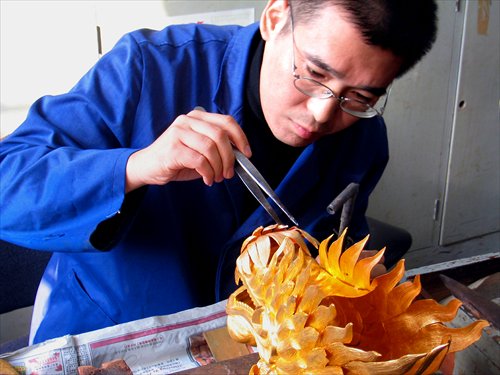
A filigree craftsman at Lao Feng Xiang embeds ornamental jewelry Photos: Courtesy of Lao Feng Xiang
Tools of the trade
Filigree techniques have developed greatly since the early days of the craft. The initial process comprises some 10 steps. Once the pieces have taken shape, more intricate work is required, which is technically demanding. Skills such as hammering, raise-pressing, welding and embedding take much trial and error to learn properly, according to Zhu.
Huang Jialin, one of the fourth-generation filigree inheritors who specializes in dragon-phoenix bracelets, said newer developments include things such as eyeballs for the dragons that feature in his work. Huang also incorporates practical elements into his design. For example, bracelets used to lack clasps, meaning wearers risked permanently stretching and distorting the bracelets when putting them on. Huang turned a ball between the mouths of the phoenix and dragon that feature in his design into a clasp, making the piece a lot more wearable.
Sometimes the craftspeople must create their own tools to fulfill specific tasks, or customize existing tools. Huang has used a spoon with its tip cutoff as a tool for smoothing the edge of his bracelets. "Learning to use the tools properly is of vital importance, and is also a touchstone for testing the skills of a crafter," he said.
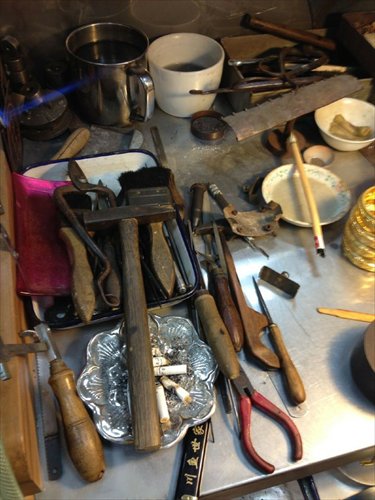
A set of filigree tools and a set of silver wine containers with filigree decoration
Challenge for the ages
Although it has a consistent history of creating masterpieces, Lao Feng Xiang has had to weather social upheavals that have cast doubt on the survival of the craft. The Cultural Revolution (1966-76) was a particular blow, as during that time owning such "luxuries" was deemed offensive. Once the period had passed, there was a lack of fresh talent. Those who knew the skill were old.
The difficulty remains today. "Now, among more than 1,000 employees in the company, the maturely skilled filigree professionals number fewer than 10," Wang said.
Furthermore, in the current education system, practical techniques are much overshadowed by academic subjects, and few graduates see a career in such crafts as being viable or desirable. While some college graduates take apprenticeships at Lao Feng Xiang, they take longer to pick up the necessary skills than previous generations, who started their apprenticeships at a much younger age.
"Nowadays, young people rarely devote themselves to the hard work required," Huang said. "But high-skilled workers are in great demand. We should try to instill people with more respect for crafts, and protect traditional arts and crafts."