Artistic awakening
Exhibition charts period that set the stage for Hungarian painting
Hungary at the turn of the 19th century experienced rapid changes in economics and political awareness against a backdrop of industrialization, while at the same time a brand-new era of independent Hungarian art came into being.
"The specific period is undoubtedly one of the most significant in Hungarian art history," said Dr László Baán, general director of the Museum of Fine Arts in Budapest during a talk at China Art Museum Monday. The prestigious gallery has recently joined with the Shanghai venue to exhibit 94 oil paintings from that period.
Mihály Munkácsy is not only one of the best artists of the period, but also the most important in Hungary. Born in 1844, the son of an office holder lived a not-so-well-off life when he was young. However, his paintings that vividly depict the daily lives of poor people cemented his place as a leading artist in Hungary. His later salon and still-life paintings in Paris expanded his success in the European art circle.
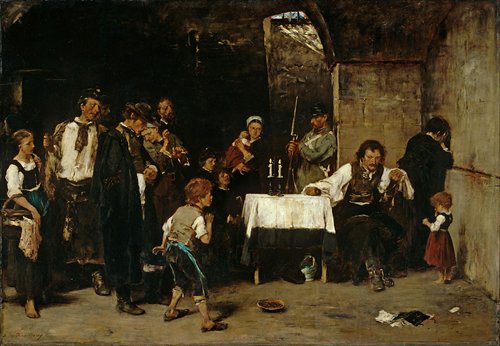
Oil paintings from Hungary at the turn of the 19th century on display at the China Art Museum Photos: Courtesy of the museum
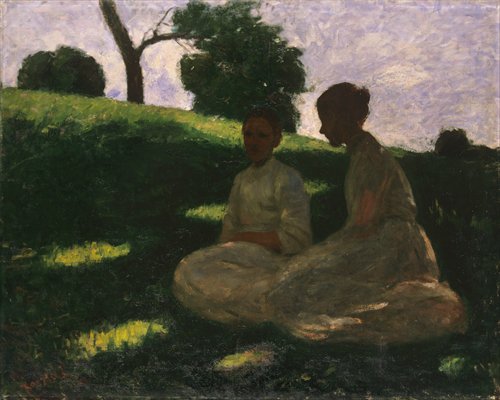
Highlighting Munkácsy, the exhibition, entitled The Age of Mihály Munkácsy: Art in Hungary at the Turn of the Century, is divided into two sections, one featuring Munkácsy's paintings from throughout his career, and the other drawing on the panorama of Hungarian art created between 1880 and 1920 through the works of around 20 other artists.
It's been over 50 years since the last extensive Munkácsy exhibition in China. This retrospective exhibition of Hungarian art is also to celebrate the 65th anniversary of the establishment of diplomatic relations between China and Hungary in 1949.
The age of Munkácsy
"Munkácsy was the first Hungarian artist who didn't merely rely upon history but searched the life of his times for subjects, and through his works he demonstratively revealed the Hungarian people's pursuit of freedom," said Shi Dawei, curator of China Art Museum, at the opening ceremony on Monday. "His spirit of humanism meant he avoided being a pessimist, although he had experienced hardship in his own life, thus even in his paintings that were permeated with the strongest feeling of desolation, those tragic heroes still manifested their unconquerable national will."
An outstanding example is The Last Day of the Condemned Prisoner created during 1869 and 1870, which made Munkácsy a well-known painter. The painting depicts a condemned outlaw's last night, when his family and friends come to bid him farewell. Country folk had sympathy with outlaws who fled to the wilderness to avoid being recruited to the Austrian emperor's army, which symbolized foreign oppression. In the painting can be seen the inner struggle of the outlaw, whose face is dark and fists clenched, and beside whose feet lies a Bible. In 1870, the work won a gold medal at the Salon de Paris, which was the greatest art event in the Western world at that time.
Also at the exhibition are paintings depicting the daily lives of Hungarians at the time such as In the Kitchen, in which the artist - who had undergone five years as a carpenter's apprentice - shows great compassion for the poor.
Meanwhile, a series of landscape paintings done in Barbizon, France, biblical paintings and refined portraits of bourgeois families created late in his career reveal Munkácsy's virtuosic capacity and extensive interest in life.

Hungarian life
"Hungarian painters after Munkácsy all more or less drew influence from him, and there were a bunch of artists who were influenced by French realist and impressionist paintings, but for this exhibition, we've chosen a number of artworks that reflected Hungarian scenery and life," said Baán.
Many European countries began to develop their own art styles rather than merely copying the prevailing French painting schools at the turn of the 19th century. "Finnish and Swedish artists often chose sea and water as their subjects, while in Hungarian paintings we see more forests, plains and fields," added Baán.
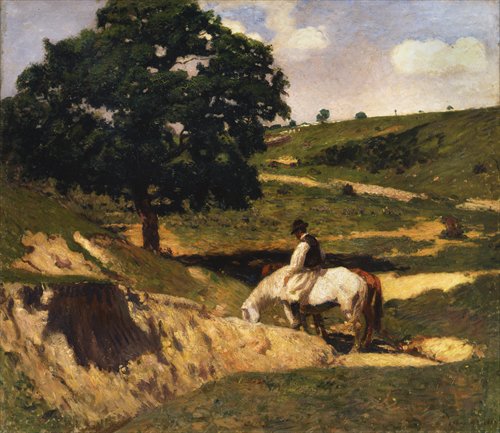
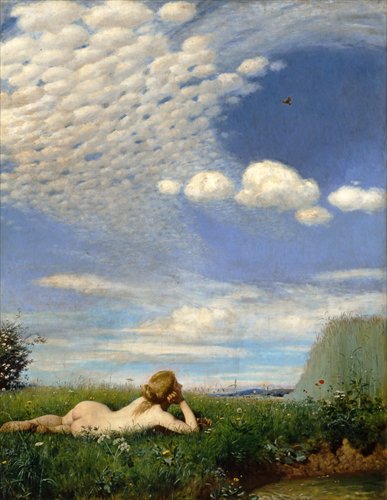
Celebrated works such as Pál Szinyei-Merse's Skylark and Red Poppy in the Field, József Koszta's On the Hillside, and Béla Iványi-Grünwald's Horse Watering are also on show at the exhibition.
Baán said that Hungarian art is still not so well-known in other countries, and he expects future cooperation with galleries in China to bring more Hungarian art, especially diverse examples of contemporary art, to a wider audience.
Date: Until January 18, 10 am to 6 pm (closed on Mondays)
Venue: 17 Exhibition Hall, China Art Museum
中华艺术宫17号展厅
Address: 205 Shangnan Road
上南路205号
Admission: 20 yuan ($3.26)
Call 400-921-2021 for details
Newspaper headline: Exhibition charts period that set the stage for Hungarian painting