HOME >> ARTS
A life on the road
By Xu Ming Source:Global Times Published: 2014-11-6 22:18:01
'Made in China’ singer crosses over to contemporary art
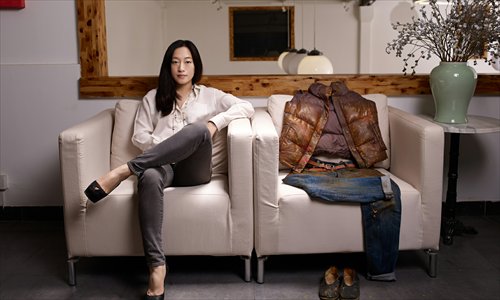
Ai Jing Photo: Courtesy of Ai Jing
When mentioning Ai Jing, the image that usually pops into the heads of music lovers who grew up in the 1980s and 1990s is still that of a long-haired young girl holding a guitar and singing the song that made her a household name throughout Asia in the 1990s: "My 1997."Over the past 20 years, the woman who was once regarded as one of the most talented female ballad singers in China has quietly changed her artistic battlefield without anyone noticing. Now she is attracting attention again as a different kind of artist after having held several contemporary art exhibitions both in China and abroad.
A mature artist who has discovered her own creative language, Ai described her change of focus simply as "a different channel to express myself," during our interview.
Musical start
Even though her focus has shifted to painting, sculpture and installation art, it seems that it's impossible for the former singer to live without music. Walking into Ai's studio in Beijing I was immediately drowned in music.
Born in 1969 in North China, Ai showed a talent for singing while still a child. To develop her musical potential, her parents found her a music teacher at the age of 9. She later attended an art school to learn to sing opera, but failed to finish because of her deep attraction to pop music.
"I couldn't find the same ambiance described in classical music in my hometown and I felt very detached when learning Italian songs in particular," Ai wrote in her new book Struggle, in which the cross-over artist shares the changes in her career and the struggles in heart with her fans.
Ai left home at 17 and finally found her music heaven in Guangzhou, Guangdong Province, where she thrived for years. After producing several cover albums, she released an album of her own work, My 1997, in Taiwan in 1992 .
The music videos for two of the album's singles, "My 1997" and "Straying Swallow," became a huge sensation in 1993 after they were broadcast on TV. Rising to fame overnight, her records became popular in numerous countries and regions throughout Asia.
Ai spent the 1990s flying across the world, dedicating herself fully to her music. This was the golden age of her music career, enjoying popularity and holding concerts across Asia.
Dreaming big, she also went to the US, home to many of the musicians that had influenced her music. However, it was during this time that she experienced a situation that started her on a path away from music.
In 1998, inspired by US rocker Bruce Springsteen's Born in the U.S.A., Ai produced her fourth album Made in China in Los Angeles. "I regarded it as a return to folk rock and I had faith in it," Ai wrote.
A week before the album was to be published however, she was informed that it had failed to pass the censorship board in the Chinese mainland. "… using 'Made in China' as the title of a song discredits China," the letter she received read.
"It's ironic, that was the first time I used the word 'love' in a song," Ai told the Global Times. "I love you China, even though you are not good enough. I cannot choose, mother. I am made in China," go the lyrics.
"Reflecting on the album, I guess I went faster than the times could accept and no one could resonate with my work. It was fate," she added.
Crossing over
The frustration brought about by Made in China made Ai reflect on her 10-year career in music, and also made her turn to other means to express her ideas - painting.
She started to learn painting from contemporary artist Zhang Xiaogang in 1999. According to Ai, she had met Zhang in 1998 and he encouraged her to pursue painting after looking at her sketches.
"After Made in China, I felt I was denied a channel to express myself. In painting and art I found another exit, or language, to show my ideas," Ai told the Global Times.
Ai concentrated on painting under Zhang's guidance while living in New York. From 2000 to 2002, while she didn't involve herself in music professionally, it was still a part of her life and greatly influenced her art.
In 2002, Ai returned to professional music with great passion, establishing her own music studio in Beijing. The next year, she released Is It a Dream, her fifth album. However, at the time the domestic entertainment market was developing in a completely different direction than she expected.
During her publicity tour for the album, she began to realize that the industry just wasn't for her anymore. "The media, mainly TV, went too far to try to be entertaining. I tried to cooperate and ended up doing things that had nothing to do with my music," Ai said.
This disappointment finally changed her attitude toward music. "I used to treat it as a life partner that I could throw myself wholly into, while expecting some sort of payback. Then I realized it was a lover I'd better not expect too much from."
Artistic language
In her other book, Ai on the way, Ai explained that she was also fond of painting as a child, but she thought music was a better way for her to express herself at the time. However, after more than 10 years, painting has opened another door for her, one with richer colors.
She explained it wasn't easy for her to make the jump from audio to visual art, and that it took years for her to find her own language.
"I don't like to be compared with artists who come from an art education background. Talent carries far more weight in the creation of art," the artist said as she sat before me spattered with paint.
Moving from painting to sculpture and installation art, she began to exhibit her work in 2007. Since then, she has held several large exhibitions in China and abroad, and several of her works have been bought by collectors.
The first contemporary artist to hold an exhibition at the National Museum of China after it reopened in 2011, the exhibit's curator, Chen Lüsheng, described Ai's works as "showing diversified aspects of Chinese contemporary art."
Next year, she plans to bring this exhibition to Milan along with some new works.
Posted in: Books