HOME >> CHINA, METRO SHANGHAI
The extra long arm of the law
By Huang Lanlan Source:Global Times Published: 2014-11-11 18:53:01
New police program catches criminals who have fled abroad

Officers escort the suspect known as Zhang through Pudong International Airport. Photo: Courtesy of the Shanghai Municipal Public Security Bureau's Economic Crime Investigation Department
On September 18, when a flight from Bali landed at the Shanghai Pudong International Airport, 47-year-old Zhang Wei (not his real name), accompanied by a police escort, slowly walked off the plane. He was returning home although it was not his desire. The Shanghai man had fled to Indonesia 17 years ago to avoid being arrested for financial crimes.
The 1.8-meter-tall man doesn't look at all Indonesian although now he speaks fluent Javanese and English. For 17 years Zhang never spoke his native Shanghai dialect in case someone overheard and found out where he came from.
"Now I've forgotten how to speak my language," he said.
Zhang is one of many wanted suspects, people who have fled abroad while being sought for crimes. He was found and arrested by Shanghai police as part of Fox Hunt 2014, a nationwide strategy launched by the Ministry of Public Security to find and extradite financial crime suspects from foreign countries. The campaign began in late July and by the end of October Shanghai police had extradited 22 suspects from 14 countries and regions including the US, Canada, Austria and Indonesia.
Of the 22 extradited, Zhang had lived abroad for the longest. In August 1997, Zhang and some accomplices fraudulently obtained a check for 10 million yuan ($1.63 million) from a city business. Shanghai police began investigating the case a month afterwards when the company reported the funds missing but had difficulty finding Zhang.
Difficult to search
In those days, finding a person in China was difficult, let alone hunting for someone who moved abroad. "There was no advanced tracking system operating then and we had to try to track him down through mobile phone records," explained one of the detectives involved in the case, a 40-year-old man surnamed Lin and one of the Fox Hunt team.
It was October 4, 1997, when Zhang flew from South China's Hainan Province to Jakarta, the Indonesian capital. Lin and his colleagues knew nothing about Zhang's journey until two months later, when they found a man who helped Zhang get a passport. Detectives later contacted one of Zhang's friends in Indonesia and obtained his phone number.
In 1998 Lin said he actually phoned Zhang asking him to give himself up. Zhang didn't believe the detective was for real until Lin named some of his accomplices in Shanghai. "Zhang said at the time he thought it was an Indonesian gang planning to blackmail him," he told the Global Times.
It was a difficult and turbulent time for Zhang. Sitting in an interview room in a detention center in Pudong New Area last Wednesday, the graying middle-aged man talked about his days in Indonesia.
"Life there was more difficult than I had thought it would be," he said. Not speaking English or Javanese at first he hid in the hilly suburbs of Jakarta avoiding the police as he had no form of identity.
Although he was carrying 700,000 yuan in cash with him this was used up quickly as he tried to buy a fake Indonesian identity card. "Six times I handed over money for a card and six times people vanished without giving me anything. I was furious but I couldn't do anything about it."
After living in a small village near Jakarta for six months, Zhang finally obtained a usable local identity card. With the card he settled in the village and began looking for a job to survive. Over his years in Indonesia, Zhang had been a miner, a fisherman and a papermaker along with many other jobs.
His quiet village life didn't last long - in May 1998, anti-Chinese riots broke out in many cities in Indonesia and hundreds of Chinese were killed. That year, one of his Chinese friends escaped the riots and returned to China. The Shanghai police contacted her trying to find more information about him. "We didn't have his new phone number," a Fox Hunt detective surnamed Su said. "No one could contact him at the time, not even his family or the friend who had returned to China."
Presumed dead
That year Zhang vanished officially. He was presumed to be dead and the case became a cold case. But over the following years detectives Lin and Su kept searching on databases for clues and information. Then in 2011, more than a decade after most people believed he had died in Indonesia, the detectives found clues that proved Zhang was still alive and was in Indonesia.
"He was working for a travel agency in Bali as a tour guide and had a nickname 'Long Feet Awei,'" detective Lin told the Global Times. "He had married a local Chinese-Indonesian woman, and was often seen rafting along the upper reaches of the Ayung River."
Tracking down people in a foreign country is one thing but arresting and extraditing them is a very different procedure. In 2013, Shanghai police flew to Bali to arrest Zhang who had then been reportedly detained by local police for being in possession of a fake identity card. But when they arrived they found Zhang had escaped from detention.
It wasn't until a year later that he was actually arrested and extradited. Four Shanghai police officers, including detectives Lin and Su, arrived in Jakarta in August, after a strategy had been set in place by the Chinese Embassy in Indonesia and local police.
Extraditing criminals is a complicated process. In Zhang's case, after arriving in Indonesia, the Shanghai detectives had to wait until the Chinese Embassy had consulted local police, the immigration department and the Chinese consulate in Bali. To make certain they would be able to extradite their man, the team hired a local university lecturer who spoke Chinese as their interpreter.
"We usually find our interpreters at travel agencies, but this time this didn't seem to be a good idea because Zhang had been working as a tour guide. It would have been awful if we had hired a tour guide who could tip him off that Shanghai police were here to grab him," Lin said.
At night on September 1 Indonesian and the Chinese police gathered outside a two-story office belonging to a travel agency run by a Taiwanese man. This was where Zhang had been working after escaping from local police custody a year before.
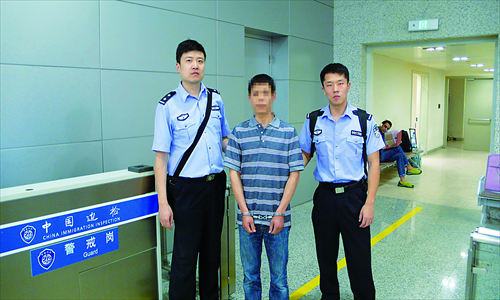
Jason Jiang is escorted through the airport by police officers in August. Photo: Courtesy of the Shanghai Municipal Public Security Bureau's Economic Crime Investigation Department
No resistance
In the end when the police raided the office Zhang did not resist arrest. "I'll come quietly - don't bother the boss or my friends here," he told the detectives.
At the detention center in Pudong, Zhang said he remembered exactly what he was told that night. "One of the policemen talked to me in Shanghai dialect and said, "you know why we're here, don't you?' I then realized it was time."
Many times over the past 17 years, Zhang had thought this would happen. "I knew that sooner or later I would be arrested and brought back to China. I just lacked the courage to give myself up," he said.
But for the detectives the physical arrest of Zhang was only the beginning of the extradition battle. Because he had married an Indonesian woman Zhang was now legally an Indonesian and the Shanghai detectives had to provide proof that he was a Chinese citizen and produce evidence of the crimes he was charged with.
Then the Bali police announced that Zhang should first be investigated and put on trial in Indonesia rather than China since he was an Indonesian. The Shanghai detectives had no idea when they might be able to bring their suspect home.
After a deadlock of 17 days the detectives had a breakthrough. Zhang confessed to his crimes and admitted that he was a Chinese citizen. Along with assistance of government departments from both countries, and Interpol, the international criminal police organization, the deadlock ended and Zhang was placed on a flight to Shanghai.
"Things would have been much more complicated and difficult if Zhang hadn't admitted his guilt," Su said.
Unlike many criminals, most of the 22 financial crime suspects arrested in the Fox Hunt campaign were well-off and well educated. "They are smart and as crafty as foxes," said Xu Changhua, the head of the Shanghai Municipal Public Security Bureau's Economic Crime Investigation Department.
Some of the 22 had new legal identities as citizens of other countries which complicated locating them and then their extraditions. "With a new name and a new nationality, they are hard to find," Xu said.
But dogged police work can overcome some of these difficulties as in the case of the man surnamed Jiang who fled to the US in 2007 after being involved in a contract fraud worth 36 million yuan. In 2008 the Shanghai police asked the US Federal Bureau of Investigation for help in finding the man.
Major crime
This took until 2011 when the FBI contacted the police here to inform them Jiang had married an American-Chinese woman in Los Angeles and was now a US citizen.
When FBI agents interviewed him Jiang denied anything to do with the case and the Shanghai police could not, at that stage, provide enough evidence that he was a Chinese citizen suspected of a major crime.
One of the detectives in that case, a man surnamed He, said he thought about the ways that a criminal with a new foreign identity might be caught. He felt that since Jiang now had a new US passport he would try returning to China under a different name.
He and his colleagues began to analyze exit-entry information, trying to pick out any people who looked like Jiang from the tens of thousands of American people who visit China every year. They also had to take into account that he might have changed his appearance.
Jiang, in the meantime, was confident that the Chinese police would not be able to trace him. In 2013, under his new name Jason Jiang, he began taking monthly trips to China.
He was stunned then on August 8, after his flight had landed at Pudong to find police and immigration officers waiting for him.
Detective He said Jiang "thought we would never find him." He said that Chinese police have now developed special techniques to identify Chinese nationals who had fled abroad and adopted foreign citizenships. Of the 22 suspects rounded up in the Fox Hunt campaign six were legally foreign citizens.
"Locating these people is not easy but we do it in the end," he said with a smile.
Police and prosecutors are completing the cases for both Zhang and Jiang who will appear in court later.
Posted in: Society, Metro Shanghai, City Panorama