HOME >> BUSINESS
Accelerating SOE reform
Source:Global Times Published: 2014-11-13 9:22:57
Editor's Note:
Over the past year, China's top leadership has been trying to move the economy toward a more sustainable path, with a slew of reforms announced at the Third Plenary Session of the 18th Communist Party of China (CPC) Central Committee in November 2013. The recently concluded Fourth Plenary Session of the 18th CPC Central Committee proposed reinforcing legislation in key areas and speeding up improvements to the legal system to reflect equal rights, opportunities and fair rules, all heralding a new chapter in the development of the Chinese legal system. Amid short-term difficulties caused by structural adjustment and the "new norm" of slower economic growth, China is set to harvest the fruits from local fiscal and taxation reform and mixed-ownership reform of State-owned enterprises (SOEs), as well as financial and stock reforms. This is the last of three issues dedicated to examining the impact of the reforms in transforming China. The following focuses on the SOE reforms unveiled in the past year.

The Third Plenum held in November 2013 set the tone for a new round of State-owned enterprise (SOE) reform, designed to overhaul bureaucratic and inefficient SOEs by injecting private investment.
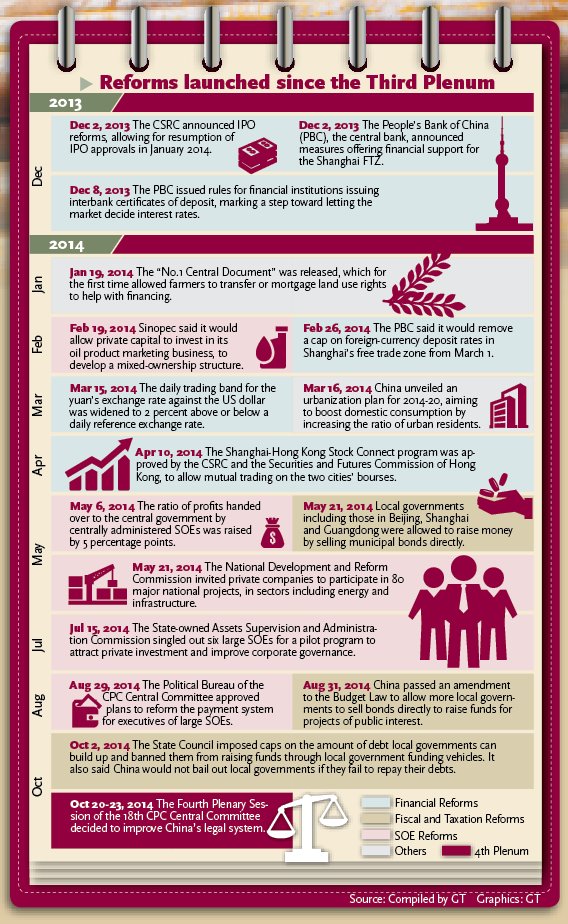
Sinopec, Asia's biggest oil refiner by output, said in February that it would engage in a multi-billion dollar asset restructuring program by selling up to 30 percent of its marketing arm, which possesses more than 30,000 petrol stations. It was China's first major SOE restructuring plan since top Chinese leader Xi Jinping unveiled ambitious reforms at the Party's top meeting last November.
The country's State asset watchdog, the State-owned Assets Supervision and Administration Commission (SASAC), said in July that six large SOEs - including the State Development & Investment Corporation and China National Cereals, Oils and Foodstuffs Corporation - would pioneer reforms in ownership, management and oversight, including setting up selective investment firms and a new board of directors system.
"Mixed-ownership reform has set a clear direction for further SOE reform," Xu Baoli, a director at the research center of SASAC, told the Global Times on Wednesday.
As of now, about 20 provincial and municipal governments including those in Shanghai and South China's Guangdong Province have worked out road maps for local mixed-ownership SOE reforms, vowing to invigorate SOEs by introducing non-State investment and consolidating local SOEs to improve productivity and competitiveness, according to media reports.
"Mixed-ownership reform provides new opportunities for private investment, and incentivizes SOE employees to improve productivity by granting them stock options," Xu said. It will also benefit the public if they operate well, he noted.
The reform blueprint of the Third Plenum set a target to transfer 30 percent of SOE annual profits into public finance coffers by 2020, so as to expand funding for social security. The current share of SOE profits paid into public finance is reportedly less than 10 percent on average.
"China must invigorate its private economy, and to do so it must conduct SOE reform. Otherwise, SOEs will be like a black hole sweeping up all resources," Zhao Xiao, chairman of Beijing-based Cypress Leadership Institute, wrote in his Weibo on Wednesday.
"Next year will be the year for implementation. Under local SOE reform road maps, new SOE conglomerates will be set up and there will be restructuring to help tackle the issues of overcapacity and losses," Li Jin, chief analyst of the Chinese Enterprises Research Institute, told the Global Times on Wednesday.
However, there is still a lack of reform policies for central government-administered enterprises, holding back many private and foreign investors from participating in the mixed-ownership reform and allowing monopolistic practices to endure in some sectors, Li said.
The reform guidelines for centrally administered SOEs are expected to be unveiled as early as in 2015, he noted.
In provincial reform plans, public flotation of SOEs is often a priority.
Guangdong, for example, aims to raise the proportion of its local SOEs that are listed to 60 percent in 2020 from the current 20 percent, while the target for Central China's Hunan Province is 80 percent by 2020.
However, "not all SOEs have investment value suitable for listings, especially the ones providing public services," Shanghai Securities News reported on Friday, citing Ji Xiaonan, chairman of the supervisory board for large firms at SASAC.
SOEs providing public services have low investment returns or even suffer losses, which would not attract investors if they are listed - instead they would face the risk of being delisted and the State might lose its controlling stake in them, Ji said.
With the acceleration of SOE reform, local SOEs will encounter asset restructuring and spinoffs, and policymakers must be alert to the risk of potential loss of State assets and corruption, many experts said.
Amid the efforts to reform SOEs, well-regulated corporate governance must be set up, covering executives' pay, employees' stock options and recruitment of professional managers, Li said.
A teleconference hosted by China's Vice Premier Ma Kai was held on November 6 focusing on SOE executive salary reform as part of a broader reorganization of management at SOEs, the 21st Century Business Herald reported on Tuesday.
The teleconference was intended to follow up a message sent out from a meeting of China's Leading Group for Overall Reform, a top reform committee led by President Xi, in August, addressing unreasonably high salaries for executives of major SOEs.
A salary reform plan drafted by China's Ministry of Human Resources and Social Security is expected to be unveiled, with the payroll for SOE executives appointed by the central government being divided into a base salary and mid- to long-term incentives, the newspaper reported, citing Su Hainan, director of the Compensation Committee of the China Association for Labor Studies.
The base salary of SOE executives will be set at the same benchmark as for civil servants, while pay for non-government-appointed professional managers will be market-based, Su said.
Over the past year, China's top leadership has been trying to move the economy toward a more sustainable path, with a slew of reforms announced at the Third Plenary Session of the 18th Communist Party of China (CPC) Central Committee in November 2013. The recently concluded Fourth Plenary Session of the 18th CPC Central Committee proposed reinforcing legislation in key areas and speeding up improvements to the legal system to reflect equal rights, opportunities and fair rules, all heralding a new chapter in the development of the Chinese legal system. Amid short-term difficulties caused by structural adjustment and the "new norm" of slower economic growth, China is set to harvest the fruits from local fiscal and taxation reform and mixed-ownership reform of State-owned enterprises (SOEs), as well as financial and stock reforms. This is the last of three issues dedicated to examining the impact of the reforms in transforming China. The following focuses on the SOE reforms unveiled in the past year.
A man works at a steel plant. Photo: CFP
The Third Plenum held in November 2013 set the tone for a new round of State-owned enterprise (SOE) reform, designed to overhaul bureaucratic and inefficient SOEs by injecting private investment.
Sinopec, Asia's biggest oil refiner by output, said in February that it would engage in a multi-billion dollar asset restructuring program by selling up to 30 percent of its marketing arm, which possesses more than 30,000 petrol stations. It was China's first major SOE restructuring plan since top Chinese leader Xi Jinping unveiled ambitious reforms at the Party's top meeting last November.
The country's State asset watchdog, the State-owned Assets Supervision and Administration Commission (SASAC), said in July that six large SOEs - including the State Development & Investment Corporation and China National Cereals, Oils and Foodstuffs Corporation - would pioneer reforms in ownership, management and oversight, including setting up selective investment firms and a new board of directors system.
"Mixed-ownership reform has set a clear direction for further SOE reform," Xu Baoli, a director at the research center of SASAC, told the Global Times on Wednesday.
As of now, about 20 provincial and municipal governments including those in Shanghai and South China's Guangdong Province have worked out road maps for local mixed-ownership SOE reforms, vowing to invigorate SOEs by introducing non-State investment and consolidating local SOEs to improve productivity and competitiveness, according to media reports.
"Mixed-ownership reform provides new opportunities for private investment, and incentivizes SOE employees to improve productivity by granting them stock options," Xu said. It will also benefit the public if they operate well, he noted.
The reform blueprint of the Third Plenum set a target to transfer 30 percent of SOE annual profits into public finance coffers by 2020, so as to expand funding for social security. The current share of SOE profits paid into public finance is reportedly less than 10 percent on average.
"China must invigorate its private economy, and to do so it must conduct SOE reform. Otherwise, SOEs will be like a black hole sweeping up all resources," Zhao Xiao, chairman of Beijing-based Cypress Leadership Institute, wrote in his Weibo on Wednesday.
"Next year will be the year for implementation. Under local SOE reform road maps, new SOE conglomerates will be set up and there will be restructuring to help tackle the issues of overcapacity and losses," Li Jin, chief analyst of the Chinese Enterprises Research Institute, told the Global Times on Wednesday.
However, there is still a lack of reform policies for central government-administered enterprises, holding back many private and foreign investors from participating in the mixed-ownership reform and allowing monopolistic practices to endure in some sectors, Li said.
The reform guidelines for centrally administered SOEs are expected to be unveiled as early as in 2015, he noted.
In provincial reform plans, public flotation of SOEs is often a priority.
Guangdong, for example, aims to raise the proportion of its local SOEs that are listed to 60 percent in 2020 from the current 20 percent, while the target for Central China's Hunan Province is 80 percent by 2020.
However, "not all SOEs have investment value suitable for listings, especially the ones providing public services," Shanghai Securities News reported on Friday, citing Ji Xiaonan, chairman of the supervisory board for large firms at SASAC.
SOEs providing public services have low investment returns or even suffer losses, which would not attract investors if they are listed - instead they would face the risk of being delisted and the State might lose its controlling stake in them, Ji said.
With the acceleration of SOE reform, local SOEs will encounter asset restructuring and spinoffs, and policymakers must be alert to the risk of potential loss of State assets and corruption, many experts said.
Amid the efforts to reform SOEs, well-regulated corporate governance must be set up, covering executives' pay, employees' stock options and recruitment of professional managers, Li said.
A teleconference hosted by China's Vice Premier Ma Kai was held on November 6 focusing on SOE executive salary reform as part of a broader reorganization of management at SOEs, the 21st Century Business Herald reported on Tuesday.
The teleconference was intended to follow up a message sent out from a meeting of China's Leading Group for Overall Reform, a top reform committee led by President Xi, in August, addressing unreasonably high salaries for executives of major SOEs.
A salary reform plan drafted by China's Ministry of Human Resources and Social Security is expected to be unveiled, with the payroll for SOE executives appointed by the central government being divided into a base salary and mid- to long-term incentives, the newspaper reported, citing Su Hainan, director of the Compensation Committee of the China Association for Labor Studies.
The base salary of SOE executives will be set at the same benchmark as for civil servants, while pay for non-government-appointed professional managers will be market-based, Su said.
Posted in: Insight