HOME >> ARTS
Shadow dancing
By Barry Cunningham Source:Global Times Published: 2014-11-16 20:33:01
The art of make-believe calligraphy
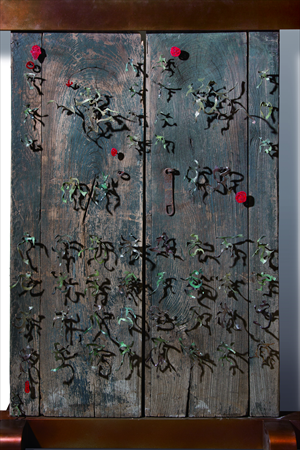
Age 2 +++++ Photo: Courtesy of the 11 Gallery
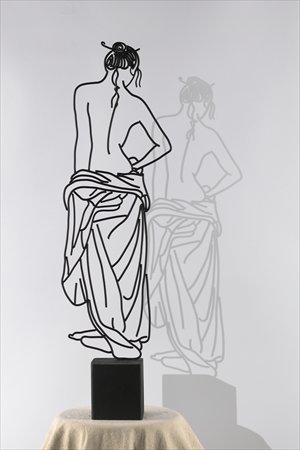
Wire sculpture Solidification Photo: Courtesy of the 11 Gallery
Shadow play has been revived countless times since the dawn of ancient China. Now comes a modern rendition of these dancing shadows, this time expressed with twisted metal sculptures inspired by calligraphy.In his latest solo exhibition Shadow Dancing, San Francisco-based sculptor Jin Feng playfully molds small metal figures into shapes that evoke 3D brushstrokes sticking out from a solid screen. From a distance these figures appear as Chinese handwriting. However, closer inspection reveals that these are not metal reproductions of real Chinese characters, but rather are faux-characters that have sprung from the artist's imagination.
Another interesting feature, each upraised "character" casts a shadow on background panels. This play of light and shadow offers an artistic inkblot test that holds different meaning for each new observer.
The exhibit opened on November 2 at the 11 Gallery in Beijing. Among the gallery-goers was Liu Shasha, a recent Peking University graduate. Walking around the gallery, she tilted her head and tried to decipher the mystery script before her. Red metal seals stuck out from the artworks, but that too was part of the illusion. In the end, Liu thought she recognized, in a way, ancient characters from a poem written during China's Spring and Autumn Period (770 BC-476 BC).
Other gallery-goers imagined the shadowy shapes to be dancers waving their hips, or acrobats doing human pretzel contortions. Still others insisted that the stick-out figures were derived from the ancient pictograms carved into oracle bones.
Throughout the exhibition, Jin keeps the mystery alive by keeping his mouth shut, letting viewers draw their own allegories. The most that the artist will acknowledge is that, "Even for Chinese, some types of calligraphy, such as the cursive script, can be difficult to read, but the enchantment of calligraphy can be understood by most people."
The sculptor is an urban archaeologist of sorts, scavenging through Beijing hutong demolitions to rescue artifacts of the past. At his Beijing studio, the metal "calligraphy" is then mounted on antique wooden doors, worn down by time and decay. The calligraphic shadows on these weather-beaten gates provide a living connection to the Beijing courtyards of yesteryear.
The sculptor left one of these courtyards 20 years ago, rising to prominence as a member of the Artists Guild of San Francisco.
Now back in China, the sculptor's prodigal return has been an emotional reunion of sorts with his classmates from a remarkable period (1987-1992) in the Department of Sculpture at China's Central Academy of Fine Arts. His close friends are notable alumni, including internationally famous sculptors Zhan Wang, Xiang Jing and Zhang Defeng.
During his time with the guild in San Francisco, Jin would often participate in the guilds many exhibitions in public parks.
During these exhibitions, featuring his large-scale sculptures, Jin would resist the "Do Not Touch" mentality that exists among art museums, inviting the public to reach out and feel his sculptures in order to better "commune with art."
However, a return to China seems to have brought a return to tradition.
"My shadow sculptures are too delicate," he grins. "I don't want anyone touching these pieces."
Posted in: Art