Following the thread
Charting the history and development of Shanghai needlepoint
Editor's Note
According to UNESCO's definition, an "intangible cultural heritage" includes traditions or living expressions inherited from our ancestors and passed on to our descendants, such as oral traditions, performing arts, social practices, rituals, festive events, knowledge and practices concerning nature and the universe or the knowledge and skills to produce traditional crafts. It has to be traditional, contemporary and living at the same time, inclusive, representative, and community-based. The safeguarding of intangible cultural heritage is an important factor in maintaining cultural diversity in the face of growing globalization. An understanding of the intangible cultural heritage of different communities helps with intercultural dialogue, and encourages mutual respect for other ways of life.
The Shanghai municipal government has designated 157 traditions as Shanghai's intangible cultural heritage. The Global Times Metro Shanghai culture page will introduce one intangible culture heritage and interview their current inheritors every month.
Shanghai needlepoint has a history of around 170 years. Each piece consists of thousands of threads that form images and patterns for decorative purposes, either as independent pictures or as furnishings such as cushion and sofa covers.
History
In the 1840s, needlepoint was brought to Shanghai when the city was opened as a trading port. Though needlepoint was widely popular in European countries, the number of people who practiced the skill began to decline when mass production techniques were developed.
About half a century later, some women in Shanghai were taught the skill by foreign nuns in Xujiahui Cathedral. An increasing number took up the craft to supplement their incomes, and the needlepoint export business flourished.
The first workshop was opened in Gaoqiao, a town in today's northern Pudong New Area. In the town, almost every resident was involved in the needlepoint industry in some way.
Shanghai needlepoint achieved maturity as an art form in the following decades.
"In the 1970s and 1980s, Shanghai needlepoint prospered," said Wang Yixiang, a senior official in charge of the intangible cultural heritage administration of Gaoqiao. Products from Shanghai's Oriental Embroidery Factory, the largest needlepoint production base in the country at that time, were exported to Europe, America, the Middle East, and Japan."
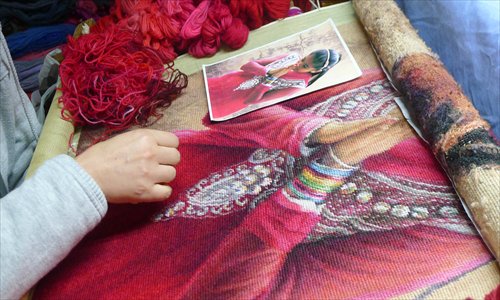
A Shanghai needlepoint practitioner from Gaoqiao making a wool embroidery version of a photo
Materials
The yarn comes from Australia, New Zealand or Uruguay, and is selected for its firmness, long fibers and high reflectivity.
Jin Wen, a sixth-generation inheritor who started learning the profession at the age of 16, says she took up needlepoint after two years of studying painting.
There are around 500 shades of thread that are commonly selected from when making home furnishing needlepoint. For pieces that are being produced as stand-alone works of art, a much larger range of colors is needed. The crafts people produce these colors as needed by dyeing the thread themselves, rather than relying on the varieties produced by the factory.
Wang Zhennan, a fourth-generation inheritor of Shanghai needlepoint, told the Global Times that imitating works of art requires crafters to learn the fundamental principles of color blending, and to also rely on intuition and experience. After the threads are dyed, they must be left to dry in the air - drying them in a machine would damage them.
Shanghai style
Shanghai needlepoint has developed its own style in colors and the skills involved. Subjects particular to China have included the Great Wall, night scenes of Shanghai and heads of State. Other common subjects include landscapes, still life, portraits, flowers and plants.
According to Sun Yuanqiu, director of the Gaoqiao Wool Embroidery Museum, European needlepoint pieces that recreate paintings are done using fewer colors than the originals, while in Shanghai needlepoint, the colors are more abundant than in the original paintings. In addition to dyeing the wool to create new colors, craftsmen will intertwine different colored threads to make new colors and more complex textures.
He Dongmei, a fifth-generation inheritor of the skill, says portraits of people are the most challenging to achieve, as they usually involve more colors. "The needlework of embroidering people's eyes, in particular, is always demanding," she said.
As the content of the works has become more varied, the materials and skills used have increased in range. Gold, silver and mercerized threads have been more widely applied to add a sheen to finished pieces. In works depicting animals, the needling tends to be irregular and random to create a natural hairy effect.
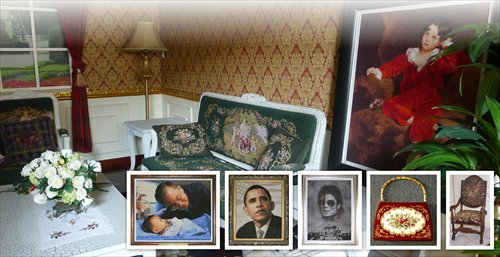
Examples of embroidery on display at Gaoqiao Wool Embroidery Museum Photos: Fang Shaoqing/GT and courtesy of the museum
Short of inheritors
From the end of the 1990s, the number of Shanghai needlepoint crafters sharply decreased after embroidery factories went through a series of mergers and acquisitions. Many crafters ended up working in other industries. Though some private needlepoint ventures were founded, the art is faced with the issue of survival. Now, some 20 needlepoint professionals remain in Shanghai, most whom are elderly.
According to Sun, though Shanghai needlepoint crafts are popular as imported commodities, they are less favored by younger generations abroad. Furthermore, it is a labor-intensive art. "Even with highly developed skills, it takes months for a needlepoint crafter to finish a piece," Wang Yixiang said. "A crafter is paid 1 fen (10 fen equaled 1 jiao or about 2 cents) per thread used, which takes an average of 10 minutes to thread into the piece. That means an average needlepoint crafter could only earn 300 yuan to 400 yuan per month."
To help preserve Shanghai needlepoint, Gaoqiao Wool Embroidery Museum was built in November of 2009. In 2012, needlepoint classes were started in Gaoqiao town, where students can train for free under Shanghai needlepoint inheritors.
Needlepoint classes have also been established in Experimental Primary School Attached to Shanghai Normal University, Gaoqiao Primary School, and Yumin Middle School.