Write on
Repairman keeps ink flowing for lovers of fountain pens
Clipping a quality fountain pen to one's chest pocket was once a symbol of fashion and high social status. In the days when ballpoint pens were not widely used, fountain pen repair was an essential service, and repairmen could be found on many neighborhood corners across the city. They worked side by side with clock, watch and zip repairmen and locksmiths, many of whom would set up their booths at the entrances to residential compounds in the city.
However, as use of cheaper ballpoint pens rose, demand for fountain pen repair services dwindled, and most repairmen gave up the business a long time ago. But 82-year-old Xun Lianbao (pictured below), who learned the skills from his father when he dropped out of school at the age of 15, still caters to customers from across the city as well as from other provinces.
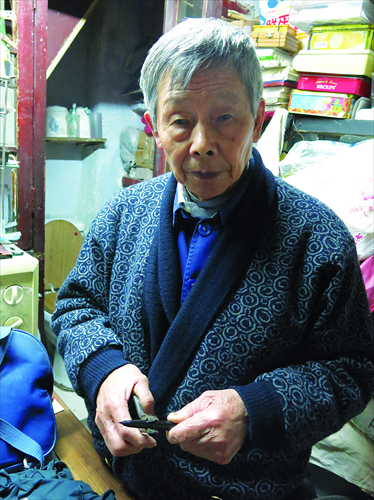
Xun's house is in the old Guangfuli neighborhood in Putuo district, and while it is difficult to locate, customers who need his services can easily find him with the help of his warmhearted neighbors, who are used to directing people to the man's home.
However, business is hardly booming. "Sometimes, I can wait for two or three weeks before a customer appears," said Xun. The old man has a short and slightly bent figure but speaks clearly and has an intelligent face. His rough hands show that he did heavy manual work for years. From the 1960s to 1990s, he worked at a steel factory as a fitter.
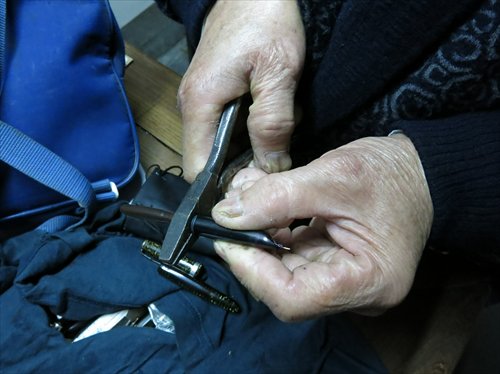
A picture of Xun Lianbao's work Photos: Du Qiongfang/GT
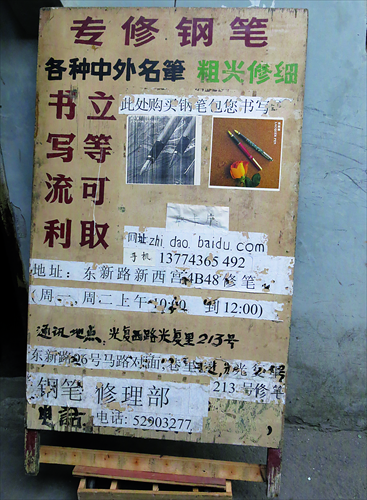
In the late 1990s after he retired, Xun resumed his former profession of fountain pen repairman. He would cycle to universities around the city where he would set up booths and offer his service to students. He was so popular with the students that some helped him create a wooden advertising sign (pictured below) to promote his services, which he would carry with him and display outside his booth. The advert said: "Specialized in repairing fountain pens, all kinds of Chinese and foreign brand pens. Sharpening pen tips and making tips write smoothly. Repairing swiftly on the spot."
In recent years, he has stopped offering services at the universities because of his old age and his wife, who became immobile after an accident.
His work desk is the only table in his small apartment of about 10 square meters. Half of the table is occupied with cooking utensils and pen accessories. He uses the other half of the table to work on, using some 10 tools including pliers and tweezers of different sizes.
In his small notebook, he keeps notes on the pens he has repaired and illustrations of their tips. The book also helps him recall the stories of his customers through the years.
A customer surnamed Wang from the Xinjiang Uyghur Autonomous Region wrote a thank letter to Xun for repairing his Ying Xiong brand gold fountain pen twice.
Another customer also had a Ying Xiong gold pen, which she inherited from her father. Her father told her she could not leave the pen with anyone else because the tip was made of 12 kt gold. When it broke, she had asked many repairmen to fix it in her presence, but they all declined. Finally she found Xun. "I received her phone call asking me if I could repair the pen in her presence. I replied that I would not repair it without her being in front of me. People pay me for repairing their pens, why would I take their belongings?" said Xun.
One of the compliments that Xun appreciates most was from a customer who told him that fountain pen repairman was a respected profession in other countries. Xun still remembers well the customer's broken Pilot brand fountain pen produced in Japan. "The pen had an elastic metal tip that China-produced pens did not have at that time," said Xun.
As a fountain pen repairman, Xu had the opportunity to study various kinds of pens including luxury ones. Once, Xun repaired two Montblanc fountain pens for a customer from Xiamen, Fujian Province, who had visited quite a few repairmen in his hometown, all of whom failed to fix the pens. When he tried one last time in Shanghai, he met Xun and finally had his pens repaired. "I was surprised when he told me that his German pen cost 20,000 yuan ($3,240). But I only charged him 500 yuan for the service," said Xun.
Xun also repaired a Parker pen for a customer, charging 100 yuan. When he finished repairing the pen, the customer told Xun that the pen was a gift from his girlfriend. Before he came to Xun for help, he had asked the Parker shop who said they could only replace the entire pen tip rather than repair it, and that the fee would be 800 yuan. But the customer thought the pen would lose its meaning if the tip was replaced. He wanted to thank Xun for saving the pen by giving him another 100 yuan. But Xun declined. Although he did not earn much from the business, he was not greedy. He only wanted to be paid what he deserved. And he was happy that his service had a lot of value to his customers.
Newspaper headline: Repairman keeps ink flowing for lovers of fountain pens