Form over function?
SOHO sticking to new design trends, despite doubts
Pan Shiyi has expressed a desire to keep on using innovative design in his SOHO China property developments, both inside the buildings and in their overall architecture. But some experts have warned that modern buildings focus too much on fancy design, at the expense of practicality.
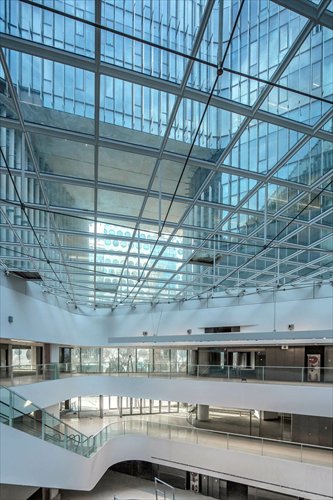
Interior of a new SOHO China building in Beijing Photo: Courtesy of SOHO China
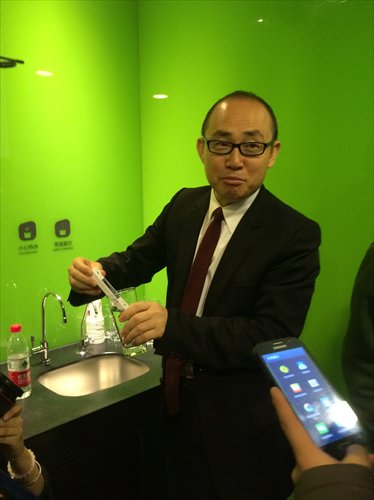
SOHO China Chairman Pan Shiyi tests the quality of the tap water of a SOHO building on Wednesday. Photo: Zhao Qian/GT
On a winter's morning in the central business district of Beijing when the city was shrouded by heavy fog and haze, real estate mogul Pan Shiyi tested the PM 2.5 reading inside his newly built office building.
"The PM 2.5 reading was only 17 micrograms per cubic meter compared with a level of around 250 outside the office," said Pan, chairman of leading commercial property developer SOHO China, as he showed the data to reporters on Wednesday.
Pan is making efforts to introduce innovations in his office projects, such as purifying the air indoors, in order to gain higher rental rates and stable returns amid the national economic slowdown, even though some of the innovations are still in their early stages and are not widely recognized by tenants.
Some experts have also noted that new buildings sometimes sacrifice efficient use of space for the sake of looking more impressive.
Unorthodox design
In addition to the filtered air and drinkable tap water inside the office buildings, Pan is also proud of the unique architectural designs of his projects.
The office and retail complexes launched in the past two months in Beijing and Shanghai all have unconventional designs.
For instance, the Wangjing SOHO complex in Beijing launched in September includes buildings that have curved, semicircular shapes.
The unique designs "are attractive for tenants, and are helpful for higher rental rates," Pan told the Global Times.
However, Pan was asked by reporters whether his projects might be similar to those discouraged by President Xi Jinping, who noted at a literary and art forum in October that developers should not build "buildings with weird designs."
In recent years, local governments around China have spent unprecedented amounts of money on the construction of various types of unconventional-looking buildings, raising concerns that booms in extravagant architecture are often followed by an economic bust.
"I think the weird buildings that President Xi was referring to are those that look ugly, while the SOHO buildings with their innovative designs look pretty. They are not among the buildings that Xi mentioned," Pan said.
However, experts' opinions have been divided on the value of unconventional architectural designs, with some pointing out that they can sometimes have lower efficiency rates, referring to the amount of usable floor area in office buildings.
A real estate industry insider, who wished to remain anonymous, told the Global Times on Thursday that although SOHO China's unique design will attract attention, "the total rental cost for the tenants will be higher due to its lower efficiency rates."
"Buildings with unconventional designs and shapes may be interesting aesthetically, but the efficiency rate usually suffers, and may not appeal to occupiers for whom cost efficiency is a priority," Sean Lim, head of landlord services at real estate consultancy CBRE China, told the Global Times Thursday.
Occupiers, especially multinational corporations, prefer office buildings with higher efficiency as it has a direct impact on capital expenditure, Lim noted.
"Although we do not see overwhelming demand from multinational companies for projects with lower efficiency rates, we do see significant interest from domestic companies and small and medium-sized enterprises, especially those from the technology, media and B2B sectors," said Lim.
Meanwhile, Anthony McQuade, senior national director of consultancy Savills Northern China, noted that having a famous architect design an attractive new building "is definitely a key advantage in developing a successful project."
"Landmark buildings draw people in. They create activity and drive commerce," McQuade explained, although he noted that design without consideration of other critical elements - including location, support services and management quality - is not sufficient.
Online application
In addition to purified water, clean air and innovative architectural design, Pan said he was considering more innovations, such as applications of Internet technologies, amid intense competition in the commercial property sector.
The fast development of the Internet industry is quickly changing people's lifestyle, so various sectors are now adopting more types of Internet applications, and "SOHO China is also developing a new business model that can combine real estate and Internet businesses closely," Pan said.
Pan declined to disclose more details, but said that the plan "will be released on February 1, 2015."
Pan disclosed that he had met Apple Inc CEO Tim Cook and Facebook Inc CEO Mark Zuckerberg in the US during the summer, but he didn't reveal what they had talked about.
He also attended the World Internet Conference held in Wuzhen, East China's Zhejiang Province in the middle of November.
Finding more ways to use the Internet has already become a development trend in the commercial property sector.
Dalian Wanda Group, another leading Chinese property developer, is also aiming to boost innovation. For instance, it announced in August this year that it would launch an e-commerce joint venture with domestic Internet powerhouses Tencent Holdings and Baidu Inc, showing the developer's determination to promote online business.
Rental returns
Pan said he would continue his strategy of renting out office space rather than selling it, because the rental business offers stable long-term returns.
SOHO China announced a business transformation plan in 2012, saying it would rent out commercial properties with a total area of 1.5 million square meters or more by 2015. Before 2012, a large amount of the company's properties had been sold to individual owners.
"For a commercial property developer, it is not wise to sell the properties to too many individual owners, who then rent them out, as it can impact the level of property management," an insider who wished to remain anonymous told the Global Times in a previous interview.
"From the start of 2015, none of the properties will be sold," Pan said.
To reduce the company's net debt ratio, Pan said SOHO China will slow down the pace of its purchasing of land.
As the boss of one of China's leading commercial property developers, Pan said he had to keep thinking about changing amid China's economic transformation.
Previously, most of the property owners in Jianwai SOHO and Sanlitun SOHO in Beijing were from the coal and steel sectors, which are now burdened by overcapacity and numerous corruption cases. But now, nearly 90 percent of the tenants in Wangjing SOHO are Internet firms, Pan said.
"The Chinese property sector spent too little on innovations in the past 20 years. We need to do more," Pan said.