‘Blind Massage’ looks at love and life in a sightless world
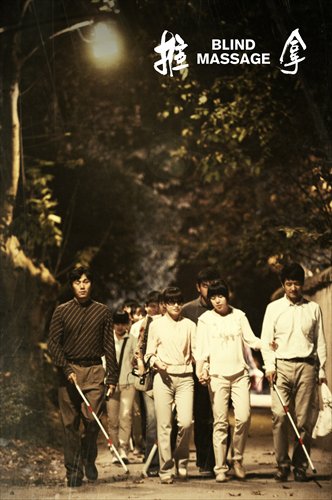
Poster for Lou Ye's new film Blind Massage, which hit the big screen on November 28 Photo: IC
Winner of the Golden Horse Award for Best Feature Film, Blind Massage, the latest work of Chinese director Lou Ye, examines the lives of a group of seeing-impaired masseurs and masseuses working at the Sha Zongqi Massage Centre in Nanjing, Jiangsu Province. The center is run by two blind co-managers: Zhang Zongqi (played by Wang Zhihua), a prudent man of few words and Sha Fuming (played by Qin Hao), an outgoing charmer who enjoys writing poetry and dancing.
The arrival of Sha's old classmate Dr. Wang (played by Guo Xiaodong) and his foxy girlfriend Kong (played by Zhang Lei) explodes like a silent bomb in this calm community, setting off an emotional love triangle. A young masseur Ma (played by Huang Xuan), normally a very spiritual person, becomes infatuated with Kong. Meanwhile, Sha himself becomes obsessed with another beautiful, self-contained masseuse Du Hong (played by Mei Ting). However, Du rejects Sha and his professed love, as she is attracted to Ma instead.
Similar to Lou's other films, love is a very important theme in Blind Massage. However, the film is more than just a love story as it touches on other serious themes: dignity, responsibility, and desire.
Real life, real people
Unlike other movies focused on the blind, such as Happy Times (2000) by Zhang Yimou and My Spectacular Theatre (2010) by Lu Yang, which present heartwarming stories, Blind Massage boldly depicts a naked (even bloody) living world. The film doesn't depict its characters as weak and poor people that should be pitied, but as real people that have their own personalities and character. Some are ambitious entrepreneurs, some fall in love and dream of grand weddings, some are trapped between desire and their own morale code; both the sweet and bitter parts of life are there for audiences to see, which goes a long way towards helping audiences understand and come to respect these characters.
Blind Massage is an adaptation of the Mao Dun Literature Prize winning novel of the same name by author Bi Feiyu. Back in 2006, when the author approached Lou with the idea of turning the book into a film, Lou was rather hesitant because he never really cared for literary adaptations. However, after reading the novel, Lou was deeply touched by the characters' stories and decided to accept Bi's proposal. In a recent interview Lou explained his reaction, "After reading Bi Feiyu's novel, I really felt that this wasn't just a world for the blind, but a world for us as well. The blind and us live in the same world."
In the movie, Lou keeps the main story line from the novel while making some changes to the characters. This is especially true for the character of Ma, who becomes the central figure of Lou's film.
As Lou himself explained, "It's very difficult to paint a group portrait of so many characters in a two-hour movie. A movie has to have a focus."
Although some have criticized the film as being fragmented, Bi said that he is quite satisfied with the adaptation.
Classic Lou style
Blind Massage was filmed in Lou's typical style. First, the movie is rich in imagery commonly used by the director, such as rain, dancing, blood and sex. Rain is one of Lou's classic harbingers of tragedy. Once it rains, bad things are sure to happen. For example, in Suzhou River (2000) rain plays witness to Mardar and Moudan's ambiguous death, whereas in Blind Massage, Dr. Wang is seen carrying a bundle of money home in the rain, which is then followed by a shocking, bloody scene involving self-mutilation.
Dancing is often used as a distinctive means to express love in Lou's movies. For example, in Summer Palace (2006) Yu Hong and Zhou Wei dance together in a bar shortly after they meet; in Spring Fever (2009) Wang Ping and Jiang Cheng dance in the park; in Blind Massage Sha attempts to express his amorous feeling for Du by dancing with her. This use of dance helps Lou paint a more intimate view of the relationship between a man and a woman.
The film also adopts Lou's shaky handheld, artfully opaque cinematography, which was also used to great effect in Purple Butterfly (2003) and Spring Fever (2009). Through the use of this technique the director is able to create a sense of chaos and confusion, which he uses alongside blurred shots to reflect the inner world of his blind characters.
To more realistically portray blind characters, several of the film's actors including Qin Hao, Guo Xiaodong, Mei Ting and Huang Xuan studied massage at the Nanjing School for the Blind. While at the school they remained blindfolded, living and eating together with other students so they could get an understanding of their lives. The film also features the debut performances of some blind actors and actresses, such as Zhang Lei, who plays Kong in the film. A student at the Nanjing School for the Blind, she won the Best New Performer Award at Taiwan's 51st Golden Horse Awards in November.
One world
In my opinion, the most remarkable thing about Blind Massage is how it breaks through the differences and boundaries between the blind and sighted.
Just like Mei Ting, one of the leading actresses in the film, wrote on her blog: "Our hearts might be blinded by what our eyes see. The blind are actually able to see more." Lou also expressed a similar opinion in an interview, "In fact, we know nothing more about this world than the blind. Fate is invisible. Looking at it this way, the blind may know even more about this world than the sighted."
"Eyes are divided: some see in the light, while others see in the dark." This movie breaks the inertia of our thinking. It shows us that blindness is not a life-ending disability and that in fact everyone has their own disabilities: When we can't find the words to share our thoughts with others, when we feel lost in a world we can't understand, when we fail, are frustrated or are deceived by others… In these situations we are no different than the blind living in the dark.
Newspaper headline: Living in the dark