HOME >> CHINA, METRO SHANGHAI
Fighting fit
By Ni Dandan Source:Global Times Published: 2014-12-15 17:33:01
City women take up Chinese kickboxing for health and self-defense
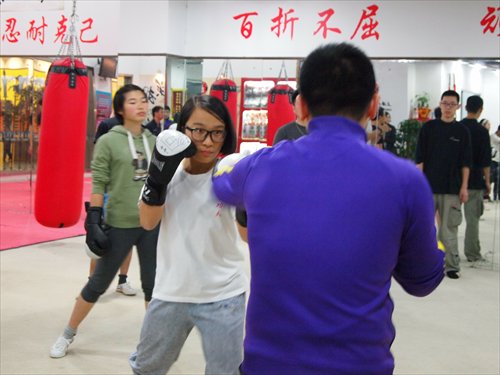
Li Baozhu (left) in a demonstration fight with her coach Yang Jiexiu Photo: Ni Dandan/GT
When Song Huimin goes to the office with bruises on her face, she doesn't feel at all embarrassed. And her colleagues are neither surprised nor suspicious. They knew that this is just another sign she has been working at her sport.
In her 20s, Song looks like any other city office worker, attractive, busy and moving with grace. But the minute she takes off her high heels and gets into a boxing ring, she becomes a fierce and determined fighter. "I enjoy feeling like an attacker. I don't like being defense-oriented. Even though there are times I am completely exhausted, I want to use all my remaining strength to throw one last punch," she told the Global Times at a martial arts club in Minhang district.
She is a practitioner of Chinese kickboxing, a Chinese self-defense system and combat sport, which is increasingly popular among young women in the city as a form of exercise.
Cao Guangyang, Song's coach and the manager of the club in Minhang, said that a few of their female members had been participating in amateur fight contests although they were a small minority of the participants. "We have fewer than 20 female members out of our membership of nearly 300," he said.
However, at another martial arts center in Changning district, women play a larger part. At one Chinese kickboxing session on a weekday night, eight women appeared in a class of 20. "Three years ago, female practitioners here accounted for only 10 percent of the class. Now the figure has risen to nearly 50 percent," the executive manager of the center, Chen Li said.
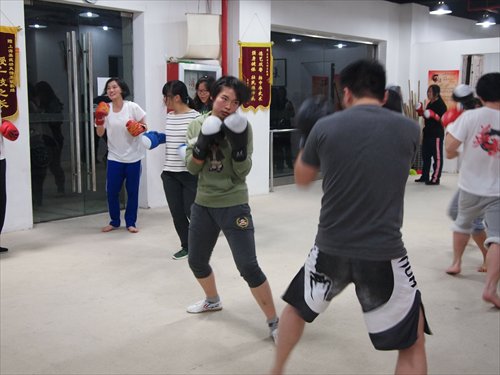
A female kickboxer spars with a male fighter. Photo: Ni Dandan/GT
Modern style
Rooted in traditional Chinese kung fu, Chinese kickboxing has been developed into a modern combat fighting style, involving full contact kickboxing. The techniques include close-range and rapid punching and kicking, with wrestling, takedowns, throws, sweeps, kick catches and, in some contests, elbow and knee strikes.
It sounds like a violent sport, but coach Yang Jiexiu said it was difficult for a woman to be hurt in a practice session. "The big reason is that most women are quite timid. They don't dare use their full strength when throwing a punch or kicking," he told the Global Times.
Yang said that women without any background in sport didn't have to worry that kickboxing might be too much or too demanding for them. The first 30 to 40 minutes of each 90-minute coaching session is a warm-up period where participants stretch, run and squat.
After this the coach pairs up his students based on their level of expertise to allow them to begin fighting proper. "Don't assume that women are always weaker. Most of the men here find some of our experienced women fighters hard to handle. To avoid harm we wouldn't pair a female newcomer with a male fighter."
One of Yang's students, Li Baozhu, has been practicing kickboxing for two years. She looks petite and is a quietly spoken but in a fight she moves quickly and ducks and weaves to avoid punches, counter striking deftly, accurately and hard whenever she gets a chance.
"I took up the sport because I want to stay healthy and, at the same time, strong enough to look after myself. Honestly I'm kind of a fan of strength sports, particular those that look a bit violent," she smiled shyly.
The 15-year-old is a 9th grade student in a city middle school and is about to sit her zhongkao (high school enrollment exams) next year. "I enjoy the sport a lot - it helps me relax in the busy study schedule," she told the Global Times.
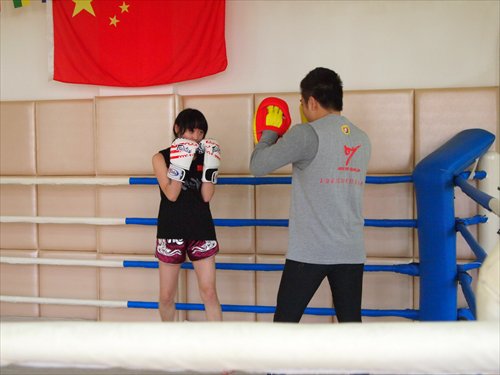
He Yao (left) practices punching techniques with coach Cao Guangyang. Photo: Ni Dandan/GT
Shaping bodies
Coach Yang said self-defense was one of the main reasons that that women came to his classes and this was what made kickboxing different from other forms of exercise available at the city's gyms. "Both kickboxing and gym exercises like aerobic gymnastics help shape bodies and improve cardio-pulmonary functions. But in a Chinese kickboxing lesson, you can learn how to react to a surprise attack."
That's why Yang said it was an essential part of training women that they have actual fights with men so they could feel how things might happen if they ever were really attacked on a street. "Real combat helps them learn their weak points and improve their skills effectively."
He said the best course for a woman would be to undertake two sessions a week and stick with it for six months. "But you have to practice these techniques at home regularly after you stop coming to the club. Otherwise it's easy to forget the moves and in an emergency be completely at a loss as to how to react."
While coach Yang told the Global Times that he had never seen any of his female students injured in practice, coach Cao said that this depended on the definition of injury. "We don't count black eyes, bloody noses or bruises as real injuries," he said, sporting an obvious cut just below his eyebrow.
"It may look as though a great deal of strength is needed to punch and kick like this. But with experience people learn how to protect themselves. The rate of injuries in kickboxing is way below that for basketball and football," Cao said.
For one woman kickboxer at a club in Hongkou district, bruises or scars on her face are not a problem. "Beauty originates from inner confidence, which the sport has helped me develop. Persisting at kickboxing also shows an ability to ensure hardship," said Huang, who works in the textile industry. She has been practicing Chinese kickboxing for a year.
Based on the three clubs that the Global Times visited, the ages of female practitioners of Chinese kickboxing range from 15 to 30 and most have different reasons for taking up the sport.
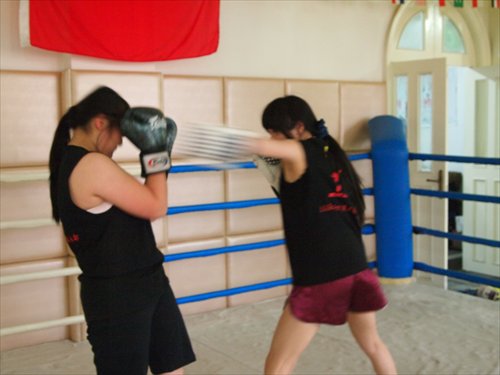
Song Huimin (left) defends against a straight left from He Yao. Photo: Ni Dandan/GT
Getting stronger
He Yao, who started to fight only two months ago, said she loved sports and was good at running and sit-ups. When she signed up for a kickboxing class, she wanted to build up her muscles. "Already I think I've got stronger," she smiled.
She has been mostly practicing basic techniques in this period. "My coach hasn't let me actually take part in a real fight yet. He's afraid that I could get hurt without a solid foundation in self-defense techniques."
A coach surnamed Zheng with the kickboxing club in Hongkou told the Global Times that some women kickboxing students imagined their muscles were growing but, in fact, it was not that easy to develop muscles. "Unlike professional Chinese kickboxing athletes, who need to take in a lot of calories and undergo long hours in weight training, amateur women kickboxers won't build up muscles easily."
However some have found that Chinese kickboxing is a fine way to lose weight. Liao Linjun, a member at the Hongkou club, has been kickboxing for six months and was surprised and delighted to see her weight drop by 5 kilograms. "I was recommended here by a friend of mine, who said this was the way lingerie models stayed fit. My persistence has really paid off."
The 30-something kickboxer Wan Lei said she had got bored with the routine exercises at gyms and found kickboxing interesting - it also helped relieve aches in neck and shoulders. "Plus, when I get back home, I teach my son some of the techniques, which is fun."
Another 27-year-old who declined to be named, said that before she started the sport she had been physically weak and broke into a sweat after just a short walk. She believes kickboxing has strengthened her physically and made her tougher mentally. "I admit I used to be a coward sometimes but I believe kickboxing has made me a stronger person physically and mentally."
Posted in: Society, Metro Shanghai, City Panorama