Dishui Lake Station
Peaceful area offers chance to enjoy nature and learn about shipping industry
This year is the 21st anniversary of the opening of the Shanghai metro. The subway has facilitated more than 13 billion journeys during its 21 years, and half of Shanghai citizens cite the metro as their favored mode of transport. To commemorate the anniversary, each week the Global Times will take an in-depth look at one metro station and its surroundings. In the case of downtown stations, we will focus on points of interest within walking distance; while for suburban areas, we will cast our net a little wider.
Metro Line 16, entirely located in Pudong New Area, has been opened for one year. It connects Longyang Road Station on metro Line 2 with Dishui Lake Station near Lingang New City on the southeastern coast of Pudong.
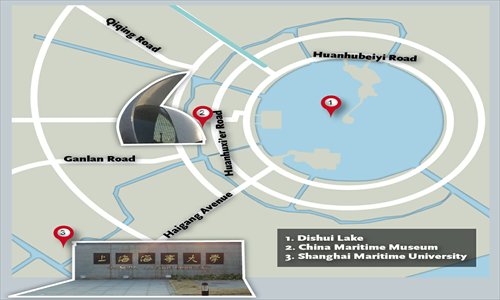
Nestled at the eastern end of the metro line, Dishui Lake Station offers a handful of scenic and cultural attractions for visitors to explore in its surrounding area.
To the east of the station, Nanhui Dongtan Wetland Park features a diversity of plant and animal life, while Nanhuizui Guanhai Park in the southeast offers a good opportunity to view the East China Sea.
Dishui Lake
Emerging from Exit 2 of the station and walking down Lingang Avenue to the east will bring you to Dishui Lake (Huanhuxiyi Road, 6828-3232), which is a must-see for anyone visiting the area. Dishui Lake is a circular 5.6-square-kilometer lake located in the urban area of Lingang New City. It is also the biggest artificial freshwater lake in the country.
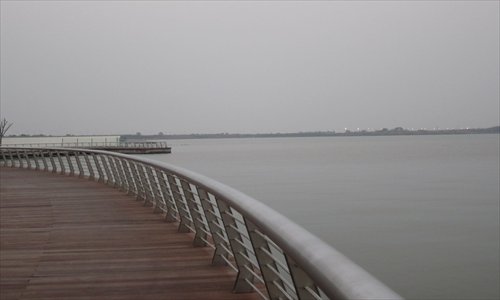
Dishui Lake is the largest artificial freshwater lake in China.
"Dishui" means "water dripping." According to an introduction board near the lake, the name comes from the idea that "a drop of water falls from the sky into the sea, causing ripples that urge each other forward."
In the middle of the lake stands a large steel sculpture shaped like a drop of water, with three small islands scattered about it.
A wooden platform offers some of the best views of the lake on a clear day. Visitors can also take a motorboat trip across the lake, which costs 45 yuan ($7.23) for adults and 20 yuan for children.
China Maritime Museum
To the southwest of the station is the China Maritime Museum (197 Shengang Avenue, 3828-7777), the first State-level maritime museum in the country, which means it has access to central government resources to provide exhibits and facilities.
The towering building features a sail-shaped façade on its upper part and, from a distance, looks like a liner setting sail. The three-story museum features six exhibition halls themed on vessels, mariners, ports, maritime safety, nautical developments and military navigation. A dazzling array of some 20,000 relics and intricately made vessel replicas are on display.
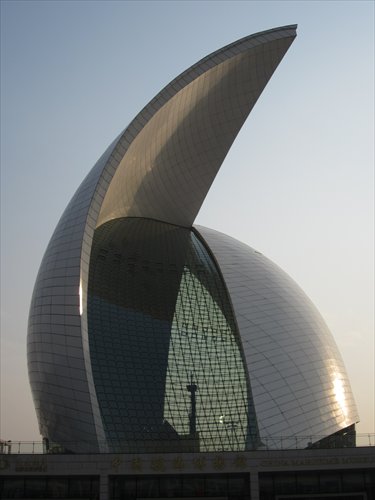
The sail-shaped China Maritime Museum
The centerpiece is a big model ship based on that of famous Chinese navigator Zheng He (1371-1433), a fleet admiral who commanded voyages throughout Southeast Asia, the Middle East, and East Africa during the Ming Dynasty (1368-1644).
Another highlight is a pirate-themed 4D cinema on the second floor. With a seating capacity of 180, the cinema shows short films with thrilling viewing effects such as moving seats and fog spray. Each film lasts about 15 minutes and costs 30 yuan per person.
An amusement center for children and a planetarium are located on the first and second floor respectively. The museum is open from 9:30 am to 4 pm from Tuesday to Sunday. Admission is 50 yuan.
Shanghai Maritime University
Grab No.1043 bus from Exit 2 of the station and 10 minutes later you will arrive at Lingang campus of Shanghai Maritime University (1550 Haigang Avenue, 3828-2000).
The university grew out of the Wosong Merchant Marine School founded early in 1912.
A towering monument to the school was erected near Merchant Marine College.
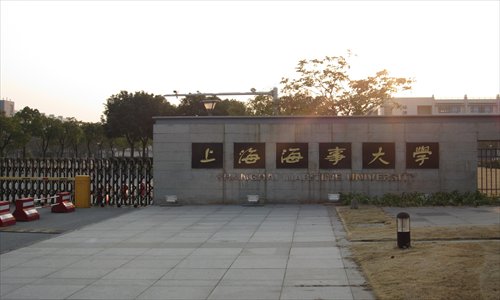
The Lingang campus of Shanghai Maritime University Photos: Yang Fan/GT
Opposite stands a bronze statue of Tang Wenzhi (1865-1954), the founder of the school and Chinese tertiary maritime education.
The university specializes in shipping and transport education with six fields of study, namely engineering, management, economics, literature, science and law.
Buildings on campus have blue and grey façades with contemporary designs.
A square in front of the library features busts of world-renowned navigators such as Christopher Colombus, Vasco da Gama, and Ferdinand Magellan.