Forests for furniture
Rosewood vanity in China threatens endangered species
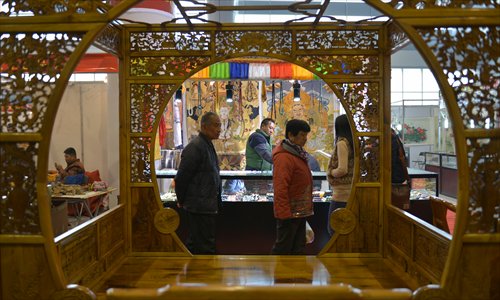
Visitors admire rosewood furniture at an art collection exposition in Liaocheng, Shandong Province on November 14. Photo: CFP
A set of rosewood furniture valued at 500 million yuan ($80 million) was displayed in Dongyang, Zhejiang Province on October 18, touted as one of the most expensive sets ever produced.
The set was compromised of 22 pieces including a bed, closets, a desk and a chair. They were made of an over-thousand-year-old fragrant rosewood tree that weighted four tons, news portal 163.com reported in October.
The past decade has seen the rapid expansion of the market for rosewood furniture in China as the middle class grew. In 2012 alone, the rosewood market was worth up to 100 billion yuan, according to data from the international environmental protection organization Greenpeace.
Meanwhile, rosewood trees have suffered from extensive logging worldwide. Siamese rosewood, one of the three types of rosewood trees, has been excessively felled in Cambodia, Laos, Vietnam and Thailand.
Fanatic obsession
Rosewood furniture has been treasured by the Chinese people since the Ming Dynasty (1368-1644). Its rarity, due to its long growth cycle, meant the furniture could only be owned by the affluent, Ma Weidu, an acclaimed rosewood connoisseur, told the Global Times.
"As a result, modern consumers use the furniture to demonstrate their social status and wealth as China has produced a great number of wealthy individuals," Ma said.
From 2010 to 2013, the price of Siamese rosewood timber quintupled from about 60,000 yuan per ton to around 300,000 yuan, an experienced rosewood dealer surnamed Gao told the Global Times, adding that the price has now dropped to about 150,000 yuan per ton due to the ongoing anti-corruption campaign in China.
Che Chang, secretary-general of the Chinese Rosewood Committee, attributed the rarity of rosewood trees, the restrictions on the international trade of rosewood and booming auction market for antique rosewood to the vigorous Chinese pursuit of rosewood furniture. Since aged rosewood is relatively free from corrosion and decay and can be preserved for a long time, rosewood furniture is seen as preserving its value for a long time, Che said.
According to a national standard for rosewood furniture introduced in 2000, rosewood includes 33 species of timber that have been traditionally used to produce high-end furniture, about four of which grow in the wild in China.
However, as it takes several centuries for rosewood trees to grow large enough to be made into furniture, experts agree that rosewood in China has become rare due to its continuous consumption, which led to most rosewood being imported.
Greenpeace calculated that from 2010 to April 2013, about 51 percent of trees brought to China were imported from Africa, 41 percent were from Southeast Asia and 8 percent from Latin America.
In 2014 alone, China imported about 1.84 million cubic meters of rosewood by October, an increase of 92 percent year-on-year, according to the Chinese Redwood Committee.
Disappearing trees
The soaring demand for rosewood furniture
has resulted in the dramatically shrinking number of trees in other countries, Pan Wenjing, Forest and Ocean Unit Assistant Manager of Greenpeace's East Asia branch, told the Global Times.
In 2011, it was estimated that Thailand had 100,000 Siamese rosewood trees, equivalent to approximately 63,500 cubic meters of timber, according to a report published in May by Environmental Investigation Agency.
"Despite a lack of systematic surveys on the diminishing number of trees worldwide, the number of species urged to be protected by international conventions and organizations, such as the Convention on International Trade in Endangered Species of Wild Fauna and Flora and the International Union for Conservation of Nature, reflect a certain degree of the severity of wanton felling of trees around the globe," Pan said. Under pressure by over-exploitation, India, Madagascar, Vietnam, Thailand, Laos and Myanmar have tightened their control over rosewood exports in recent years, timber business portal wood168.com reported in April. Still, illegal logging and smuggling prosper, in order to meet the rising demand for rosewood in China.
Guangzhou customs seized 615 containers holding 14,000 tons of smuggled rosewood timber valued at 1.05 billion yuan, the Xinhua News Agency reported on August 30.
Business people also resort to processing furniture in the countries that grow rosewood trees, instead of shipping the materials directly to China, an approach that aims to circumvent bans or restrictions on the export of raw wood, Gao said.
Wider crackdown
Cracking down on smuggling is far from enough, Pan said. She called on the government to strengthen its supervision of the rosewood market. "The government may ask traders to prove that the whole trading chain is legal, especially logging and exporting," Pan said.
Pan suggested that "media and famed furniture connoisseurs promote the understanding of rosewood furniture among ordinary consumers who are fanatically obsessed with the material as it is not the only criterion to appreciate a piece of furniture."
However, all the collectors reached by the Global Times dismiss the proposal as "unrealistic."
Both Ma Weidu andYu Hongyan, deputy heads of China Association of Antique agreed that it is unlikely to be able to change their attitude since the Chinese pay great attention to the quality of wood.
"Unlike in Western cultures, there is no tradition in China of respecting professionals' opinions," Ma said. "And due to a lack of art appreciation, all the criteria they can adopt are materialistic: the heavier the better."
Yu added that "Business people, who encouraged people to attach great importance to material, always speak much louder than professionals. After all, it is them who maintained direct contact with customers."
Ma appealed for international conventions to curb felling and trading, saying it was the only feasible solution to slow the growth of the market.
Yu said connoisseurs may try to "guide consumers to divert their attention from material quality to other elements that furniture can boast, such as its design, artistic value and cultural significance."
After a national standard for rosewood was established in 2000 and incorporated 33 species of rosewood, the new draft of standards that solicited public opinions in November has not included more species into the rosewood category.