Rescuers recover bodies, debris at AirAsia crash site
Incident deals yet another blow to SE Asia tourism: expert
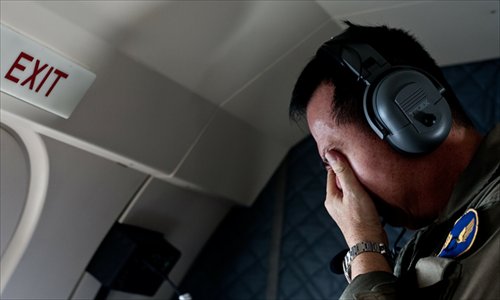
A family member of passengers onboard the missing Malaysian air carrier AirAsia flight QZ8501, reacts after seeing an unidentified floating dead body during a search and rescue mission with Indonesian military personnel over the waters of the Java Sea on Tuesday. Photo: AFP

Graphics: AFP/GT
Indonesian officials on Tuesday confirmed that the debris found in the sea off the coast of Borneo came from the missing AirAsia flight QZ8501, a statement from the airline said.
Flight QZ8501, an Airbus A320-200, lost contact with air traffic control early on Sunday during bad weather on a flight from the Indonesian city of Surabaya to Singapore.
Debris from the aircraft was found in the Karimata Strait around 110 nautical miles southwest of Pangkalan Bun, in Kalimantan province on the island of Borneo.
The Indonesian navy said 40 bodies had been recovered as dusk fell, although later reports contradicted this. Just three bodies had been recovered, AFP reported.
The main body of the plane has yet to be found and there was no word on the possibility of any survivors. The debris was discovered in an area where the water is 20-25 meters deep, and will be accessible by divers.
Tony Fernandes, Group Chief Executive Officer of AirAsia, said he was absolutely devastated. "This is a very difficult moment for all of us at AirAsia as we await further developments of the search and rescue operations, but our first priority now is the well-being of the family members of those onboard QZ8501," Fernandes said in an AirAsia statement.
Indonesian media broadcast pictures of floating bodies on television and relatives of the missing gathered at a crisis center in Surabaya wept with their heads in their hands. Several people collapsed in grief and were helped away, a Reuters reporter said.
As night fell, pictures had begun to emerge of some of the debris that had been recovered, which included a plane door, oxygen tanks, an emergency slide and some luggage.
"The challenge is waves up to three meters high," Fransiskus Bambang Soelistyo, head of the Search and Rescue Agency, told reporters. The recovery operation was suspended late Tuesday due to bad weather and is expected to resume on Wednesday.
About 30 ships and 21 aircraft from Indonesia, Australia, Malaysia, Singapore, South Korea and the US are searching across an area of up to 10,000 square nautical miles.
China's foreign ministry spokeswoman Hua Chunying said Tuesday that Chinese maritime search and rescue forces will soon depart to aid in the search.
The plane, which did not issue a distress signal, disappeared after its pilot failed to get permission to fly higher to avoid bad weather because of heavy air traffic, officials said. It was travelling at 32,000 feet (9,753 meters) and had asked permission to ascend to 38,000 feet.
Pilots and aviation experts said thunderstorms, and requests to gain altitude to avoid them, were not unusual in an area often referred to by veteran pilots as the "thunderstorm factory."
The Indonesian pilot was experienced and the plane last underwent maintenance in mid-November, the airline said.
The aircraft had accumulated about 23,000 flight hours in some 13,600 flights, Airbus said.
Three airline disasters involving Malaysian-affiliated carriers in less than a year have dented confidence in the country's aviation industry and spooked travelers across the region.
Malaysian Airlines Flight MH370 went missing on March 8 on a trip from Kuala Lumpur to Beijing with 239 passengers and crew on board and has not been found. On July 17, the same airline's Flight MH17 was shot down over Ukraine, killing all 298 people on board.
The incident will likely deal a blow to tourism in Southeast Asia.
"Tourism will be affected during the coming Spring Festival holiday, as some tourists may switch their destinations to Japan or Russia," Deng Zongde, a research fellow with the Tourism Research Center of Chinese Academy of Social Sciences, told the Global Times.
Southeast Asia has been a popular travel spot for Chinese for many years with more than 18 million people traveling between China and the region every year, and over 1,000 flights traveling back and forth every week, the Xinhua News Agency reported.
Several Chinese tourists told the Global Times that they would avoid flying on AirAsia or Malaysia Airlines.
Wang Jun, 28, said she would choose a domestic airline for her trip to Thailand. "I won't choose AirAsia or any Southeast Asian airlines out of safety concerns."