HOME >> CHINA
A burning issue
By The Beijing News – Global Times Source:The Beijing News – Global Times Published: 2015-1-14 20:40:20
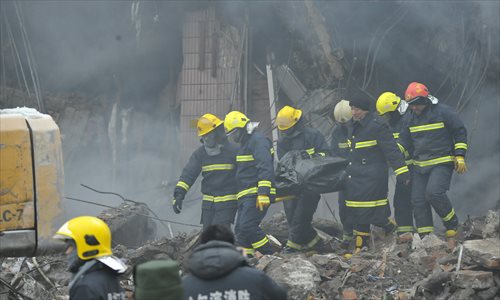
Firefighters carry the body of a colleague out of the charred ruins of a warehouse in Harbin, Heilongjiang Province on January 3. The fire a day earlier took the lives of five firefighters. Photo: CFP
Five young firefighters lost their lives while trying to put out a warehouse blaze in Harbin, Northeast China's Heilongjiang Province on January 2.
The firefighters - the oldest was 22 years old and the youngest 18 - were buried alive while trying to extinguish a fire that was ravaging the third floor of the warehouse.
The five men's names are now added to the long list of Chinese firefighters who have been killed in the course of their life-saving duties.
According to statistics from People's Public Security, a magazine run by the Ministry of Public Security, from 2008 to 2012, 140 firemen were killed in action in China, with the average age of those killed being 24 years old.
The latest tragedy in Harbin has led to reflections on the flaws of China's firefighting system. Fire protection experts argued that it is time to face long-running problems including the shortage of hands, low level of training offered to firemen and alleged interference of local officials in firefighting operations.
Unskilled firefighters?
On January 2, when Harbin resident Zheng Zhonglei arrived at the scene of the warehouse fire, he could see that the young firefighters had no idea how to tackle the inferno, or even how to use their equipment properly, he told the Beijing News. "Some of them even didn't know how to connect the fire engine to the fire hydrant," Zheng said.
This led to just one tragedy in a litany of such tragedies.
In May 2014, two firefighters, 23-year-old Qian Lingyun and 20-year-old Liu Jie were blown out of a window by the force of an explosion and were killed while putting out a high-rise fire in a Shanghai residential neighborhood.
In January 2013, three 22-year-old firemen lost their lives due to shifting winds while attempting to extinguish a serious fire at a factory in Xiaoshan, Zhejiang Province.
So why have so many young Chinese firemen been killed?
Chen Ping (pseudonym), an official from the Harbin fire department, said that most new firefighters are rookie soldiers between 18 and 22 years of age.
"We have no threshold for the recruitment of firefighters, they are eligible as long as their physical condition is good, so it takes a lot of training," Gao Ming, director of Jinan's firefighters, in Shandong Province, wrote in Firefighting Weekly, a supplement of the People's Public Security magazine.
Theoretically, new recruits are not allowed to go out on firefighting missions until they have undergone at least one year of training.
But in reality, most firefighters are dispatched to fight fires before they have finished this training period.
While trying to put out a conflagration in a mosquito repellent incense factory in a city in Fujian Province, a new firefighter suffered serious burns after the air mixing with flammable powder exploded, according to the Beijing News.
"Firefighting is a career that relies heavily on personal experience," Ma Tingguang, a fire prevention and safety technology expert at Oklahoma State University in the US, told the Global Times.
Even for some firefighters who have two to three years of experience, it is often difficult to deal with the complicated situations they are faced with on a regular basis.
Ma suggested that this is a systemic problem and that China could learn from the US firefighting system.
"Firefighters in the US require 10 years of experience before they are allowed to put out fires indoors and it is normal that a firefighter will serve 15 to 20 years in the US career firefighting system," Ma said.
Interfering officials
Insiders have said that it is common for local officials who have no firefighting knowledge to cause problems for firefighters.
Chen Ping claimed that "the Harbin warehouse firefighting operation did not follow a scientific method but the orders of some local officials."
Normally, firefighters will only enter a building on fire after they have clear knowledge about the inner structure of the building. However, in the case of the Harbin fire, the warehouse reportedly failed to provide the map of the warehouse until the building had been burning for 15 hours.
According to the Beijing News, some local officials reportedly asked firefighters to enter the warehouse inferno and extinguish the fire nine hours after the fire began. This order was strongly rejected by the experts present.
This was not an isolated case. An anonymous fireman from Henan said that, once, a fire had already devoured a building, but local officials still demanded that firefighters enter the building and save the property.
Some firefighters admitted that their methods are always chosen by local officials. "We have to work by reading the looks on their faces, from routine inspections to the actual firefighting," another firefighter who preferred to stay anonymous told the Beijing News.
Understaffing
Chronic understaffing has put firefighters' lives at risk.
The Harbin fire department that 18-year-old firefighter Zhao Zilong Zhao belonged to had long been short of personnel, so Zhao began fighting fires just one month after he was recruited, the Beijing News quoted insiders as saying. Zhao died in the mission on January 2.
Provinces and cities across China suffer from this understaffing. Statistics show that normally there are 10 firefighters for every 10,000 citizens in developed countries and on average three to five firefighters per 10,000 citizens in developing countries. In China, the figure is much lower: There are only two firefighters for every 10,000 people.
To improve this situation, some local authorities have begun to recruit firefighters from the civilian population. Now, half of some firefighting teams are soldiers and the other half are contracted firemen recruited by local authorities.
However, a fire fighting expert said that despite the fact that these measures have been in place in some areas for over a decade, the results have not been very impressive.
The heavy workload, low pay and limited promotion opportunities mean it is hard to recruit quality civilian firefighters.
For instance, a firefighter in Ningbo, Zhejiang, is paid 2,500 yuan per month while waiters in the city can earn an average of 3,000 yuan per month. Also, there is little room for career growth. Unlike soldiers who can be promoted to a higher military rank, civilian firefighters stand little chance of promotion. Their options are to find another job when their contract is over or remain in a low-paid, dangerous job.
Posted in: In-Depth