Temporary measures to win ‘civilized city’ award under question
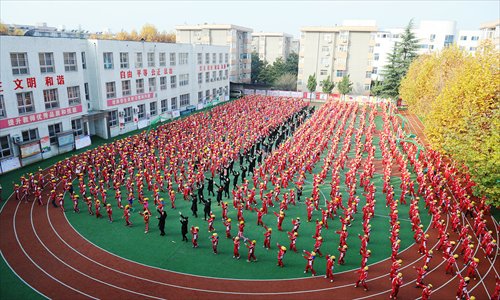
Students and teachers at a school in Xi'an, Shaanxi Province stage a group dance as part of the city's bid for a "civilized city" award. Photo: IC
Two weeks after a "national civilized city" inspection team left a university in Central China's Hubei Province, little evidence of the high-profile promotion of "core socialist values" that had involved the entire university could be seen, except for a few banners carrying key words from the list of values that still hung limply around the campus.
"Nobody here is talking about the values now, and I've already forgotten most of them," a graduate student surnamed Dong at the Central China Normal University in Wuhan, capital of Hubei, told the Global Times.
Dong's university required all students to recite the values in preparation for the random checks made by the inspection team at the end of December, and threatened to revoke the scholarships of those who did not impress the inspectors.
In a bid to win the triennial "national civilized city" award that is scheduled to be awarded early this year, a total of 88 candidate cities faced undercover inspections organized by central authorities - which looked at aspects ranging from the cities' urban and moral environments to their social security and public services - and carried out a variety of promotional campaigns to demonstrate their commitment to "core socialist values."
Wuhan rolled out a mandatory citywide "core socialist values" recitation campaign last October.
The values, which were the main assessment criteria for this year's "national civilized city" award, comprise a set of moral principles including prosperity, democracy, civility, harmony, freedom, equality, justice, the rule of law, patriotism, dedication, integrity and friendship.
These values have been promoted by the Communist Party of China (CPC) since its 18th national congress in late 2012. It is a national campaign that aims to rebuild public faith in socialism amid concerns that the world's second-largest economy has lost its moral compass during its three-decade economic miracle, according to the Xinhua News Agency.
Local governments see the "national civilized city" award as being very important, as officials from award-winning cities are more likely to be promoted, observers said.
In the last competition, 24 major cities and three districts won the title. The winning cities included Guangzhou in Guangdong Province, Zhengzhou in Henan Province, and Changsha in Hunan Province.
The winning districts were Chaoyang in Beijing, Changning in Shanghai and Yuzhong in Chongqing, according to the CPC's Central Civilization Office, organizer of the "national civilized city" award.
However, preparations made by local governments for the inspections were widely criticized, as many of these costly measures ended up bringing no lasting changes.
Uncivilized measures
When Dong's university asked students to memorize the values, only some obeyed. Others came up with alternative ways to pass the checks.
"One way is to pretend to be a tourist on campus, and then you can pass the checks by saying something good about Wuhan," Dong said.
Beside the mandatory recitation, many students were upset after a street outside the university where restaurants and street vendors sold food popular with students was demolished.
The recitation campaign was widely mocked by local citizens. At an annual televised conference on January 6, a Wuhan district leader was even asked by a citizen representative to recite the socialist values himself. The official Wang Li, of Wuchang district, struggled to recite all 24 characters.
Wuhan is not the only city in the spotlight due to its temporary "civilized" measures.
In Harbin, Heilongjiang Province, the local railway station management authority released photos of the undercover inspection team, and asked its employees to report to their superiors if they spotted any of them, according to the China National Radio.
In the last "national civilized city" competition that was held three years ago, a township in Zhengzhou, Henan Province, erected a temporary wall to hide dilapidated houses and garbage dumps from the eyes of the inspectors, the Xinhua News Agency reported.
Beijing's Chaoyang district closed many restaurants, shops and expelled street vendors during the inspection period in 2011, which caused inconvenience for local residents.
The closed stores reopened after the inspection ended.
Undercover observations
The Central Civilization Office had warned local governments not to launch temporary measures to try and win the award.
"Many citizens complained about the formalism and fraudulent measures that are common in cities' efforts to win the award," reads an announcement on its website. The office vowed to punish those that cheat or carry out temporary measures during the inspection period.
An officer from the Hubei provincial civilization office, surnamed Hu, who is one of the undercover inspectors, told the Global Times that the inspections focus more on people's actions rather than a city's temporary preparations.
"When I went to a hospital for an undercover inspection, I would not ask doctors to recite any slogans, but pay attention to their services, such as their patience as well as their medical skills," said Hu, adding that they do not inform any cities about the dates their inspections take place.
During his inspections, Hu would pretend to be a tourist and ask locals for directions in order to get an idea of the friendliness of the residents, and he would go to city service centers and pretend to be a city resident to observe the work of the civil servants.
In Hubei, the cities that have previously won the award are inspected every year to prevent cheating and short-term policies from being enacted in preparation for the inspections, according to Hu.
Obviously, this did not work quite well as planned.
Assessing officials' performance
"The title of national civilized city is not just something to put on a city's postcards to drive both economic and tourism growth, it's perceived as a government achievement that is closely connected to officials' careers," Zhu Lijia, a professor with the Chinese Academy of Governance, told the Global Times.
After the country removed local GDP from the criteria by which government officials' are evaluated, the title of "national civilized city" has become an important way to assess their performance, according to Zhu.
The West China City Daily said that most of the local officials from the cities that won the title in earlier competitions have since been promoted. The Party secretaries of some prefecture-level cities were even promoted to provincial positions.
"Many cities have used uncivilized ways to win the civilized city award, which consumed lots of manpower and public money and resulted in negative effects," Zhu said.
He added that such competitions should no longer be held.
Newspaper headline: Fleeting face-lift