Moving into smart home
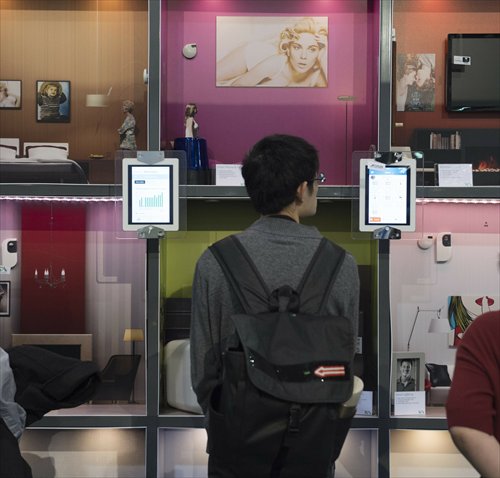
An attendee views a model home illustrating smart home products by GreenPeak, at the 2015 International Consumer Electronics Show in Las Vegas on January 8. Photo: IC
Beijing-based Xiaomi Inc has once again made headlines after recent media reports said it was making inroads into the country's home décor market through a venture fund co-funded by the entrepreneur who set up the upstart Chinese smartphone maker.
Shunwei Capital Partners - the China-based venture fund where Lei Jun, founder of Xiaomi, is also founder partner and chairman - has invested over 60 million yuan ($9.68 million) in home décor start-up ikongjian.com, the Beijing Youth Daily reported on January 6.
Ikongjian, which has ambitions to be the Xiaomi of the décor market, was only founded in 2014, and its creator Chen Wei is moving ambitiously to embed the Internet into his business, with pledges to provide his clients with Internet-enabled monitoring of decorating projects.
Chen's idea appears to fall in with an Internet-based business model that is seen to be vital to the success of Lei's smartphone venture, and analysts are speculating that the investment might pave the way for Xiaomi's foray into smart homes, poised to become the next wave of technology advances.
"Home décor is an indispensable part of creating a smart home, as relevant smart gadgets and furnishings need to be well incorporated to the decoration of the home," Liang Zhenpeng, a Beijing-based independent industry analyst, told the Global Times on Wednesday.
When contacted for confirmation about the investment on Wednesday, Li Lei, a PR manager with Xiaomi, told the Global Times that the smartphone maker is not directly related to Shunwei and therefore has no comment to make. Neither Shunwei nor ikongjian could be reached for comment by press time.
Taking a first bite
Although Li from Xiaomi did not confirm or deny the speculation, he stated the company has a very positive outlook for smart home technologies - "a segment that will be worth tens of millions of US dollars."
At the heart of Xiaomi's smart home business strategy are its smart router portfolios that connect relevant appliances such as smart televisions, Wi-Fi-enabled plugs, and air purifiers, according to Li.
Apart from three categories of Xiaomi-made devices - smartphones and tablets, TVs and TV set-top boxes, and routers - the rest of their gadgets, furnishing products that tune homes to the tastes of smart technology aficionados, all come from an ecosystem consisting of 25 firms with investment from Xiaomi, he disclosed.
The Beijing-based handset maker, which has catapulted itself to the top echelon of vendors both domestically and globally in a matter of just a few years, is hardly the only high-flier setting its sights on the smart home arena.
On New Year's Eve, JD.com Inc, a leading online direct sales company in China, announced a strategic partnership with domestic home appliances maker Midea Group Co, planning a deeper cooperation in areas that include smart homes.
The partnership followed JD.com's introduction of a cloud service app featuring the functionality of controlling smart devices made by different firms in June 2014, partnering with a slew of home appliance manufacturers including Haier Group, Hisense Group and TCL Corp.
The eagerness of traditional home appliance makers to gain a foothold in the next wave of technology could be epitomized by TCL's two consecutive moves highlighting its expansion into smart home territory.
On January 5, TCL released an announcement which revealed it was teaming up with the Dalian Wanda Group in a range of fields including the development of smart home systems.
The tie-up came after its announcement in November it was setting up a company devoted to the creation of a whole set of smart home experiences such as remote home monitoring.
On the global stage, Apple Inc already unveiled its smart home initiative at its Worldwide Developers Conference in San Francisco in June 2014, which integrates its voice-activated assistant Siri in enabling users to control a range of Internet-connected home items from either iPhones or iPads.
Apple's closest rival Samsung Electronics, which revealed its proprietary smart home platform at the Consumer Electronics Show in Las Vegas in January 2014, also showcased its latest smart home technologies at this year's CES, which ran from January 6 to January 9.
What matters most?
Joining the smart home initiative, technology heavyweights including Japanese conglomerate Sony Corporation and US mobile chip maker Qualcomm Inc had their newest smart home portfolios showcased at the recently concluded trade show in Las Vegas.
Some related technology providers such as the Netherlands-headquartered GreenPeak Technologies, a leading provider of semiconductor products and software technologies for smart home data communications, were also seen presenting their most recent products at last week's CES.
At the show, a wide range of objects connected to the Internet, including vehicles and homes, appeared to have stolen the limelight from smartphones.
There have been very few killer smart home initiatives so far, but the smart home arena is definitely a future growth engine for both traditional home appliance makers, furnishing vendors and smart gadget manufacturers, remarked Liang.
Amid the fight to be first to put down roots in the space, potential problems that lie ahead, for domestic players in particular, include the lack of indigenous operating systems that would play a vital role in building a smart space around the home, according to Liang.
In anticipation of "a flurry of new connected objects" that will lay the foundation for smart homes, Thomas Husson, Paris-based vice president and principal analyst at research firm Forrester Research, also wrote in a note e-mailed to the Global Times on January 6, "Beyond hardware, what will matter is the extent to which key players will announce partnerships to differentiate their ecosystem in what will soon become a crowded space."