Social cancer
Author’s controversial comments spark debate
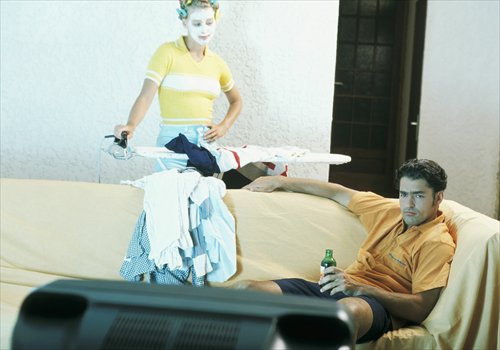
Photo: IC
Last week, a comment made by writer Zhou Guopin - a research fellow at the Institute of Philosophy, Chinese Academy of Social Sciences known for his translations of the works of Nietzsche - on Sina Weibo caused yet another round of debate about women's role in society.
"One of the valuable aspects of women is that they are closer to nature than men. Men have thousands of ambitions… while women just have one - they see love and giving birth as the most important things in their lives. A woman, so long as she follows her nature, will find that no matter if she is madly in love, happily doing housework or focusing all her attention on breastfeeding a baby, she is always beautiful."
This comment, which was posted on January 12, quickly attracted a large amount of criticism. Netizens soon found that similar opinions have appeared in many of Zhou's books and blog posts. For instance, in an earlier article titled "Women and Men," Zhou wrote: "The intelligence of a woman is that she is able to appreciate a man's intelligence."
Zhou later posted another comment as a reply to critics "I didn't mean to tell women to go back home… For me, no matter how intelligent or successful a woman is, if she is not willing or is incapable of being a gentle lover, a caring wife and a loving mother, her beauty becomes heavily discounted in my eyes."
Chauvinism - a mental cancer?
Zhou's comment was categorized by many as zhinan ai (straight men's cancer), a popular phrase used to describe a man who likes to criticize women, judges their appearance and who believes housework and taking care of men are all responsibilities belonging to women or at the very least are the most vital criteria used to judge a woman's worth.
As social media has made reaching out to a wider audience increasingly easy, cultural celebrities, especially writers and scholars, are no longer hiding behind books. As a result, more readers have come to realize their spiritual idols are not as wise as they once thought.
Due to the endless wave of criticism Zhou even went back and deleted his original post, a rare event according to him.
However, try as he might to hide his opinion, the problem doesn't just lie with one individual. It seems many male public intellectuals in China share Zhou's views about women.
For instance, not long ago, Lin Shaohua, a professor at the Ocean University of China famous for translating the works of famous Japanese writers such as Kawabata Yasunari and Haruki Murakami, posted a comment on his Sina Weibo.
"One of my students asked me how I can translate so many books and write so many essays while still teaching. My answer was only four words long: I never do housework. The boys from the class laughed while the girls kept silent. I told the girls that the damage from doing housework is lethal to a man - bowls and plates kill a man's sophistication and masculinity - that's why our society has so many sissy men and tough women."
Han Han, a writer who is seen by many as a representative figure for China's post-1980 generation, also seems to be a zhinan ai sufferer.
When he was asked by ELLE magazine in 2010 if his partner could have a close male friend, his answer was "absolutely no way." "She can look for her girlfriends if she has got something to say," Han said.
A global view
Recently Internet portal NetEase has posted a diagram in its women's section showing that despite women taking on more responsibility in the workplace this has not changed the fact that they are still the main force of house work at home.
Data from NetEase suggests a similar situation exists in China, Korea, Japan and also Western countries like the UK. According to this data, women spend an average of over three hours on housework per day whereas the amount of time for men is only 40 minutes.
The fact that Zhou and others' comments have generated so much attention online can also be attributed to the improved social position of women in China. According to the World Economic Forum's 2014 Global Gender Gap Report, out of 142 countries, China ranked at No.87 on the list, a much better position than Japan, which was at No.104.
Recently cultural critic Lü Pin wrote an article titled "What kind of disease is Zhinanai?" which was published by The Beijing News.
In the article Lü points out that Zhou Guoping's opinion was like something that came out of the 1980s, a time when people's appeal to a "return to human nature" went hand in hand with a redefinition of the role of men and women.
"The claim that women should focus on serving men's needs has a profound historical background and is still not out of date for many, though women have never been fans of such opinions," wrote Lü.
She added that although society is providing more information and opportunities for women, old ideas are not that easily abandoned.
Thus, we have found ourselves living in an era with more controversies regarding gender issues than ever before.
"This actually was just a start. Zhou will not be the only person to be pulled down from their pedestal… This controversy is a good thing, because it will make people to think before taking a side," Lü wrote.