HOME >> OP-ED
Auschwitz and Nanjing teach same lessons
By Ding Gang Source:Global Times Published: 2015-1-28 22:03:02
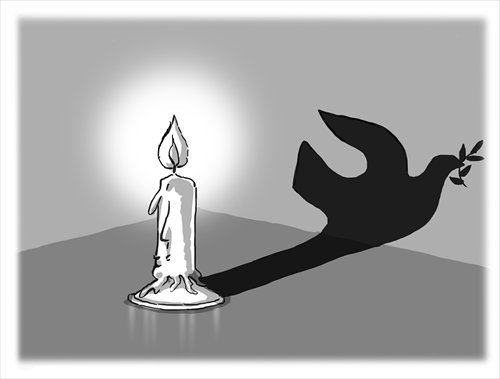
Illustration: Liu Rui/GT
In November 2005, the UN General Assembly adopted the 60/7 resolution that declared January 27 as an annual International Day of Commemoration in memory of the victims of the Holocaust.On this day in 1945, the Soviet Red Army liberated the Auschwitz death camp in southern Poland. The miserable experiences during WWII, including the Holocaust, played an important role in prompting the establishment of the UN. The UN Charter says everyone is entitled to human rights, no matter what their race, gender, language or religion.
The resolution urges member states to "develop educational programs that will inculcate future generations with the lessons of the Holocaust in order to help to prevent future acts of genocide."
As early as the 1950s, some European countries already started to introduce educational programs about the Holocaust in schools. In this regard, Asian countries have lagged behind as such education is still absent in the curriculum of primary and middle schools in some countries.
It doesn't mean that such education is not needed in Asia. On the contrary, some racist problems arising in Asia, particularly the re-emergence of right-wing thought in Japan, indicate that the absence of such education is not conducive to the harmonious coexistence of the next generations.
Since Japan was defeated 70 years ago, many appalling killings that the Japanese army staged in multiple parts of Asia have been gradually unveiled, but these atrocities are usually attributed to the nature of imperialist invasion.
If reflection on WWII misses the national psychology that led to the war, it can neither touch upon the tender spot of Japan nor bring deep and far-reaching warnings to nations in Asia.
Auschwitz was not that different from the Nanjing Massacre in China. In concentration camps such as Auschwitz, German Nazis targeted Jews and other Untermenschen ("lesser people") for murder.
In the Nanjing Massacre, Japanese soldiers similarly held an extreme racist mind-set that labeled the Chinese as inferiors.
This kind of racism, the same as that held by the Nazis, constitutes the darkest part of Japan's national mentality and pushed Japan toward the path of seeking expansion through invasion. It brought about the extreme barbarity of Japanese militarism.
History shows that confrontations between races can become more persistent, bitter and deadlier than those purely over national interests.
In today's Asia, many countries are still haunted by national disputes and racial conflicts. What happened in Auschwitz and Nanjing still comes up in some Asian places. The atrocities may be smaller in scale, but remain the same in nature.
In Myanmar, tens of thousands of Rohingya people are denied citizenship and can only live in temporary camps and shelters to escape attacks. It's been just over 10 years since sizable slaughter and robbery happened to ethnic Chinese in Indonesia.
More than 1,000 ethnic groups live in Asia, accounting for about half of the world's total. These groups have their own linguistic, religious, and economic cultures and differ in their levels of development.
In the context of globalization, the failure of nations and peoples in Asia to live in harmony with each other has become a prominent problem. Division caused by long years of colonial rule also affected the stability and development of many countries.
This year marks the 70th anniversary of the end of WWII. It will be very helpful for Asia's development if educational programs can be carried out extensively in the next generations by combining Asia's racist crimes, post-WWII peaceful development and national relations.
The next generations are obliged to always remember those who were slaughtered by fascists, who were devoted to driving out the invaders and who were committed to independence, freedom and peace.
But this is not enough. They also need to learn the evil of racism from history, which will empower them with the morals and conscience needed for the continuation of human civilization.
The author is a senior editor with People's Daily. He is now stationed in Brazil. dinggang@globaltimes.com.cn. Follow him on Twitter at @dinggangchina
Posted in: Critical Voices