Cantonese Opera 2.0
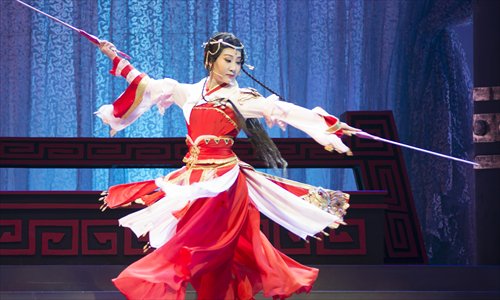
Li Jiayi performs on stage as Xiaoqi in the Cantonese Opera Fighting for the Great Tang Empire on Saturday at the Guangdong Cantonese Opera Art Center in Guangzhou, Guangdong Province. Photo: Courtesy of the Guangdong Cantonese Opera Institute
What would happen if we mixed traditional Chinese opera together with an online game?
That was the very question that came to Peng Qinghua's mind when he received a phone call from his friend Chen Jiling in July of 2013, during which Chen told Peng that she could get him the adaptation copyrights to Jianxia Qingyuan 3, an online game based on Tang Dynasty (618-907) history.
Peng, 38, is a national-level actor specializing in Cantonese Opera and currently head of a young troupe at the Guangdong Cantonese Opera Institute. After an 18-year career of traditional performances, the call sparked excited images in Peng's mind: hot blooded music played with fast drums, while actors dressed in ancient costumes fought with splendid martial arts and actresses performed water sleeve dances. Excelling in these areas, he agree to take the job to create the first traditional Chinese opera based on an online game - Fighting for the Great Tang Empire.
Peng hoped that if he succeeded in adapting such a popular game it would attract some younger audiences to Chinese opera, and succeed he did. When the full version of this experimental Cantonese opera finally premiered at the Guangdong Cantonese Opera Art Center in Guangzhou, Guangdong Province last weekend, the theater, which usually only sold around one third of its seats per performance, was completely sold out.
"For me, the most successful part of this opera is that it inspired someone like me, who can't even understand Cantonese, to take the train all the way here to see the show. It made me cheer and cry, and has now attracted me to the art of Cantonese Opera," wrote netizen Boyebei on Sina Weibo.
Breaking the rules
The adaptation took Peng and his colleagues an entire year to put together as most of the professional actors at the institute are often busy with regular performances. Much of the effort spent working on the project was made during their spare time.
Unlike a novel or a movie, the online game did not have a clear story line and lacked a real start and finish. "Our adaptation is mainly based on the Non-Player Characters (NPCs) and the world background. We developed the relationships between the roles and plot according to the game's original character design. We chose the An Lushan Rebillion from the game's time line, as the war was perfect for presenting the soldiers patriotic spirit in fighting for their country," Feng Minyi, one of the scriptwriters for Fighting for the Great Tang Empire, told the Global Times. When it came to writing the opera's main characters they chose the games more popular NPCs, such as General Li Cheng'en, heroine Xiaoqi, Taoist priest Qi Jin and healer Gu Zhilan.
Choosing a game as his foundation, Peng gained a lot of support from China's ACG (Anime Comics Games) community. Fans of the game, Chen and script writer Yang Yihong were brought in to write the script. Peng also contacted several famous cosplayers to get their advice on costumes. One of these, NADA is famous for his serious work and the delicate details of his cosplay props. He helped Peng make the armor worn by the opera's generals look as close as possible to that worn by the virtual characters in the game. Another cosplayer, Anxi Qiansui, also offered a lot of suggestions and eventually even became part of the opera itself as female general Cao Xueyang. This help from the community earned the opera an all new level of popularity among gamers.
The influence of online gaming can also be seen in the opera's music and stage setting. While usually, Chinese traditional musical instruments are used in Cantonese opera, this time the team looked to how Western music is arranged for inspiration and added some sound effects as well. The stage set made good use of several modern electronic equipment such as using multimedia projectors for onstage phenomenon, while wires were used to make the fight scenes more spectacular; all things that are usually not seen in Cantonese Opera.
Testing the waters
In addition to rehearsals, Peng also invested a lot of energy in promoting the show, such as holding impromptu street performances and giving speeches on college campuses about the links between Wing Chun martial arts and Cantonese Opera.
On August 23, 2014, the troupe attended an ACG Carnival celebrating the fifth anniversary of Jianxia Qingyuan 3 in Guangzhou, Guangdong Province. In front of nearly 10,000 game fans, Peng, starring as the main character General Li Cheng'en, performed a 6-minute piece from the opera with his colleagues.
This was the first time the opera had been seen by the public.
People were silent when the actors stepped on stage dressed just like characters from the game, but they soon started to cheer when the actors showed off their amazing martial art skills. The performance ended to the huge applause from the audience.
"Commercial performances don't usually do something like that. But we are trying something that crosses borders, and we really need feedback from our new audience," said Peng. "I was very nervous about the reaction to our show. I was afraid that it wouldn't be accepted by either game fans or Cantonese Opera experts. The only thing we could do was keep testing it."
The troupe soon tested another piece at an ACG award ceremony on September 28 and an hour long performance on December 5 last year. Both were well received.
"It's the god's truth that for opera arts to survive we have to live off the audiences' love," said Peng.
As it looks now, Peng and his opera's continued survival is a sure thing. After the premiere, hundreds of netizens left messages calling for a national tour. Peng said that they are currently still thinking about it, but for a national tour they might need to improve the script much more.