Singing the blues
Karaoke firms hit by falling popularity
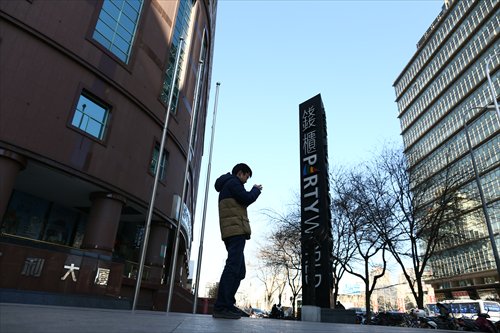
Inset: A man standing in front of the flagship branch of Cashbox Party World KTV on Beijing's Chaoyangmenwai Street Photo: IC
It used to be common for people to eagerly crowd into the flagship branch of Cashbox Party World Party World on Chaoyangmenwai Street in Beijing, even on midweek days.
But now the gates are closed and a notice has been put on a small bulletin board in front of the gates saying the business has finished.
The noted karaoke chain closed its Chaoyangmenwai on Sunday.
Feeling sad at the closure, 31-year-old Shirley Yang, a white-collar worker at a foreign-backed firm in Beijing, told the Global Times Tuesday that she remembered happy hours of singing together with her friends at the Chaoyangmenwai branch when she was a few years younger.
The branch previously raked in one-day revenues of as much as 780,000 yuan ($124,644), financial news website jiemian.com reported on Monday.
But the karaoke sector has suffered in recent years, with a number of factors chipping away at revenues.
Out of tune
At its peak in 2008, Cashbox Party World had four branches in Beijing, but the number was reduced to two in 2014, and now, following the closure of the flagship store over the weekend, there is only one left.
Currently, the KTV chain still runs six branches in the mainland, compared to 18 back in 2008, according to the jiemian.com report.
Some other popular karaoke venues such as Melody KTV and Haoledi KTV have also closed some of their branches across the country, especially in the past year, which has been seen as evidence of the challenges facing the country's KTV market.
The main reason for the closure of Cashbox Party World's flagship branch is a slump in revenues, which made it impossible for the company to renew the leasing contract signed in 2001, said the jiemian.com report, citing an unidentified source within the KTV chain.
Neither the original rental price nor the new terms asked by the property owner have been revealed.
A rise in rental costs is partly to blame, but industry watchers said it was simply the last straw for the company.
The rental cost for a karaoke establishment varies depending on its location, but generally it is not the main source of operating costs for the firms, Xu Ning, deputy general manager of leasing services at RET Rui Yide commercial real estate company in Beijing, told the Global Times on Monday.
Maintenance costs such as hiring security guards and cleaning workers are a big part of the burden for the business owners, Xu noted.
Property owners used to be inclined to offer karaoke businesses preferential rental terms in order to attract more visitors.
But now, the wider choice of businesses who want to rent the properties has curbed enthusiasm for karaoke establishments, Xu said.
Another big problem is that karaoke is not as fashionable as it used to be.
Even Yang, who used to be a frequent visitor to karaoke bars, said she only goes occasionally now.
"I would prefer to travel, or do some exercise in my spare time," she said.
One other factor applying pressure to the karaoke market has been the campaign by China's leadership against corruption and lavish spending by officials.
"The days of earning large amounts of money are over," Chen Hua, founder and CEO of Changba, a Chinese app providing karaoke services over mobile devices, told the Global Times on Monday.
Call me maybe
To survive the difficult times, karaoke firms have started to offer a range of preferential deals, such as hefty discounts posted on group-buying websites. For instance, Melody KTV is currently offering an 80 percent discount, and singing at one of its outlets costs as little as 30 yuan per hour.
But another challenge to the KTV bars has emerged in the form of apps like Changba, which cut the cost of karaoke down to zero.
Changba started in 2012 and there are already around 200 million accounts registered with the company, according to Chen.
Some users pay for various value-added services offered by the app, but most of them are using it free of charge.
A lot of people, particularly those born after 1990, have shown an interest in singing over the phone, he noted.
The app displays a real-time assessment of their performance by using a 100-point system. People can then see their ranking among all the other app users who have sung the same song.
"It's very interactive," Carlson Wang, a university student aged 20 in Shanghai, told the Global Times on Tuesday.
The app allows for singing in any place, and has diminished his eagerness to go to brick-and-mortar karaoke bars, he said.
However, even a large user base doesn't automatically guarantee big profits. Chen, the app's founder, is still seeking new ways to boost revenue.
Prior to the weeklong Chinese Spring Festival holidays, which start on February 18, Changba will open four physical karaoke outlets in Beijing, in partnership with My Song KTV, Chen said, adding that he was not concerned about the closure of Cashbox Party World's Chaoyangmenwai branch.
Over the next five years, more than 2,000 physical outlets will be opened across the country, according to Chen, who is also considering partnerships beyond My Song KTV.
"For the time being, the expansion into physical KTV space is not directly aimed at generating profits, but rather at gaining more users to provide the foundations for the firm's future development," he noted.
One of the strategies the firm will use in its expansion off-line will be cheaper prices compared to the industry average.
Charges at the physical outlets start from 25 yuan per hour, significantly lower than many of the established KTV chains.
Chen said the app's popularity will also help attract users to its off-line venues.
Meanwhile, Changba plans to groom the best of the singers using the app and develop them into professional artists by cooperating with an entertainment agency.
Nonetheless, becoming profitable "is still a long way off," Chen admitted.