HOME >> METRO SHANGHAI
The struggle for stardom
By Xie Jun Source:Global Times Published: 2015-3-15 17:43:01
China’s young hopefuls battle to find roles in acting schools
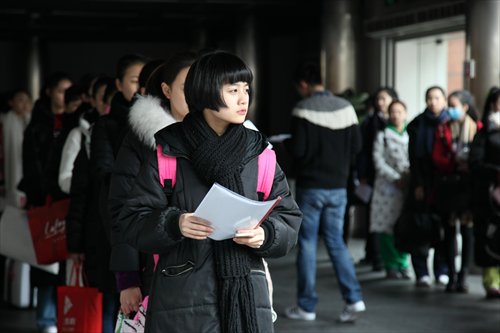
Young people wait their turn to audition at the Shanghai Theatre Academy. Photo: Xie Jun/GT
Wang Yidan is one of some 3,000 young people who have applied for undergraduate performing arts courses at the Shanghai Theatre Academy (STA) this year. This is one of the leading drama schools in China and its graduates include A-list stars like Tong Dawei and Li Bingbing.
To be accepted Wang has to pass three rounds of auditions and a general examination. On March 6 Wang had passed her first audition and was waiting, with another bunch of hopefuls, to undergo the second.
The auditions for the undergraduate acting courses at China's leading art schools - The Central Academy of Drama, the Beijing Film Academy, the Communication University of China, and the Shanghai Theatre Academy - have become a national widely publicized event.
This year only one applicant in 172 will be accepted by the performing arts department of the Communication University of China. If that's tough then making a full-time career in acting is even tougher. The Beijing Examinations newspaper reported that in 2011, 70 percent of the performing arts graduates in China had changed their career paths. But this does not daunt Wang or the others.
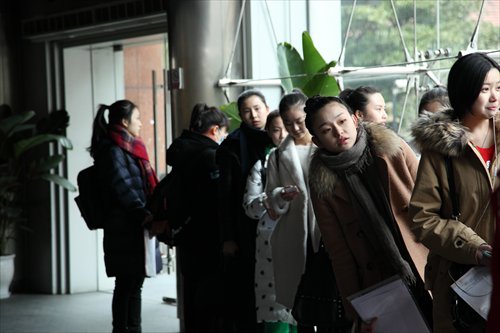
Young people wait their turn to audition at the Shanghai Theatre Academy. Photo: Xie Jun/GT
Warming up
"I didn't know the academy didn't provide costumes for the auditions," Wang admitted a little nervously. The attractive 17-year-old from Anhui was wearing a black jumpsuit with her hair pulled back in a tight bun. "I will have to dance wearing these," she pointed at her high-heeled shoes before heading to a corner of the theater and beginning some warm-up exercises.
Like many others Wang had applied for seven drama schools throughout the country and had been busy auditioning since late February. Three days earlier she learned she had failed to be called back after her second round of auditions at The Central Academy of Drama. She and her friends had a big meal out that night to "celebrate" the setback.
Wang knows full well being accepted and trained at a leading academy is a vital step towards a career in acting. "It's my dream. I don't want to become a superstar - I just want to become a good actress."
To make her dream come true Wang first has to show that she has something that the thousands of others auditioning with her have not got. It's a savage competition. This year, the performing arts department at the Beijing Film Academy will accept one in 123 applicants and the Shanghai Theatre Academy will take one in 75. It takes considerable skill and luck to get into one of these schools.
Another hopeful, Zhang Yafei, from Shenyang, took a train to Shanghai early in the morning on March 6. Like Wang, she had failed to be called back after her second audition at The Central Academy of Drama. "All the candidates I saw at The Central Academy of Drama were really good-looking," she said. "It's very hard to stand out." She had applied for a total of five academies and had just been accepted by the Nanjing University of the Arts.
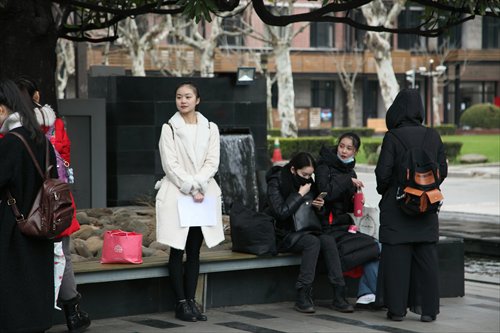
Young people wait their turn to audition at the Shanghai Theatre Academy. Photo: Xie Jun/GT
Determination a key
Determination is also a key. Lin Fu (pseudonym), a 21-year-old from Shandong, was applying to the Shanghai Theatre Academy for the second time. Three years ago he had applied, failed, and went to a local college. Two years later he dropped out of college and did part-time work with a city theater group while also looking for work in film and television.
"When I was 17, I stole 3,000 yuan ($479.35) from my dad and went to Beijing. I hung around The Central Academy of Drama for two weeks before the money ran out and I had to go home," he told the Global Times.
Occasionally he managed to score some bit parts, once appearing as a translator in the television show Old Farmer. "I found out I really needed professional training so I decided to give it another shot."
Like many others, Lin has been busy rushing about between different drama schools for auditions since early March. When he arrived at Shanghai on the morning of March 6, his luggage had not arrived with him from Beijing. "I am very tired these days, but that's also part of the appeal of this career - you get to meet new friends all the time."
One of the problems Lin was facing was that audition times for different drama schools often clashed and he had to choose which audition he would try for. "Doing the audition for the Shanghai Theatre Academy means I have to give up The Central Academy of Drama," he said with a wry smile.
A girl from Harbin had the same problem. She had applied to take the auditions in Beijing on March 7 and took a 5 am flight to Shanghai on March 6, only to discover the Shanghai Theatre Academy auditions were also on March 7. She burst into tears and pleaded with staff to change the times - "I didn't want to miss a chance." When she was later told that the audition times could not be changed she decided to miss the Beijing auditions. "I want to stay in Shanghai," she said.
Fellow candidate Lin had also decided to stick to the Shanghai Theatre Academy. "The chances of being accepted by the STA are higher."
The age limit for applicants to performing arts courses is generally 22 years old so this is the last chance Lin has. "If I fail, I will start looking for acting jobs and see if I can work something else out."
Lin's idol is Deng Chao, a famous actor and member of the National Theatre of China, who was a graduate of The Central Academy of Drama. "But I never think I will be a star like him. I just want to take one step at a time."
Lin was talking to the Global Times in the Duanjun Theatre and in the middle of the auditorium there was Sun Yizhou, a soap opera star and a graduate of the Shanghai Theatre Academy, talking to candidates about his career. "In fact acting is a very hard job," Sun told the crowd around him. "But you have to believe in yourself. If you do that you can pass auditions and become a star."
From the back of the theater Lin looked carefully at the elegantly dressed star. "When I dropped out of college many of my friends said I was ruining my life. My parents wanted me to find a stable job with a company in my hometown," said Lin. "But I just can't give this up. Acting gives me a thrill."
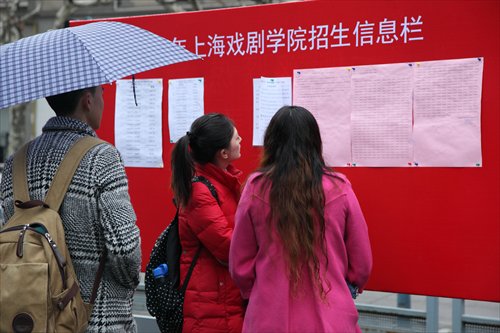
Anxious candidates look for their names on the lists for the next auditions. Photo: Xie Jun/GT
Harder and harder
As thousands of young people battle each other for places in drama schools throughout China, the career path for actors has never looked less promising. "It's harder and harder nowadays for youngsters to get into a good academy to study acting," said Zhang Shengquan, a professor at the Shanghai Theatre Academy.
A candidate looking to complete a performing arts major has to undertake three rounds of auditions. At the first audition candidates have to sing and read a prepared article. At the second audition they have to improvise and perform a given scene. The third audition involves longer performances that include singing, speaking, movement and acting. "We weed out a large number of the candidates in the first round and leave around 200 to be tested in the second and third rounds," Zhang said.
With acting courses becoming increasingly popular in China, there have been reports that some of the panelists who select the candidates for the courses have shown bias in the past. "The examiners had tended to favor candidates that they had been coaching themselves. This year, the Shanghai Municipal Education Commission has stipulated that candidates' coaches cannot be appointed as panelists. We had one tutor who had a student auditioning this year and he volunteered to drop out of the panel," Zhang said.
Zhang said that for the first audition there were five assessors on each panel. Each had an iPad with details of each of the candidates. After each applicant ends their audition, the assessors record their votes on their iPads. If three of the five assessors vote for a candidate, he or she will go through to the next round.
"The assessors are not allowed to discuss the performances among themselves," Zhang said. "If one of the panel is a famous teacher he might unfairly influence the others."
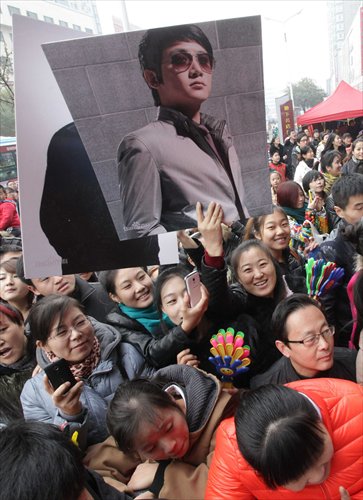
Fans crowd outside a venue hoping to catch a glimpse of their idol. Photo: IC
An advantage
To some extent, graduates of the major drama schools, like the STA, have an advantage. When Chinese star Lu Yi was a sophomore at the STA he was selected by director Zhao Baogang to star in the television series Never Dies Content. Gong Li was picked by director Zhang Yimou for his highly acclaimed film Red Sorghum when she was a freshman at The Central Academy of Drama. Both of them were catapulted to fame with these moves.
However that's not the norm. Zhang regularly warns his students that only a few will become stars. "In 1995, the acting class which included Lu Yi, had 23 students. Only four or five have made a name for themselves so far." Most acting school graduates have problems finding work.
Zhang said that many of the graduates of the STA also had to change careers. "Some became drama teachers for children. Some have become office workers. Some opened their own wedding companies. Cai Guoqiang, one of our stage design graduates, has become a noted artist. There are plenty of possibilities."
Those who dream of an acting career, however, need a bit of luck to find stable employment. In China a few actors and actresses can find regular employment with established national or regional companies like the Shanghai Film Factory, the Beijing People's Art Theatre or the Shanghai Dramatic Arts Centre.
But only a small number have this sort of luck. "Of the 30 or so acting graduates from our academy every year, only four or five will be employed as actors by one of the big companies," Zhang said.
The rest have to drift along finding occasional parts in movies or television. "If they aren't famous, their income is random and sometimes minimal. One of our acting graduates, Liao Fan, was a latecomer to stardom. He was largely unknown until he was in his forties. You can never tell. Success in acting is mostly a matter of luck."
Tian Fang (pseudonym) is an STA graduate and confirmed that being a professional actress was an insecure way of life. To support herself she has worked in several non-theatrical jobs like becoming a magazine journalist. Now she has a full-time contract with the Shanghai Children's Art Theatre. "I don't make a lot of money from this but being employed by a company like this gives me a sense of security."
Posted in: Metro Shanghai, City Panorama