Powering up
Rolls-Royce pursues greater efficiency, innovation
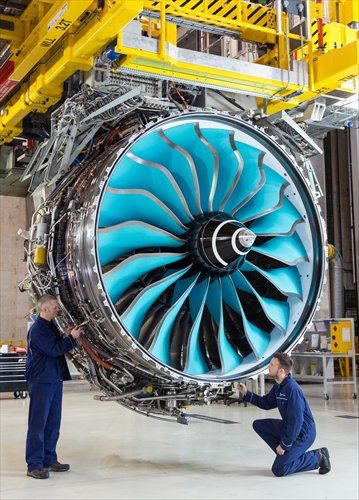
Rolls-Royce's future engine design Photo: Courtesy of Rolls-Royce

Paul Stein, chief scientific officer of Rolls-Royce Photo: Courtesy of Rolls-Royce
Earlier this month, Rolls-Royce announced that it had been selected by Turkish Airlines to supply Trent 700 engines and long-term service support for four Airbus A330 freighter aircraft.
As a company with about 40 percent of its business in what it calls "land and sea" and the other 60 percent in aerospace, Rolls-Royce focuses on making large engines for wide-body aircraft such as the A330.
The deal with Turkish Airlines shows the global market's continued demand for the aircraft, as well as for the Trent 700 engine, which was launched 20 years ago.
Plane manufacturers now hold a more cautious attitude toward aircraft development, so engine makers must adapt to the market demand. It's necessary to have "a more open attitude about the road map for new products planned beyond current products," Paul Stein, chief scientific officer of Rolls-Royce, said in a group interview in Beijing on March 13.
"We want to show our customers and shareholders that we are not finished with innovating; it is a journey that continues forever."
According to Rolls-Royce, the Trent 700 engine has won more than 60 percent of new orders worldwide over the last three years and accounts for a similar percentage of future A330ceo deliveries.
In 2014, Airbus showed its plans for the A330neo aircraft at the Farnborough Airshow. The plane will be powered exclusively by the Trent 7000 engine, the latest addition to Rolls-Royce's Trent family.
The Trent 7000 provides a 10 percent improvement in SFC (specific fuel consumption).
In October 2014, Rolls-Royce announced two next-generation engine designs, called the "Advance 3" and the "UltraFan."
"We have been increasing the efficiency of our engines by about 1 percent per year for the past 15 years. So even though there has been a temporary relaxation of oil prices recently, we don't really expect that pressure ever to be reduced," Stein said, adding that the company is now working with plane makers including Airbus on distributed electric propulsion designs for the future.
It remains the case that the time between the announcement of new designs and selling them can be quite long, so Rolls-Royce must still sell and make a profit from today's engines while designing tomorrow's ones.
For example, the Trent XWB engine, which has been developed exclusively to power the Airbus A350XWB, took some eight years to get from concept development, through critical design and flight tests before finally entering into service.
"The challenge is to change what we need in order to be innovative at every step," Stein said.
"In the first phase we may use innovations to come up with new functionality to address the unmet needs of our customers, so we may come up with a brand-new approach to the design of the engine that has not been used before. In the next phase, we might use innovation to drive costs down. And in the service phase we use a lot of innovation for improving our services for customers," Stein said.
"If you are in the aerospace business you have to be patient, because things don't happen overnight."
Made in China 2025
In the government work report he delivered at the annual session of the National People's Congress (NPC) on March 5, Premier Li Keqiang outlined guidelines for "Made in China 2025," an initiative that emphasizes green and innovation-driven development, application of smart technologies, and an effort to upgrade China from a big manufacturing country to a strong manufacturing power.
Insiders said the Made in China 2025 strategy can be likened to Germany's "Industry 4.0," a plan that was created to spur progress in Germany's industrial sector.
According to Stein, there is no one single killer technology in manufacturing - instead there is a spectrum of new techniques and new ways of interconnecting machines in order to bring about a revolution in manufacturing technology.
Speaking about how China might draw inspiration from Industry 4.0, Stein said the concept "represents the collection of all those techniques coupled with the drive to keep quality, costs and delivery at the best in class."
"So my advice is to regard 4.0 manufacturing as a complete system, not as an individual collection of technologies," he said.