Strolling on Wuxing Road
Street takes you on a trip that includes history and culture
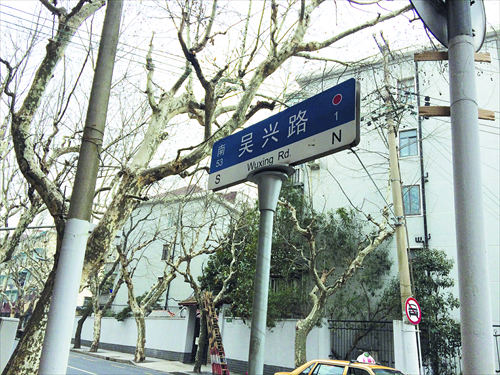
Located in Xuhui district, Wuxing Road is a one-way street that starts at Huaihai Road Middle and crosses Kangping Road, Hengshan Road and Jianguo Road West to end up at Zhaojiabang Road.
Photos: Hu Bei/GT
Wuxing Road is a typical former French concession street, with its mixture of two- to three-story old garden houses, villas and residential buildings beneath canopies of trees. Each of these buildings has its own history and charm, and among them are plenty of hidden spots of exceptional beauty.
Counter service
Behind a red door flanked by bamboo trees, Kappo Yu is a Japanese kaiseki restaurant on 33 Wuxing Road (6466-7855), near Huaihai Road Middle.
Its name ("Kappo" means counter in Japanese) refers to the 10-seat curved red counter at which customers can sit. There are also two private tatami-mat dining rooms.
The delicate and subtle setting is also reflected in the restaurant's food and cooking style. It has a range of seasonal premium Japanese dishes marked by their consideration for balance, texture and even temperature.
Established by Tokyo-born executive chef Yohei Terada, who used to cook at top Tokyo restaurants like Nadaman and Nobu, the restaurant offers a 10-course menu which changes every day depending on the availability of the fresh ingredients shipped directly from Japan. The 10-course set meal costs around 690 yuan ($111.06) per person.
The diner opens from 6 pm to 10:30 pm Monday to Saturday and reservations are taken from 3 pm onward.
Classic conversion
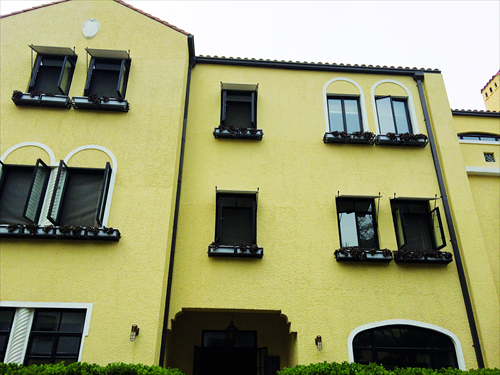
No.83 and 85 Wuxing Road is a stand-alone Spanish-style garden villa (pictured above) with an attached Sino-Western style Buddhist worshipping hall.
Built in 1938, the three-story house of brick-and-concrete composite has yellow washed exterior walls and double-lined terra cotta roof. Within lies a center courtyard, romantic balconies, fancifully shaped columns and wrought iron details.
The villa was originally owned by the Rong's family, which was one of China's most renowned tycoon families during the 1930s and the 1940s. Notable members include famous industrialist Rong Hongren, and former Chinese vice president Rong Yiren, who held the office from 1993 to 1998.
Retaining most of its original features, the villa was converted into a boutique hotel last year.
It has 15 separate guest rooms that range in price from 1,888 yuan to almost 4,000 yuan per night. The attached Buddhist hall now serves as the hotel's massage club.
Typewriter museum

Passing through an array of old residential houses, 248 Wuxing Road is home to the Hanbin Lu Typewriter Museum.
It is housed in a two-story, French-style building with white doors and windows.
In the 1990s, while traveling around Europe, the owner of the house, a Chinese-Czech man called Hanbin Lu, began to collect typewriters. In 2010, he brought nearly 300 typewriters of some 32 different brands and 14 different languages to Shanghai and founded the museum.
As well as old typewriting machines, there's also an old-fashioned, free-standing camera in the museum that appeared in the 2009 Chinese movie The Founding of a Republic. The film was made to commemorate the 60th anniversary of the founding of the People's Republic of China.
The museum doesn't charge for entry and is open from midday to 5 pm. It also regularly holds art events.
Silk on display
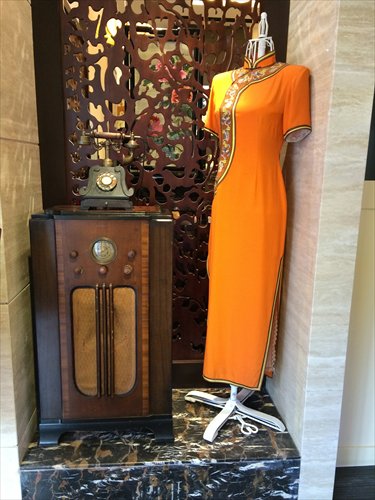
Shanghai Silk Culture Development Company at 277 Wuxing Road (6473-2388) offers the chance to purchase good-quality silk, satin, damask, brocade, velvet and muslin. Most of the fabrics are delicately embroidered in the style of traditional Chinese painting.
The outlet also has a showroom in which visitors can see how silk is produced and learn about Shanghai's history as one of the country's most important points of silk manufacture and export.