True love, marriage and mortgages
Shanghai’s regulations and traditions make it tough for young couples
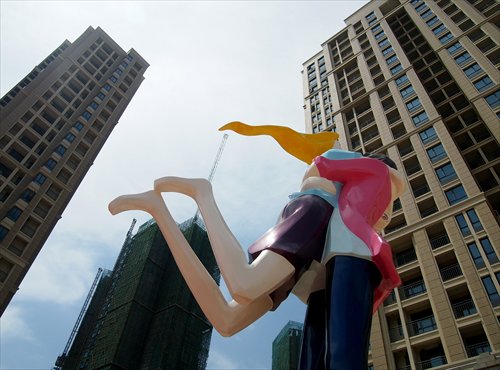
It has become a tradition in Shanghai that a man and his family must purchase a home before he gets married. Photo: CFP
There is a tradition, an unwritten law even, in Shanghai that when a couple gets married, it is the responsibility of the husband-to-be and his family to provide the home for the couple, and the responsibility of the wife-to-be and her family to provide the car and furniture.
But this tradition can be a threat to a "happy ever after" dream. William Bu works as an IT engineer in Shanghai. He met his girlfriend in college in Shanghai, and they have been together for almost six years. In 2012, he proposed to his girlfriend. But after meeting Bu, the girl's parents demanded that he own a house before they would approve the marriage.
Bu is the victim of revised legislation introduced in Shanghai in 2012. "When I graduated in 2010, I didn't have enough money to put a deposit on an apartment," he told the Global Times.
The new legislation bars anyone who is single and doesn't have a Shanghai hukou (household registration) from buying property in the city.
Coming from Jiangsu Province, Bu doesn't have a Shanghai hukou, so he can't buy a house in Shanghai. The bitter irony is that if he was married to his girlfriend, he would be allowed to. But the girl's parents are adamant and refuse to let her marry unless he owns property.
"According to the unwritten rules in Shanghai, the family of the man has to provide the housing, and the family of the woman provides a car, and then a marriage can go ahead. Because of these rules and restrictions I can't buy an apartment."
Wedding on hold
The wedding plans have been put on hold because he lacks a house. But does owning a house bring happiness? Not according to a report in sh.house.qq.com, the housing section of one of the largest Internet service portals in China. This story featured a man surnamed Zhou who, for his marriage, bought an apartment in Pudong New Area in May 2014. The apartment was worth 2.5 million yuan ($402,325). Both Zhou and his girlfriend's parents paid the deposit but the young couple now has to meet mortgage repayments of 12,000 yuan a month and this leaves them just 3,000 yuan a month to live on.
They can only afford to buy discounted clothing and they use public transport keeping their travel costs below 400 yuan a month. They dare not have a child knowing they would not be able to properly provide for a baby.
"Many of my colleagues envy me for I have a house and a wife. If I tell them I'm too stressed all the time because of this they would think I was being hypocritical," Zhou said.
The "tradition" of buying a property to ensure a marriage was approved began in the mid-1990s, after the opening-up policy had been introduced and people were earning more, explained Shen Liang, the owner of the Jiangnan Marriage Customs Museum.
"In the past, wealthy families built houses for their children so they could marry. Not so wealthy families would set one room aside in their houses when their children married. In the 1970s and 1980s, Chinese employees had apartments assigned to them by their companies or official institutions. In the 1990s, when the market economy allowed individuals to buy houses, buying a house for a marriage came into fashion," Shen told the Global Times.
A status symbol
Parents want their children to have a house or an apartment when they get married, mostly out of love and their desire that they enjoy a good material life. In the East, parents try their best to arrange stable lives for their children. They do this at any cost, like paying the deposit on a property for them. It also shows the family has status if the children have a home when they marry.
Shu Xin is the director of the National Research Center for Marriage Counseling Services and said that now in China, family life cannot be separated from housing - there is only a family home when there is a house.
Chen Mingwei, an agent with Centaline Property told the Global Times that more than 30 percent of the properties sold in Zhangjiang Hi-Tech Park, Pudong New Area were bought as part of marriage settlements in 2014.
On half of these houses, Chen said, the deposit was paid by the man and his parents, and one-third of the houses were jointly bought by both families.
Properties in Zhangjiang have been quite popular in recent years. It is the base for several high-tech companies. Compared to Pudong New Area, Putuo district is not as popular for young couples. Gu Junjian, an agent from http://www.iwjw.com/, an online real estate agency, told the Global Times that only 10 percent of the apartments sold in Putuo district were for marriage settlements. "More people buy 'marriage' apartments in Pudong New Area, Jiading district and the middle of Shanghai," Gu said.
In most of the deals Gu has been involved with, parents have paid the deposit leaving the young couples to continue making the mortgage repayments.
"Once I had a case where the deposit on an apartment was paid by the parents of the man and they demanded that this be stated clearly in the property deeds. At first, the woman's family objected to this as their daughter would be helping pay off the mortgage but in the end they compromised," Gu said. If this couple were to divorce, the fact that the man's parents paid the deposit would be taken into consideration when the assets were divided.
Gu said that in many other places in China, this division of initial rights to the property is not so important but in Shanghai, where the prices of property are so high and where couples need help from their parents to buy a home, it becomes more complicated.
Lawyers involved
The complications mean that there are disputes and when there are disputes lawyers have to become involved. Qin Ling is a conveyancing lawyer with the Shanghai Yanzhi Law Firm and said there were many disputes over properties bought for marriages. Often disputes involved cases where the man had the deposit for a property but was not allowed by law to buy it himself. "So the apartment is registered in the woman's name. Now if they decide not to marry or if they want to get divorced there can be a big fight over the ownership. But even understanding this people still want to buy apartments as part of a marriage settlement."
A survey by zhaopin.com, a leading Chinese employment platform with consulting and human resources services, showed that in 2014, 16.18 percent of the 2,480 office workers polled in Shanghai believed that they would only get married after they or their spouses had bought a property. More than 41 percent believed it was better to own a property before getting married or to buy a property shortly after getting married. That is to say, 57.36 percent of these Shanghai office workers wanted a house as part of the marriage settlement.
But in Shanghai, especially, this is costly. The zhaopin.com survey showed that in 2014, 14.71 percent of office workers in Shanghai bought apartments for between 10,000 yuan to 15,000 yuan per square meter. About 8.8 percent bought apartments for 15,000 to 20,000 yuan per square meter, and 26.46 percent bought property for 20,000 yuan or more per square meter. The survey concluded that 52.94 percent of the city's office workers needed their parents to help them buy their homes.
The Jiangnan Marriage Customs Museum's Shen said there were people who were getting married who didn't own an apartment in the city but that was essentially because they couldn't afford to buy property.
Main issues
"In China, houses, cars and money are the main issues in a marriage. They will become more and more important, becoming a real burden for Chinese parents in the future," Shen said. Few young people can afford a deposit on a house before they have turned 30.
The Marriage Counseling Services Center's Shu said while parents who have some savings can help their children purchase homes, parents without much saved have to borrow from relatives and friends. The young couples have to battle to pay off mortgages and many daren't have children because of the financial burden.
Shu said young couples didn't have to buy houses when they got married - they could rent. Then if they changed employment they could move more easily without a property holding them down. When their finances improved they could then buy a home. "There is no need for them to pay mortgages for the rest of their lives just for a wedding day."
Buying a home at a young age is not only an economic burden on the families, but also a barrier to the development of society, said Deng Weizhi, a retired professor at the School of Sociology and Political Science, Shanghai University. "The homeownership rate in the US is 70 percent. But the homeownership rate in China is 85 percent, higher than the US. This is not a good sign. Usually, a lower homeownership rate means that the society has more mobility, and thus more economic development and civilization. The high homeownership rate in China indicates that the mobility of people is poor. This does not help with the economic development of China or the development of society."