Modern metempsychosis
Play revisits Taoist philosophy with narratives split across time
There are a thousand ways to talk about the ambiguity of reality and illusion, but around 3rd century Taoist philosopher Zhuangzi put it succinctly when he said: "Now I do not know whether I was then a man dreaming a butterfly or whether I am now a butterfly, dreaming I am a man" on waking from a dream in which he was fluttering hither and thither.
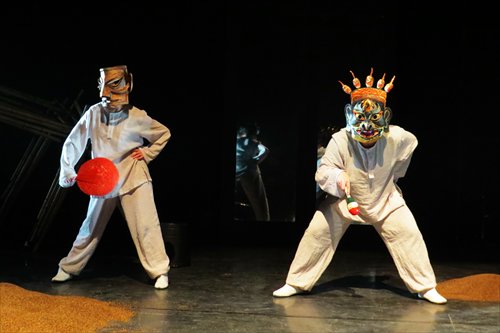
A scene from the play
Yet another metempsychosis - or movement from the soul into a different bodily form - is at the heart of journalist-writer Pang Bei's new 90-minute play Mr Zhuang. Like Zhuangzi himself, the production team tries to address complexity with simplicity.
The title character is a modern-day associate professor and Zhuangzi researcher. He is unhappily caught in academic bureaucracy and marital betrayal. In a parallel story line, Zhuangzi appears in comparable scenes from his own time.
Making the multi-narrative understandable and approachable was a major challenge for the director Huang Kai (pictured below).
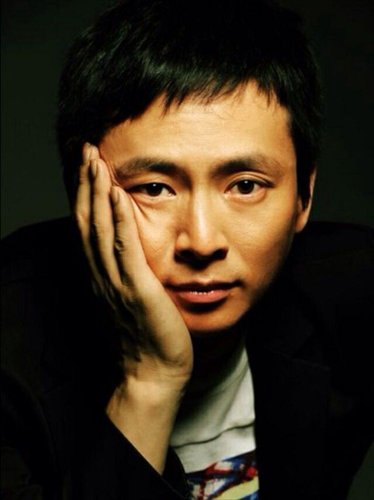
"The number of scenes in the script is comparable to that of an average film. They are constantly changing, sometimes with very short intervals. Also, it is difficult to make the two story lines feel coherent," Huang told the Global Times.
"It is down to the efforts of the actors, choreographers, lighting staff and literally everyone on the team to make the changes smooth," Huang said. "I am happy to have found a good interpretation, one that is both concise and coherent."
One in two
Some of the audience at the play's Beijing and Shenzhen renditions suggested the work encourages people to wonder aloud if Zhuangzi is a dream of Mr Zhuang's, or even vice versa, clearly echoing the butterfly dream.
For Pang Bei and Huang Kai, Zhuangzi and Mr Zhuang are in fact one person in two time dimensions. Both embodiments are played by Pei Kuishan.
"This is my interpretation after reading and rereading the script. I've come to see Zhuangzi/Mr Zhuang as an ordinary man who is fleshy, tangible and relatable, instead of a highbrow whose intellectual world we aim to introduce the viewers into," Huang said.
To get the audience on the same page, Huang wanted to avoid making Zhuangzi's story line contrived by ensuring the allusion-loaded tale developed naturally. He did this by presenting it as a diary of Zhuangzi's inner thoughts and spiritual journey.
"In this way, we help the viewers ignore the fact that they are literal quotations, and try to put them in the character's shoes so they can understand why he wrote what he did," Huang said.
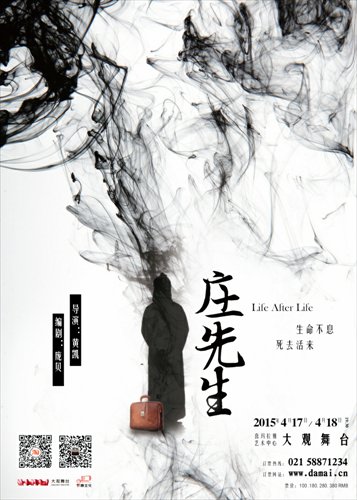
A poster for the play Photos: Courtesy of DaGuan Theatre
Inner investigation
Zhuangzi and his writings are well-known for his detachment from the drive for status and material wealth. However, in the play, he openly displays frustration and irritation on his way to his realizations. Meanwhile, the audience wonders if Mr Zhuang can achieve the same.
Pang believes the work is an answer to what he calls a modern spiritual crisis. "We might be rescued from such a crisis if we look for remedies in the cultural resources of earlier ages," Pang said when the play premiered in Beijing last December. "My message is that salvation is possible on the premise that you choose to exist as a human being, not just a living being purely driven by material desires."
Pang's script has been praised by established film critic Zhou Liming among many others.
Pei Kuishan, the lead actor, said it shows more than ideas and talent. "It takes a lot of courage to take these real-life push and pulls to the stage," Pei said.
Huang said Pang's story is unique in today's Chinese theater. "Nowadays, plays rely heavily on bizarre plots and bold visual effects to attract viewers, but this script shows little consideration of such things. It focuses on inner feelings and expressions instead," Huang said.
It took Pang Bei six years to write the play, during which time he studied Zhuangzi and his classics, in the same manner as Mr Zhuang does for a living. He might see himself in both Mr Zhuang and Zhuangzi.
We are all welcome to experience that oneness and transcendence, even if it is just for a fleeting second or two.
Date: April 17 and 18, 7:30 pm
Venue: DaGuan Theatre
Address: 3/F, Zendai Himalayas Centre, No.1, Lane 1188 Fangdian Road
芳甸路1188弄1号证大喜马拉雅中心3楼
Tickets: 100 yuan ($16.10) to 380 yuan
Call 5887-1234 for details