Sweep treats
Qingtuan season hits in the run-up to Tomb-Sweeping Festival
Qingtuan (green dumplings) are a specialty of Southeast China. Originally eaten as part of ceremonies to honor ancestors, qingtuan are traditionally eaten by Shanghainese around Tomb-Sweeping Festival.
Qingtuan are made from glutinous rice mixed with wormwood and stuffed with red bean paste. The bamboo steamers in which they are cooked are lined with reeds to add a delicate fragrance.
As Tomb-Sweeping Festival approaches, many street vendors and restaurants are selling qingtuan. Some are sticking with tradition by selling regular, sweet qingtuan, while others are being more adventurous. The Global Times has looked at some of these variations on the qingtuan theme, and selected some of the best.
Wormwood wrapping
Traditionally, qingtuan's wrapping includes wormwood. However, the high demand for qingtuan around Tomb-Sweeping Festival means many makers use wormwood powder or green wheat juice instead.
However, Shanghai Wangjiasha (805 Nanjing Road West), a traditional snack brand, still uses wild wormwood. Three years ago, their food team found a type of wild wormwood in the mountainous areas around Ningbo in Zhejiang Province and used it to create their own wild wormwood qingtuan, which proved to be very popular.
These qingtuan (pictured below) differ from others in that they are olive in color and don't look as shiny as regular qingtuan. However, their taste is fresh and exceptional.
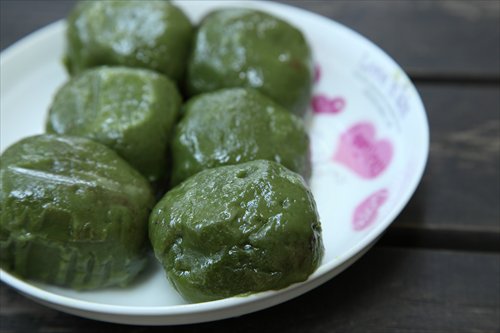
Usually, Wangjiasha qingtuan have several types of stuffing. Red bean paste is the most popular. Wangjiasha uses a special type of red bean from Haimen in Jiangsu Province, which is extremely soft. Also available are wild vegetable qingtuan and egg yolk qingtuan.
Shepherd's purse
Shepherd's purse is a vegetable that comes into season in early spring and is used in Shanghaiese dumplings. Famed snack brand Shendacheng (636 Nanjing Road East) uses it to stuff qingtuan (below). The fragrance of the shepherd's purse mixed with minced pork gives a truly unique taste experience.
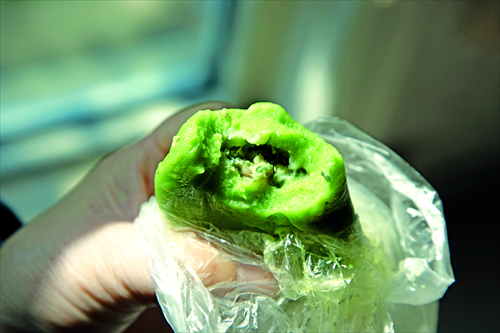
Shendacheng also serves traditional qingtuan stuffed with red bean paste. Their red bean paste is so delicate and smooth that it is almost like juice rather than paste. Its mildly sweet taste is also a must for qingtuan lovers.
While most shops in Shanghai only sell qingtuan in packages, Shendacheng sells them singly. However, be prepared to queue at the popular city center branch shops like the one on Nanjing Road East.
Assorted stuffing
Many local people have heard of Guangmingcun (588 Huaihai Road Middle), an old restaurant famous for their prepared food that also sells good snacks. Every year in the run-up to Tomb-Sweeping Festival, Guangmingcun sells three types of qingtuan: red bean paste, purple yam and assorted.
The assorted stuffing qingtuan (below) are Guangmingcun's specialty. The stuffing is made of dried turnip, dried shrimp meat, pork and mushroom.
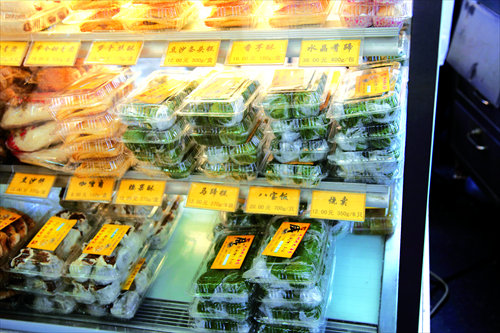
Tomb-Sweeping Festival is the time when qingtuan are traditionally enjoyed. Photos: Xie Jun/GT
Ancient towns
Qingtuan are readily available in the old towns in the suburbs of Shanghai, like Zhujiajiao and Qibao.
Zhujiajiao is one of the few places in Shanghai where you can pick wild wormwood. In early April you will see many local residents harvesting wormwood in large bamboo baskets.
Shops selling fresh qingtuan are easy to find in Zhujiajiao, and you can often watch them being made and try a sample. Most of the qingtuan are stuffed with red bean paste, but occasionally other stuffing such as sesame, soybean and pork can be found.