HOME >> CHINA
Not a miner problem
Source:Global Times Published: 2015-4-7 19:33:01
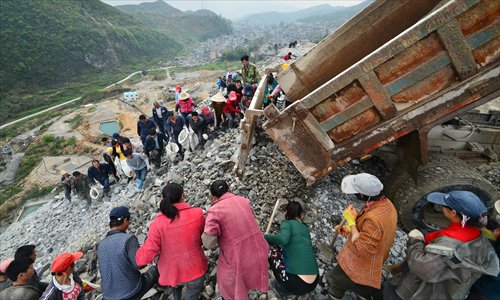
The miners circle around a pile of waste rocks, just unloaded from a truck. Photo: CFP
Scouring rocks for ones that might carry minerals and crushing them with hammers - this primitive way of mining is still practiced at the Yaogangxian tungsten mine in Chenzhou, in Central China's Hunan Province.The people doing the work are not professional miners, but farmers from nearby Yizhang and Zixing counties who make a living mining on the waste rocks and tailings from the mine. The local authorities have turned a blind eye to their mining activities.
With an area of over 23 square kilometers, the Yaogangxian mine, located in the mountains between Yizhang and Zixing counties, is the largest tungsten mine in China, producing over 3,000 tons of tungsten concentrates in 2014. It has rich deposits of wolframite, stannite, ferberite, among others.
Most of these farmers are searching for wolframite, which are highly valued as the main source of tungsten, a strong and dense material with a high melting temperature. Tungsten can be used for electric filaments and armor-piercing ammunition. China is the largest miner of tungsten, accounting for over 80 percent of its global production.
Earning an average income of 2,000 yuan ($323) a month, these farmers live in makeshift tents in the rubble and wait for trucks loaded with waste rocks to arrive every day.
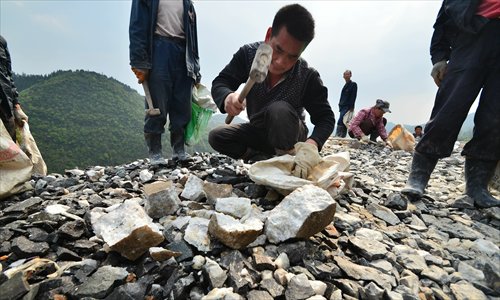
A man crushes a rock with a hammer, but finds nothing. Photo: CFP
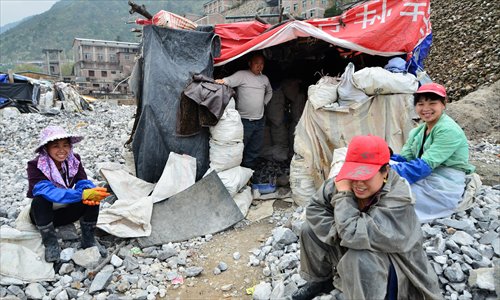
The miners take a rest outside a makeshift tent made of twigs, cardboard and rags. Photo: CFP
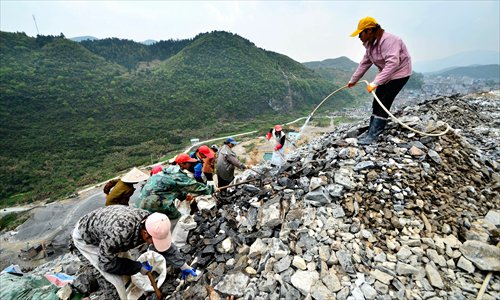
Climbing onto a small hill of waste rocks, the miners hunt for usable ore. Photo: CFP
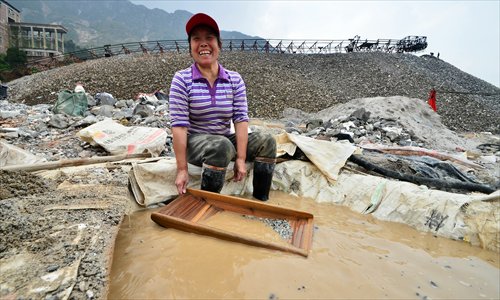
A female miner shows her finds for the day. Photo: CFP
Posted in: In-Depth