Channeling an icon
TV station faces uphill climb in bid to launch Lei Feng-themed programming
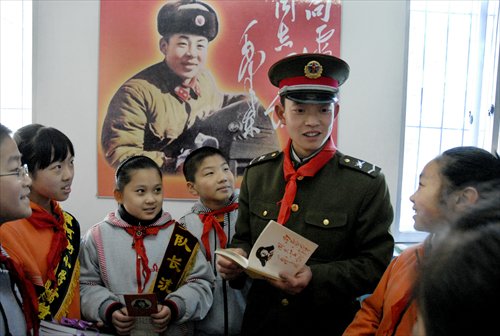
A soldier from the unit where Lei Feng served in Fushun, Liaoning Province, shares stories about Lei with students. Photo: CFP
The TV show's first scene shows a middle-aged woman lighting a kitchen fire with sticks. The view suddenly cuts to a bed where the woman is giving water to an elderly person. The last scene shows an elderly woman waving goodbye.
The shots are all part of a TV program broadcast by the newly launched Lei Feng Channel in Fushun, Liaoning Province. The middle-aged woman in the program is a local village official who often helps older villagers.
The channel, which was launched on March 25, and claims to be the first TV channel in China exclusively devoted to promoting Lei's spirit says it only reports good news and good deeds. Stories of good Samaritans are broadcast many times a day out of its studios in Fushun.
Fushun, where Lei served in the military, has been dubbed his "second hometown." Lei was born in Hunan Province in 1940, and in 1963, a year after his death, w country launched a nationwide "Learn From Comrade Lei Feng" campaign.
Each day the channel broadcasts six one-hour programs, which are replayed later that day and early the next day.
With a total broadcasting time of 18 hours every day, the channel also includes non-Lei Feng-related TV dramas and documentaries.
"We [want to show] good and positive things, not dark things like murders or fires, so people can feel comfortable after watching," Shang Zeyou, the head of Fushun Broadcasting and TV station, told the China Youth Daily on April 8.
However, the channel has been struggling to gain traction, and a number of observers have said the channel is mostly commercial hype, with very limited social significance.
Spreading positive energy?
Only people in Fushun can watch the channel on TV. Viewers in other cities have to watch online.
On one news program, Sunshine Information, a female anchor begins her report with "reporting good things every day!"
After a report on the female village official, the program moved on to reporting the income of local residents, citing an unnamed survey to show that the city's income growth rate is the third highest in the province. The end of the program included interviews with city residents on what the Lei Feng spirit means to them, and finished by showed several dirty dustbins, calling on residents to stop littering.
A program hotline was displayed on in the bottom-left corner of the screen throughout the show. The number went unanswered when a Global Times reporter dialed several times.
An employee with the station surnamed Zhao told the Global Times that Shang decided to suspend all the interviews because of mixed public reactions to the channel. "Due to limited manpower, we have not achieved ideal conditions."
"We went through a year of planning before launching the channel. The Fushun government invited experts a number of times to consult on researching and designing the programs," Shang said.
The TV station prepared eight program samples for review before the launch, and Shang and his colleagues even went to Beijing for discussions a few days before the Spring Festival.
Shang said the channel focuses on moral guidance and serving the people's livelihood. "On the content and positioning, experts agreed that the channel should meet viewers' demands rather than reporting something political or conceptual."
A producer of the channel, Zhu Yikui, told the China Youth Daily that citizens would pay more attention to positive energy in society if media reported on it more frequently.
The good people and good deeds reported by the program are chosen and recommended by different local government organs, but Zhu has found himself annoyed that most departments have recommended stories with strong similarities - only the names of the characters are different.
So the Good Samaritan segment's frequency has been dropped from one broadcast every day to twice every week, according to Zhu.
"We have to ask interviewees to re-enact their good deeds so we can film it," Zhu was quoted as saying.
In the past two weeks, the segment reported the story of a young volunteer teacher on five consecutive shows.
Shang was glad that many companies have showed interest in advertising on the channel, but said he would be strict in choosing high-quality advertisements. "Otherwise, it's defaming the name of Lei Feng," he said.
In 2012, a group of young soldiers in Fushun were overwhelmed by criticisms from Net users who accused the squad of posting propaganda on its "Lei Feng" microblog. The account was shut down soon due to criticism, Southern People Weekly Magazine reported.
Commercial hype?
Yu Guoming, vice dean of the School of Journalism and Communication at the Renmin University of China, told the Global Times that good news like that of the Lei Feng channel can generate only limited positive value for society.
"A channel with original programs lasting only one hour cannot be a TV channel. It's just commercial hype," said Yu, adding that positive programs can be broadcast on other TV channels that already exist.
Society needs positive things, he said; but more importantly, it needs media to reveal problems and discuss possible solutions.
The Lei Feng channel set up an official Weibo account on January 19. So far it has less than 300 followers nationwide. Very few of the channel's posts attract comments or reposts.
Zhuang Xihai, a former TV host and producer who is now a professor at the Southwest University of Broadcasting in Chongqing, echoed Yu.
"Today you have a TV channel named after a public figure, tomorrow you can have more such channels bearing other public figures' names, but they cannot achieve the goal of educating people," Zhuang told the Global Times.
TV channels follow market rules, and they need advertisements and a strong and steady viewership to compete, Zhuang said.
In an networked society like China, information distribution relies heavily on new media. The Lei Feng Channel, which can be watched mainly by local residents, is not paying enough attention on the vast number of netizens, Zhuang told the Global Times.
Even Fushun residents do not watch the channel often. Some have never even heard of it, China Youth Daily reported.
According to Zhuang, such Lei Feng-theme channels should be launched by the central government rather than a local TV station, since Lei Feng is not a local, but a national figure.