Shadowy figures
Silhouette portraits return to the limelight
Decades ago, one of the most popular street crafts in Shanghai was silhouette portraiture. Artists would create silhouettes of their subjects using paper. The portraits made popular gifts and souvenirs.
Although silhouettes have been eclipsed by cellphone selfies on the streets of modern-day Shanghai, one man is trying to preserve the art and make it more relevant to today. His name is Li Jianguo, and he has developed a new style of silhouette portraiture in an effort to appeal to modern audiences.
His creations have been serialized in the Xinmin Evening News since 2006, and his designs have been used on stamps, postcards and transport cards.
A new set of stamps and city tour cards featuring his Shanghai-flavored silhouettes will be issued by the Shanghai Philatelic Corporation this Sunday in celebration of the 15th World Intellectual Property Day.
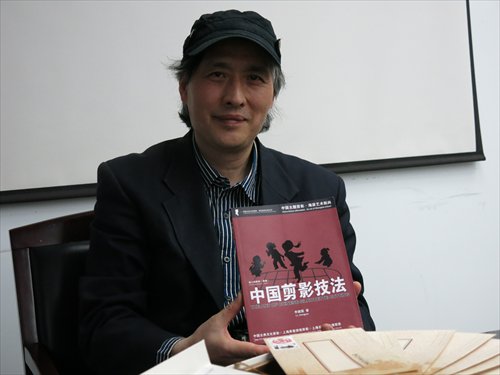
Silhouette portraiture artist Li Jianguo with his book on the techniques of his art Photos: Du Qiongfang/GT and courtesy of the artist
Silhouette cutting is a branch of paper cutting that originated in the Han Dynasty (206BC-AD220), when it was used to make the materials for shadow plays.
The Yuan Dynasty (1279-1368) introduced shadow plays to the West.
Europeans replaced the donkey and bull skins that were used by the Chinese with cardboard, and silhouette portraits became a popular art in the West.
The art form was brought back to Shanghai by well-known journalist Ge Gongzhen, who traveled to Europe in the 1920s and published a picture of the cardboard silhouettes he had seen in Paris in the Shanghai News.
Li was introduced to the art by Wan Laiming, the Chinese cartoon industry pioneer, director of famous cartoon Havoc in Heaven (Danao Tiangong), and the director of Shanghai Animation Film Studio. Wan had seen Ge's silhouette picture and decided to try making his own. He went on to create silhouette portraits of many Chinese celebrities.
Li joined Shanghai Animation Film Studio in the late 1970s, and worked in the silhouette film department. He also helped create the famous Chinese cartoon series Hulu Xiongdi.
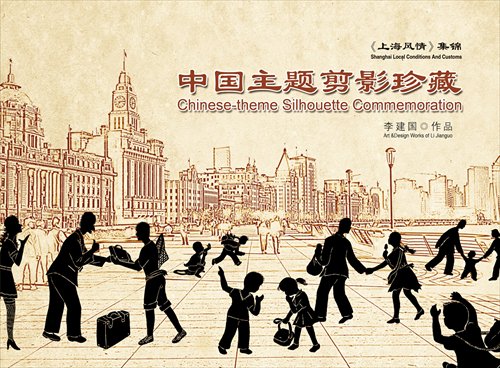
Li has gone on to develop a style that has expanded from portraits to encompass themes from Chinese culture, with a focus on Shanghai (pictured bottom). He finds inspiration in poems and idioms, as well as stories of people's lives in Shanghai, particularly in the 1970s and 1980s.
"In all kinds of art, the theme that most people focus on is human beings. When talking about Shanghai, the lives of local people and folk customs are parts of Shanghai culture that resonate with locals and attract foreigners," said Li.
One of his series focuses on children's street games, and another on the lives of the residents of shikumen (stone-gated lane houses). Li got the idea for the two series in 2000.
"Shanghai was changing rapidly at that time. Shikumen alleys were disappearing quickly. With the disappearance of the shikumen, the daily life of the alleys was also disappearing," said Li.
Moved by the disappearance of the traditional pastimes seen in the shikumen, such as the children's games, along with the loss of the tight-knit communities, Li decided to record what he could using his art, before it was too late. "Silhouette art is a distinctive technique that integrates my own understanding and is also imbued with my own emotions and feelings," said Li.
Li also thinks silhouette art is an effective way of promoting Shanghai culture and history, as it incorporates elements from both East and West.
"Many Chinese arts are somewhat stylized. It was the same with silhouette art in the past. But gradually, Western realism was incorporated, making it acceptable to both Chinese and foreigners," said Li.
When Li visited Nagasaki in 1994, his silhouettes were well received by Japanese people. Many young women dressed up and asked Li to make silhouette portraits of them.
In an effort to incorporate their jewelry into his silhouettes, Li used a needle to make holes in the portraits in patterns reminiscent of their necklaces and earrings.
After that, Li began incorporating more than just people into his creations.
A Malaysian tourist asked Li to create a silhouette of him on his bicycle.
In a silhouette aimed at depicting the lives of Shanghai residents in the 1970s, Li incorporated the silhouette of a pair of tongs, which women would use to perm their hair.
Li also creates incomplete scenes that invite viewers to fill in the blanks. In many such scenes, he purposefully depicts just half a character to express a dynamic feeling. "If the character in the silhouette can echo the character out of the picture, it can extend the content of the picture," said Li.
One of the images in the alleyway game series depicts hopscotch.
"Viewers can imagine the girl hopping in and out of the squares, which makes the silhouette alive. Without facial features and expressions, I show character's emotions through actions, because of my experience in the film industry," said Li.
Li has published a book of techniques titled The Art of Chinese Silhouette Cutting. However, while any budding silhouette artists can use the book to learn the basics of the art, to become a master takes years of experience and an understanding of humanity.
For Li, theme selection and the mode of expression are the most important part of his art.