In a pickle
SOEs in Northeast China face tricky transition
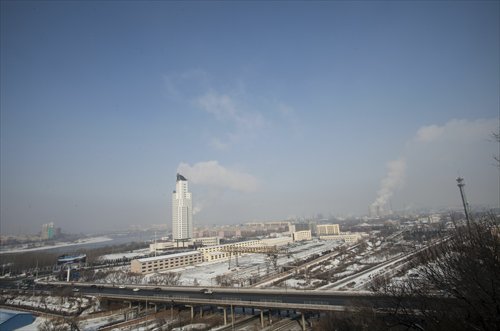
A view of an industrial district in Jilin, Northeast China's Jilin Province on February 27 Photo: IC
State-owned enterprises (SOEs) based in Liaoning Province had a hard year in 2014, but now they are facing potentially even bigger problems.
SOEs in the Northeast Chinese province will have to turn over a 5 percentage-point greater proportion - now ranging between 10 percent and 20 percent - of their profits to the central government from 2015, according to a document recently issued by the Liaoning Provincial Finance Department, China Youth Daily reported Sunday.
This will make the already difficult situation for these SOEs worse, experts said.
Hard times
The difficulties are not limited to Liaoning. SOEs in the other two provinces in Northeast China - Heilongjiang and Jilin - are also facing hard times.
There have been numerous media reports about problems facing large SOEs in the region in recent years, such as Heilongjiang-based Xi Lin Iron and Steel Group, Daqing Oil Field Co and Heilongjiang LongMay Mining Holding Group, and Jilin-based Petro China Jilin Petrochemical Co. Some of the companies have even had to stop production.
The predicament of Northeast China's SOEs is also bad news for the region's overall economy, because these SOEs contribute around half of the area's total economic output, compared with an average proportion of just 30 percent nationwide. Back in the early 2000s, Northeast China's SOEs accounted for more than two-thirds of the region's economic output.
The problems at Northeast China's SOEs have not gone unnoticed by the central government, particularly after the release of highly disappointing economic data for the region.
According to official statistics, the GDP growth in 2014 in Liaoning, Jilin and Heilongjiang provinces was 5.8 percent, 6.5 percent and 5.6 percent, respectively, ranking in the bottom five provinces and municipalities nationwide, and below the accepted reasonable range of economic growth.
Premier Li Keqiang has expressed his deep concern about the economy in Northeast China on several occasions, including earlier this month when he led a high-level official team on an inspection tour of the region. During the tour, Li suggested various measures that could potentially boost growth.
"Premier Li's inspection tour and the measures he mentioned show that the central government is paying close attention to reform of Northeast China's SOEs," Wang Aixin, director of the Institute of Economics of Heilongjiang Provincial Academy of Social Sciences, told the Global Times Tuesday.
The main problems
Northeast China has traditionally been China's industrial base, and it contributed a lot to the country's economy during the years of rapid growth. The region has focused on heavy industry due to its geographic conditions and energy reserves.
However, these former advantages have become disadvantages at a time when China is making an economic transition away from manufacturing and heavy industry.
"It's unavoidable that Northeast China's SOEs will suffer a lot during the economic transition," Norman Sze, northern region managing partner at Deloitte China, told the Global Times on Tuesday.
Experts pointed out that the government's role in managing SOEs is one factor behind the difficulties the companies face.
"The central government is taking away the majority of the profits the SOEs make, and it gives them a relatively small financial allocation, which means they lack the funds needed for further growth," Wang said.
In addition, the central government has put tight restrictions on all SOEs in an effort to curb overcapacity, Wang said, noting that "this hurts the SOEs in Northeast China, where there is sufficient demand and oversupply is not a problem."
"The government has interfered too much in SOEs in Northeast China, such as in the appointment of executives," Liu Shengjun, vice president of the CEIBS Lujiazui Institute of International Finance, told the Global Times on Tuesday.
Wang also noted that "a lot of the government's guidelines are not realistic and not forward-looking."
Xu Gao, chief economist at Everbright Securities, said that a slide in demand is another key factor.
"Reduced demand in international markets since the 2008 global crisis and China's continued economic transition have led to a reduced need for the industrial products that have always been the focus of Northeast China's SOEs," Xu noted.
Liu said that changes need to be made.
"China's current economic transition will make the old economic model of heavy industry obsolete. Northeast China and [North China's] Hebei and Shanxi provinces, where heavy industry is the local economic lifeline, are all facing heavy transition pressure," said Liu.
What to do?
"Innovation and high technology are certainly necessary," Wang said, "but it's even more important to change the old institutional ways. The government has been interfering too much in the management of Northeast China's SOEs and this administrative interference is a deviation from market-based economic development."
Wang mentioned the case of Heilongjiang LongMay Mining Holding Group, which tried to integrate the better-performing assets of its subsidiaries into its main unit ahead of a potential listing, while leaving its inferior assets to the subsidiaries.
But LongMay sill suffered a loss of 5 billion yuan ($815 million) in 2014, bringing it close to collapse, Xinhua News Agency reported on Tuesday.
"LongMay's restructuring was largely led by administrative guidance, depriving the subsidiaries of the impetus to further their own development," said Wang.
"Local governments in Northeast China must abandon their conservative ideas, and not worry that participation by private capital in the ownership of SOEs could cause a loss of State assets. What the authorities should do is to allow more private capital to enter into SOEs, as this would provide funding for their development, as well as making SOEs more transparent and self-driven," Sze suggested.
Liu Shengjun also called for mixed ownership reform, saying it could help in reducing government intervention and promoting entrepreneurial spirit in the SOEs.