HOME >> BUSINESS, METRO BEIJING
Private hospitals move beyond bureaucracy
By Yin Yeping Source:Global Times Published: 2015-4-23 18:28:01
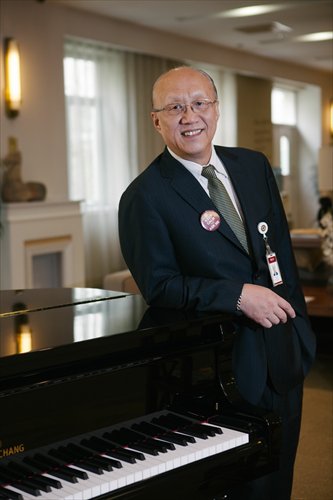
Peter Chen, the founder and president of Oasis International Hospital Photo: Li Hao/GT
Beijing's private hospital sector has boomed in the last few years. Driven by the growing demand for personal and international medical services, the potential of private hospitals is immeasurable.Yet just five-to-ten years ago, this market was still a grey one, with tons of obstacles for those who dared to step in. Peter Chen, the founder and president of Oasis International Hospital (Oasis) in Beijing, has been a witness and participant in the sector's changes. He shared his experiences with Metropolitan.
Located in the Lido business area, Oasis's placement and its international standard of service cater for both domestic and foreign needs. Its doctors, nurses and patients all come from a huge variety of countries and regions, with between 100 and 150 patients passing through the hospital every day. About 70 percent of their patients are expats, who come to them for their "world-level" services.
But Chen says that establishing Oasis took a huge amount of work and perseverance.
Before he established Oasis, he was vice-president at Beijing United Family Hospital (UFH) for seven years. He left in 2010 to establish his own international, locally based, high-end hospital. "I felt that there was a need for a hospital that caters to the locals, while also meeting the international standard of healthcare," he said.
Chen's startup was not encouraging. After spending weeks roaming the city looking for a suitable location, he finally found a 15,000 square meter empty ground near the 798 Art Zone in Chaoyang district and turned it into a hospital. "With a large parking lot and a good location, it's a good place for a hospital," he said, though the monthly rent for the empty ground was one million yuan ($161,400).
Chen then faced months of seeking interested investors. Five years ago, with the sector underdeveloped and private hospitals scarce, many investors weren't interested, though 10 months later Chen had managed to gather 130 million yuan of private investment. Ground was broken on the project in September 2011.
Looking back to the starting point, Chen said that he was keenly aware of the challenges and risks.
Another thing that troubled him was gaining approval from authorities. Chen said that in late 2010, he had to go from department to department to get all the documents and approvals necessary for building a hospital. "The local health bureau was not happy, claiming that we were supposed to ask for their approval before paying the rent for the empty ground," he said.
Even after he had signed a lease, the right documents were hard to obtain. "With one million yuan monthly rent for the empty ground, and no progress on the approval, you dare not think what might happen next," said Chen. At the end of 2010, the central government issued a policy document, offering new support for private investors to open up hospitals. With this signal from the top, the health bureau finally gave its approval.
In 2010, even importing magnetic resonance imaging (MRI) machines for medical use needed government approval, meaning that applications had to be made at least three years in advance.
"Although there is no need for official approval now, it is how it was when we started," said Chen, adding that they managed to find machines that were made in China instead.
Five years on, the developing environment for domestic private hospitals has seen huge changes. "One good example is that investors didn't see private hospitals as a good business five years ago, but now the situation has reversed - many investors came to us with proposals for expanding or buying our hospitals," said Chen.
Oasis aims to provide patients with international levels of healthcare at affordable prices. "Not only are our medical services comprehensively 20 percent cheaper compared with the UFH, we also launched some new specialties like traditional Chinese medicine and plastic surgery that are market-oriented," he said.
In order to improve customer service, the hospital has a special team who are working on the research and development of wearable health related devices that will enable doctors to interact with their patients and provide them with better personal care.
Believing that the Internet will play a major role in the future medical services, Chen's next plan is clear: building dozens of online clinical platforms, and reaching out to more patients in less developed regions.
Posted in: Press Release, Enterprise