Volga River echoes
Russian Peredvizhniki masterpieces on show at the National Museum of China
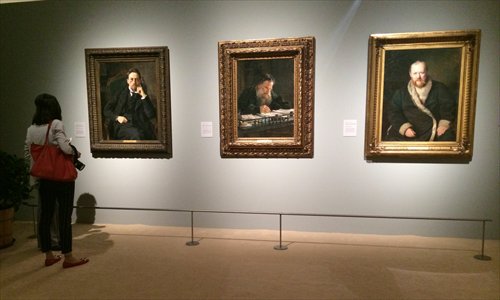
A visitor looks at paintings on display at the Echoes from the Volga River: Masterpieces of the Peredvizhniki exhibition at the National Museum of China on April 23. Photo: Xiong Yuqing/GT
Kicked off on Friday and running until July 26, the art exhibition Echoes from the Volga River: Masterpieces of the Peredvizhniki from the Tretyakov Gallery is bringing 53 masterpieces by 35 Peredvizhniki painters to Beijing's National Museum of China (NMC). After the exhibition Leo Tolstoy and His Times last year aroused warm memories in Chinese viewers last year, this marks the second time the NMC has cooperated with Russia for an art event.
"Beauty is life," this famous sentence from Russian philosopher Nikolay Chernyshevsky (1828-1889) has been quoted by Chinese students in articles countless times. This idea also forms the core view of Peredvizhniki (also known as The Itinerants in English), a group of Russian realist painters from the 19th century.
The exhibition is divided into five parts: a prelude that features three of the group's most valuable masterpieces in order to introduce the overall theme of the exhibit to visitors and four following sections that focus on costume paintings, portraits, landscape and masterpieces by later generations of the school.
Portrait of Pavel Tretyakov by Ilya Repin, one of the most representative works in the collection at the gallery, can be seen just steps from the entrance. It depicts the great collector standing inside his gallery as famous paintings from the time hang on the wall behind him.
"P.M. Tretyakov, the founder of the Tretyakov Gallery, possessed extraordinary artistic perception and sense of purpose. He founded his best hopes in the success and development of the Russian art on the art of The Itinerants. Our museum possesses the most complete and important collection of works by these artists, so it is often called the Home of The Itinerants," Zelfira Tregulova, director general of the Tretyakov Gallery, wrote in the preface to the exhibition.
Though many people may not be familiar with the name of this painting school, the Chinese public is sure to see something familiar in their painting style - an article discussing the painting Barge Haulers on the Volga by Ilya Repin is featured in China's nationwide primary school textbooks. Though this well-known painting doesn't make an appearance at the exhibition, some other important masterpieces by this painter sit front and center.
According to Chinese curator Wang Shu, during the period from 1949 to the late 1970s, there were a lot of opportunities for Chinese painters to learn from Russian artists. Many Chinese artists went to Russia and some Russian painting masters were invited to China. As such the exhibition features some elements that many Chinese visitors are sure to find familiar as a number of Chinese painters have merged these elements into their own creations.
"Top Chinese painters such as Jin Shangyi were deeply impacted by Russia's Peredvizhniki. We can see from Luo Zhongli's Father, a painting work that shocked the nation during the late 1970s, was influenced by Ivan Kramskoi," said Wang.
At the opening press conference for the exhibition on Thursday Tregulova explained that the Peredvizhnik arts had a very strong connection with the local literature culture at the time. Many painters were influenced by writers such as Tolstoy and Chekhov. The portraits of these literary masters by well-known Peredvizhnik artists can be seen in the second section of the exhibition.
Russian curator Glina Churak told the Global Times that many artists and writers were close friends at that time and so many of them share similar themes: Some writers and artists cared about the life of poor people while some liked to present the complicated relationships and struggling minds of the people in their work.
For instance, The Drowned by Vasily Perov focuses on a drowned woman's body and the night watchman beside her. According to Churak, Perov needed a model of a dead woman for this painting and so visited a local mortuary where he came across the corpse of a woman who had previously modeled for him. He used her face as the reference for this painting, while filling the night watchman's eyes full of sadness and pity to reflect his own feelings.