HOME >> METRO SHANGHAI
Going easy in Guilin
Source:Global Times Published: 2015-5-11 16:08:01
Mystical karst landscape and clear waters await
"East or west, Guilin landscape is the best," goes a famous Chinese saying celebrating the beauty of Guilin.
Located in Guangxi Zhuang Autonomous Region, Guilin is a beautiful city surrounded by karst splinters and twisting rivers. Its unique karst topography was listed as a world heritage in 2014.
At two hours' away from Shanghai by plane, Guilin is an ideal destination for city dwellers who want to escape from their daily routines. During the May Day holiday, the Global Times set off to explore the beauty and laid-back living of Guilin.
Lijiang River
The Lijiang River is the pride of Guilin. Starting from Mao'er Mountain, the 164-mile-long river goes through the city and its nearby counties from north to south, before joining the Zhujiang River.
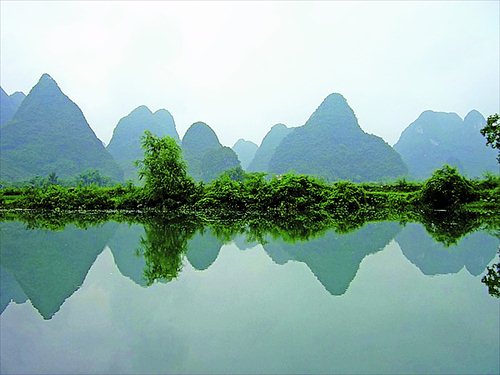
Taking a boat and drifting upon the Lijiang River is perhaps the best way to enjoy the scenery around Guilin. Various types of boats and routes are available to choose from, catering to different needs and distance. One can take a sightseeing ferry traveling from county to county, or take a more leisurely wooden raft propelled by a bamboo pole.
The waterway from Xingping county to Yangdi village covers the best scenery along the Lijiang River. It takes about two hours to go from one pier to another by a motor-powered boat. Made up of 10 PVC pipes and a sun shed, each vessel can hold four passengers and has an experienced local pilot who will not only point out the scenery but also tell interesting stories about the area.
This stretch of water is clear and still, with reflections of the sky and limestone karst outcrops scattered over the wide, smooth surface of the river. The beauty is enhanced when it drizzles and the mist hovers among the hills, which mushroom along the river like bamboo shoots after a spring rain.
Many of the hills are named after their shapes, with some looking like horses and others like fish. As when gazing at clouds, you can look at these rocky formations and let your imagination run riot.
During the trip, the pilot will stop to allow passengers to disembark and take photos, buy souvenirs and treat themselves to delicious meals.
Longji Terrace
Longji Terrace lies on Longji Mountain, in Longsheng county, 80 miles from Guilin. Construction of the terrace began during the Yuan Dynasty (1279-1368) and was completed in the early Qing Dynasty (1644-1911). It demonstrates the strong will of the local people to survive the tough surroundings and live in harmony with nature.
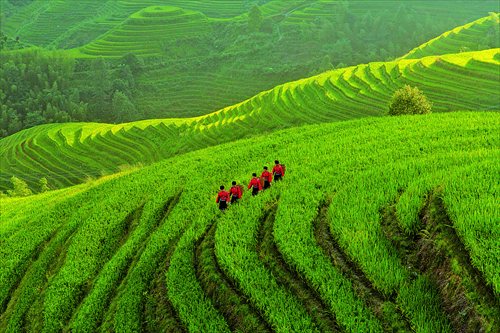
The altitude of the terrace ranges from 300 meters to 1,100 meters. It circles the mountains round and round like a coil of chain, coiling through different villages inhabited by ethnic minorities, mostly the Zhuang and the Yao.
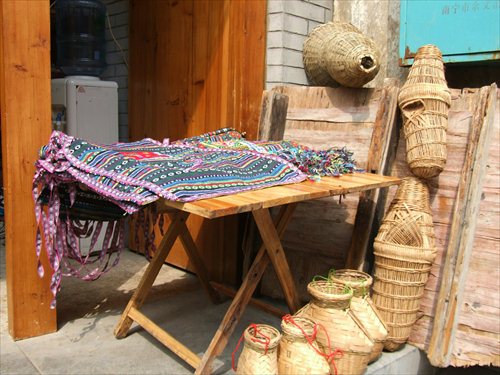
In one of the Yao settlements, Changfa (Long Hair) village, women wear dark, long hair and bright traditional clothes. They cut their hair only once in their lives - when they come of age - and then wear it in a bun at all times. It is said that the average length of their hair could be as much as 1.7 meters. What's more interesting is that even the elderly ladies have dark hair, which is believed to be due to them washing it every several days in water which has been used to wash rice.
The best times to visit Longji Terrace is May to June, when the terrace is freshly irrigated, and September to October, when the rice is ripe and turns gold.
Guilin rice noodles
Rice noodles are another famous feature of Guilin. It is said that the dish dates back to the Qin Dynasty (221BC-206BC), when the first emperor of Qin sent armies to conquer the south of ancient China. The soldiers from the northern part of ancient China, who were used to dining on noodles, fell ill as they were not accustomed to the food in Guilin. So the rice noodle was invented.
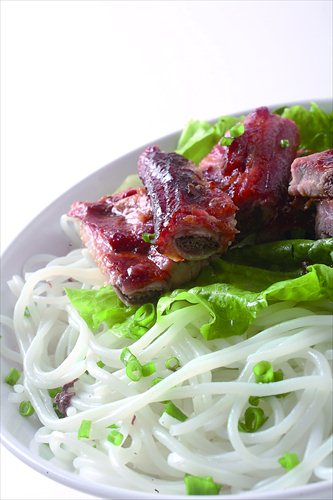
Although Guilin rice noodle shops can now be found all over the country, they are still at their most authentic in their city of origin. Walking along most streets, you will encounter dozens of rice noodle stores offering the delicacy at a far lower price than in bigger cities. In Minggui Rice Noodle, a chain store for example, you can buy a bowl of fresh, steaming-hot gravy rice noodles with chopped green onions, green beans, fried peanuts and bone soup for only 3.5 yuan ($0.56).
Global Times
Located in Guangxi Zhuang Autonomous Region, Guilin is a beautiful city surrounded by karst splinters and twisting rivers. Its unique karst topography was listed as a world heritage in 2014.
At two hours' away from Shanghai by plane, Guilin is an ideal destination for city dwellers who want to escape from their daily routines. During the May Day holiday, the Global Times set off to explore the beauty and laid-back living of Guilin.
Lijiang River
The Lijiang River is the pride of Guilin. Starting from Mao'er Mountain, the 164-mile-long river goes through the city and its nearby counties from north to south, before joining the Zhujiang River.
The Lijiang River
Taking a boat and drifting upon the Lijiang River is perhaps the best way to enjoy the scenery around Guilin. Various types of boats and routes are available to choose from, catering to different needs and distance. One can take a sightseeing ferry traveling from county to county, or take a more leisurely wooden raft propelled by a bamboo pole.
The waterway from Xingping county to Yangdi village covers the best scenery along the Lijiang River. It takes about two hours to go from one pier to another by a motor-powered boat. Made up of 10 PVC pipes and a sun shed, each vessel can hold four passengers and has an experienced local pilot who will not only point out the scenery but also tell interesting stories about the area.
This stretch of water is clear and still, with reflections of the sky and limestone karst outcrops scattered over the wide, smooth surface of the river. The beauty is enhanced when it drizzles and the mist hovers among the hills, which mushroom along the river like bamboo shoots after a spring rain.
Many of the hills are named after their shapes, with some looking like horses and others like fish. As when gazing at clouds, you can look at these rocky formations and let your imagination run riot.
During the trip, the pilot will stop to allow passengers to disembark and take photos, buy souvenirs and treat themselves to delicious meals.
Longji Terrace
Longji Terrace lies on Longji Mountain, in Longsheng county, 80 miles from Guilin. Construction of the terrace began during the Yuan Dynasty (1279-1368) and was completed in the early Qing Dynasty (1644-1911). It demonstrates the strong will of the local people to survive the tough surroundings and live in harmony with nature.
Longji Terrace
The altitude of the terrace ranges from 300 meters to 1,100 meters. It circles the mountains round and round like a coil of chain, coiling through different villages inhabited by ethnic minorities, mostly the Zhuang and the Yao.
Handicrafts by the Yao minorities Photos: GT and CFP
In one of the Yao settlements, Changfa (Long Hair) village, women wear dark, long hair and bright traditional clothes. They cut their hair only once in their lives - when they come of age - and then wear it in a bun at all times. It is said that the average length of their hair could be as much as 1.7 meters. What's more interesting is that even the elderly ladies have dark hair, which is believed to be due to them washing it every several days in water which has been used to wash rice.
The best times to visit Longji Terrace is May to June, when the terrace is freshly irrigated, and September to October, when the rice is ripe and turns gold.
Guilin rice noodles
Rice noodles are another famous feature of Guilin. It is said that the dish dates back to the Qin Dynasty (221BC-206BC), when the first emperor of Qin sent armies to conquer the south of ancient China. The soldiers from the northern part of ancient China, who were used to dining on noodles, fell ill as they were not accustomed to the food in Guilin. So the rice noodle was invented.
Guilin rice noodles;
Although Guilin rice noodle shops can now be found all over the country, they are still at their most authentic in their city of origin. Walking along most streets, you will encounter dozens of rice noodle stores offering the delicacy at a far lower price than in bigger cities. In Minggui Rice Noodle, a chain store for example, you can buy a bowl of fresh, steaming-hot gravy rice noodles with chopped green onions, green beans, fried peanuts and bone soup for only 3.5 yuan ($0.56).
Global Times
Posted in: Metro Shanghai, About Town