HOME >> METRO SHANGHAI
Backward steps
Source:Global Times Published: 2015-5-13 16:53:01
Few young people want to dance with the dragon
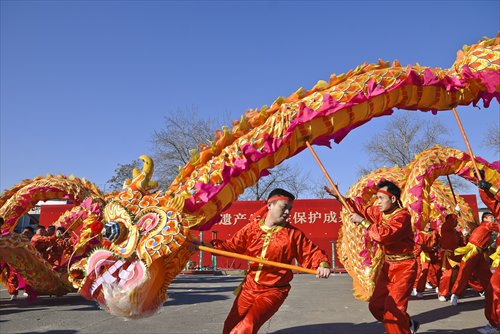
The development of dragon dancing needs more funding and support from the government and the people. Photo:IC
The Sanlin Dragon and Lion Dance Troupe were stars of the Sanlin Temple Fair which ran between April 29 and May 3 in Pudong New Area. Coach Zhao Wenqiang and his team brought the dragon to life for thousands of visitors at the fair.
It was a moment of glory but when the fair ended Zhao had to return to the bitter reality - the glorious dragon he and his followers had made come to life, prance, dance and dazzle, might not be appearing in public for much longer. Like other dragon dance teams they are running short of performers and few youngsters want to learn the art form and maintain this centuries-old tradition.
A long history
Dragon dancing has a long history in Sanlin town, in Pudong New Area, and dates back to the Song Dynasty (960-1279). Traditionally people in olden times believed dragons controlled the waters and the wind and they would perform dragon dances to pray for rain or to recover from natural disasters like flooding. In the mid-19th century, the neighborhoods formed their own dragon dancing teams and festivals and temples around Sanlin regularly welcomed and applauded these performers.
In Sanlin 66-year-old Lu Dajie is the Dragon King. He watched dragon dances when he was a little boy and was inspired by these to become a performer himself. "I'm a Sanlin local. My grandfather ran a furniture business here and he used to help fund dragon dances for festivals."
In 1976, Lu, then the head teacher of the performance department at Sanlin Middle School, wanted to promote the development of dragon dancing in Sanlin. In the 1990s he set standards for dragon dances and established the Sanlin Dragon and Lion Dance Troupe. In 2000 Lu and his teammates performed in Germany and France backing Shanghai's bid to host the World Expo 2010 and scooped up several gold medals in international competitions. Following their work at home and abroad in 2004 the General Administration of Sport of China named Sanlin town as "the hometown of Chinese dragon and lion dances."
In 2010, 61-year-old Lu and his colleagues performed at the Shanghai Expo gala and in the same year the Sanlin dragon dance was listed among the third group of national intangible cultural heritages.
Aging performers
These days as veteran Sanlin dragon dance performers get older and look to step out of the performance area, the team is struggling to find adequate replacements.
On March 19, the Shanghai Sanlin official WeChat account sanlintang posted an advertisement seeking people interested in learning dragon dancing. It wanted candidates between 18 and 35 years old. Residents, students, teachers, retired soldiers and sports fans from the Sanlin area were preferred. However, over the past two months, fewer than eight people have expressed interest.
Zhao has told local media that the Sanlin Dragon and Lion Dance Troupe has now only one team of 10 dancers capable of appearing in professional competitions and only two are full-time.
"A dragon dance team needs at least 10 members. One carries the dragon ball on a stick and leads the other nine teammates who hold and move their support poles. Now if someone cannot make it we have no backup. We have far from enough people for the extra large shows with double dragons and four lions when 22 dancers are needed."
Trying to solve this problem, the dragon dance team aimed at attracting more people. Though dancers under 30 are usually considered the best candidates for dragon dancing, which is very physically demanding, the Sanlin team extended its age limit to 35 and allowed non-Shanghainese to try. Disappointingly still few people showed any interest.
Low pay
Zhao believes that the reason the once popular dragon dancing has become less appealing is because it's very hard to master the skills and, even if one has the skill, there's little money to be earned.
Dragon dancing combines martial arts, performance and dance moves. A dancing dragon has a ball, a head, a body and a tail. To bring a dragon to life takes one or two years of hard practice.
Every performer starts with basic skills. "You have to be strong enough to carry the 10-kilogram dragon head. But it takes more than just strength. To perform a dragon dance, you have to be quick and able to jump, leap, twist and turn quickly in unison." Like any artistic achievement this can take 10 years of practice to be able to deliver one minute of a great performance on stage. "Every member of our team has tripped and tumbled several times and it's common for one of us to be hurt and bleeding during daily training," Zhao said.
But the energy and skills involved don't pay well. Usually, a dragon dancer gets paid 200 yuan ($32.22) for a commercial show. "These days we are usually hired by companies who invite us to annual meetings or opening ceremonies." For other major non-commercial performances, Zhao and his teammates get paid minimal amounts. "One can't earn a living just by dragon dancing. That's why most people do it part time."
Sanlin's dragon dance team founder Lu believes that to promote the development of the award-winning team and the national cultural heritage, more finance and support are needed. "It's also important to get more people to learn about dragon dancing and enjoy the performances. We are ordinary people but we can look like heroes by making our dragon move."
Compiled by the Global Times based on an article in the Shanghai Morning Post
Posted in: Metro Shanghai, City Panorama