Beijing’s Old Summer Palace reborn
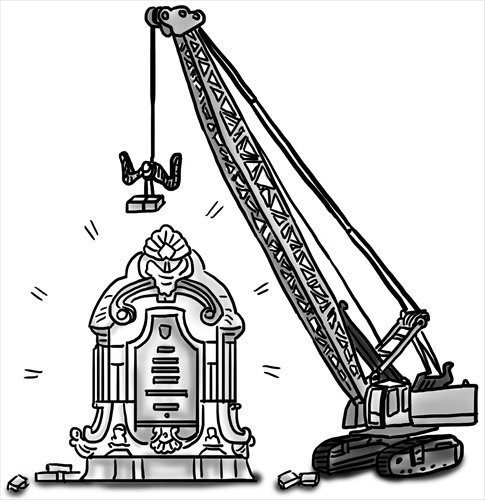
Illustration: Xia Qing/GT
The opening of a full-sized replica of Beijing's Old Summer Palace (Yuanmingyuan) in Hengdian, Zhejiang Province was reported around the world recently.
The project cost 30 billion yuan ($4.8 billion). Although not entirely finished yet, it is already open to tourists, and will also be used as a film set.
The project has stirred a great deal of controversy in China, with both Net users and curators of the Old Summer Palace ruins asking whether it is right to recreate a site of such historical sensitivity.
For those not in the know, the Old Summer Palace was deliberately burned and looted by the British and French over three days in 1860, its priceless treasures carried off and sold. The ruins are now maintained as a reminder to visitors of China's past humiliation at the hands of Western powers.
As a British citizen, I really don't have a good feeling about the Old Summer Palace. After all, it was my country's fault that it was destroyed.
We British were the ones who humiliated China during the Opium Wars by forcing the authorities at the barrel of a gun to allow us to sell opium to Chinese people.
For me, today's vestiges of the palace gardens are a sad and stark reminder of an exploitative and destructive era in my own country's history.
Some of the exhibits in London's museums were taken from Yuanmingyuan in 1860. It is something of a mystery why they have not been given back, since we stole them. What other theft could be presented in a museum like this?
A visit to the palace grounds gave me a strange feeling, as if the Chinese nation was looking at me and thinking: it's your ancestors who did this, you know. I didn't feel at ease walking around the stone rubble in the gardens.
So is the reconstruction of the Old Summer Palace in the southeast of China a good idea? I don't see why not. If people are curious to see an approximation of what it looked like before it was destroyed, then let them.
As far as I am concerned, the replica could be a way of restoring to China what it has lost, of psychologically overcoming a bitter period in the nation's history.
As a British citizen I welcome this attempt to move on by finding a way to make something positive for future generations out of the terrible events of 1860.
The man who is behind the project, Xu Wenrong, is on record as having said that he was inspired to rebuild the palace by a book written by the French journalist, Bernard Brizay. Brizay suggested that the building of a replica would help in some way to provide some historical restitution for France's misdeeds.
Although this new Old Summer Palace was not reconstructed or funded by the British or French, and was instead bankrolled by a Chinese businessman, I still think it is a positive step.
Instead of only being able to study the ruins in Beijing, visitors of all nationalities can go to Hengdian and celebrate the glory of China's past rather than mourn its sad remains.
Hopefully then, Xu's ambitious project can lead China toward improved relations with its former tormentors from Europe, while reminding Europeans of what they so thoughtlessly destroyed.
This article was published on the Global Times Metropolitan section Two Cents page, a space for reader submissions, including opinion, humor and satire. The ideas expressed are those of the author alone, and do not represent the position of the Global Times.