HOME >> BUSINESS
O2O invades the home
By Park Gayoung Source:Global Times Published: 2015-5-27 19:38:01
Experts hail online platforms that deliver services to customers’ doorsteps
In China's competitive and fast-growing online-to-offline (O2O) market, more and more entrepreneurs are looking into customers' homes for untapped opportunities. Now Chinese customers have their nails done or get a massage at their homes. Experts say on-demand services to home might be a next big thing in China.
In China's vibrant start-up scene, online-to-offline (O2O), mobile or Web-based platforms that give customers access to offline goods and services, has been the hottest buzzword since the group-buying craze in 2011.
O2O businesses were valued at 237 billion yuan ($38.22 billion) in 2014 on the Chinese mainland and are set to more than double by 2017, according to Beijing-based market research firm iResearch.
In the past year, which saw a mega merger of two taxi-hailing mobile applications, Didi Dache and Kuaidi Dache, entrepreneurs in search of untapped opportunities in the O2O sector have gone beyond merely linking online and bricks-and-mortar retailers. Instead, they have directly stepped onto customers' doorsteps.
The list of O2O businesses, currently dominated by group buying, car hailing, food delivery and restaurant deals, has now expanded into on-demand door-to-door services including manicure, massage, makeup, cooking, car washing and cleaning.
Perhaps the most successful story comes from the beauty sector where customers and service providers are quickly adapting to the idea of on-demand door-to-door services.
At your beck and call
Liu Chunlei, a 24-year-old nail artist, visits three to four places around Beijing each day. She spends a good chunk of her time on the road and has to lug around a 30 kilogram toolbox, but she won't go back to a traditional nail salon to work.
"One thing is that I couldn't handle the pressure from the store I used to work for," Liu told the Global Times Monday, referring to her monthly sales quota. "The other thing is that I can set my own hours. All I need to do is to turn off my app."
Rather than working at a nail salon where she has to answer to a boss, Liu has been working as on-demand door-to-door nail artist since December, when she signed up for an O2O platform called Helijia. The platform links customers to people like Liu, who travel to the customers' homes to paint their nails, do their makeup or give them a massage, among other services.
Liu is one of the 3,000 people - most of them manicurists - registered with Helijia, which takes about 2,000 orders a day.
In the past six months, Liu has earned about the same amount she made at a salon, but hopes to become a star nail artist. For instance, a star nail artist nicknamed Seven claims to make more than 70,000 yuan ($11,284) a month through Helijia.
Liu has seen more and more of her friends in the industry take an interest in working freelance.
"When we started a year ago, it took one month to get 100 nail artists registered. But in October, it only took one week to get 100 nail artists registered in Shenzhen," Helijia Vice President Song Zhao told the Global Times Friday. "It is not an earthshaking effect, but there are some nail salon owners who have complained about our existence."
Another manicurist surnamed Qian closed her store near a popular shopping center in Beijing in September 2014, and now works through Helijia.
"The income is about the same," she told the Global Times. "I handle a smaller number of customers because I have to be on the road, but I don't have any fixed costs such as rent or electricity."
Qian said there are still drawbacks to working through Helijia.
"It's not worry-free. There are no fees that I have to pay to the company, but what if something changes in the future?" she said.
Currently, Helijia doesn't take a cut from what the freelancers earn. However, it does require them to purchase their gear, such as Liu's manicurist toolbox, through the company.
Helijia said its profit margin on these products is paper-thin, and it is only a strategy to encourage good artisans to stay with the company.
Helijia has no plan to change any time soon.
Promotion spree
Consumers are also taking to the idea of on-demand door-to-door services.
"Now going to a store feels like a waste of my time and money when I can get cheaper and more convenient service at home," said a 32-year-old woman in finance who only gave her surname as Li.
Li feels like this might be the best time for good deals because so many firms are offering hefty discounts on services, such as 1 yuan for a car wash.
These offers are the companies' efforts to grab a bigger slice of the O2O pie. Classified platform 58.com, one of Helijia's competitors, unveiled several on-demand services recently. Helijia began a 100 million yuan promotion Monday. The promotion came after the company announced a $50 million investment in a third round in April.
Helijia, which has 1 million users in six cities around the Chinese mainland, aims to reach 100 million users in the next two years while looking for a sustainable profit model, Song said.
The competition and investment is reminiscent of the group-buying frenzy a few years back, said Will Tao, analysis director with iResearch.
At the peak of the group-buying craze, there were about 5,000 group-buying websites in existence, but only a handful have survived.
The fierce competition might bring many similar ups and downs for O2O entrepreneurs, but it will be a big thing in China for a while.
"Labor and operating costs are still quite competitive in China compared with other countries," Tao told the Global Times in early May. "More importantly, China has a huge number of Internet and mobile users, which makes any O2O business promising."
China has the world's largest number of Internet users, according to the China Internet Network Information Center. Almost 650 million people were online at the end of 2014.
Tao pointed out that many group-buying firms failed to control for quality and only focused on short-term growth - creating many unsatisfied customers. For O2O services, it is more locally focused. The quality of the services matters for growth.
"O2O will be a long-term phenomenon in China so long as companies can provide better services," he said.
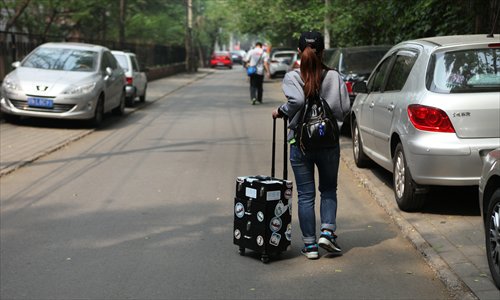
Independent nail artist Liu Chunlei pulls her 30 kilogram manicurist kit down a street in Beijing in early May. Photo: Park Gayoung/GT
In China's vibrant start-up scene, online-to-offline (O2O), mobile or Web-based platforms that give customers access to offline goods and services, has been the hottest buzzword since the group-buying craze in 2011.
O2O businesses were valued at 237 billion yuan ($38.22 billion) in 2014 on the Chinese mainland and are set to more than double by 2017, according to Beijing-based market research firm iResearch.
In the past year, which saw a mega merger of two taxi-hailing mobile applications, Didi Dache and Kuaidi Dache, entrepreneurs in search of untapped opportunities in the O2O sector have gone beyond merely linking online and bricks-and-mortar retailers. Instead, they have directly stepped onto customers' doorsteps.
The list of O2O businesses, currently dominated by group buying, car hailing, food delivery and restaurant deals, has now expanded into on-demand door-to-door services including manicure, massage, makeup, cooking, car washing and cleaning.
Perhaps the most successful story comes from the beauty sector where customers and service providers are quickly adapting to the idea of on-demand door-to-door services.
At your beck and call
Liu Chunlei, a 24-year-old nail artist, visits three to four places around Beijing each day. She spends a good chunk of her time on the road and has to lug around a 30 kilogram toolbox, but she won't go back to a traditional nail salon to work.
"One thing is that I couldn't handle the pressure from the store I used to work for," Liu told the Global Times Monday, referring to her monthly sales quota. "The other thing is that I can set my own hours. All I need to do is to turn off my app."
Rather than working at a nail salon where she has to answer to a boss, Liu has been working as on-demand door-to-door nail artist since December, when she signed up for an O2O platform called Helijia. The platform links customers to people like Liu, who travel to the customers' homes to paint their nails, do their makeup or give them a massage, among other services.
Liu is one of the 3,000 people - most of them manicurists - registered with Helijia, which takes about 2,000 orders a day.
In the past six months, Liu has earned about the same amount she made at a salon, but hopes to become a star nail artist. For instance, a star nail artist nicknamed Seven claims to make more than 70,000 yuan ($11,284) a month through Helijia.
Liu has seen more and more of her friends in the industry take an interest in working freelance.
"When we started a year ago, it took one month to get 100 nail artists registered. But in October, it only took one week to get 100 nail artists registered in Shenzhen," Helijia Vice President Song Zhao told the Global Times Friday. "It is not an earthshaking effect, but there are some nail salon owners who have complained about our existence."
Another manicurist surnamed Qian closed her store near a popular shopping center in Beijing in September 2014, and now works through Helijia.
"The income is about the same," she told the Global Times. "I handle a smaller number of customers because I have to be on the road, but I don't have any fixed costs such as rent or electricity."
Qian said there are still drawbacks to working through Helijia.
"It's not worry-free. There are no fees that I have to pay to the company, but what if something changes in the future?" she said.
Currently, Helijia doesn't take a cut from what the freelancers earn. However, it does require them to purchase their gear, such as Liu's manicurist toolbox, through the company.
Helijia said its profit margin on these products is paper-thin, and it is only a strategy to encourage good artisans to stay with the company.
Helijia has no plan to change any time soon.
Promotion spree
Consumers are also taking to the idea of on-demand door-to-door services.
"Now going to a store feels like a waste of my time and money when I can get cheaper and more convenient service at home," said a 32-year-old woman in finance who only gave her surname as Li.
Li feels like this might be the best time for good deals because so many firms are offering hefty discounts on services, such as 1 yuan for a car wash.
These offers are the companies' efforts to grab a bigger slice of the O2O pie. Classified platform 58.com, one of Helijia's competitors, unveiled several on-demand services recently. Helijia began a 100 million yuan promotion Monday. The promotion came after the company announced a $50 million investment in a third round in April.
Helijia, which has 1 million users in six cities around the Chinese mainland, aims to reach 100 million users in the next two years while looking for a sustainable profit model, Song said.
The competition and investment is reminiscent of the group-buying frenzy a few years back, said Will Tao, analysis director with iResearch.
At the peak of the group-buying craze, there were about 5,000 group-buying websites in existence, but only a handful have survived.
The fierce competition might bring many similar ups and downs for O2O entrepreneurs, but it will be a big thing in China for a while.
"Labor and operating costs are still quite competitive in China compared with other countries," Tao told the Global Times in early May. "More importantly, China has a huge number of Internet and mobile users, which makes any O2O business promising."
China has the world's largest number of Internet users, according to the China Internet Network Information Center. Almost 650 million people were online at the end of 2014.
Tao pointed out that many group-buying firms failed to control for quality and only focused on short-term growth - creating many unsatisfied customers. For O2O services, it is more locally focused. The quality of the services matters for growth.
"O2O will be a long-term phenomenon in China so long as companies can provide better services," he said.
Posted in: Insight