Slow burn
Agarwood incense preserves tradition while helping people unwind in a fast-paced world
The use of agarwood, or agalloch eaglewood, has a long history in China. Agarwood is rare dead wood containing naturally forming aromatic materials.
It is used to make incense and carved crafts. It is so rare that the skills required to make agarwood products are demanding. In Shanghai, the production and processing skills have absorbed the different characteristics of agarwood processing methods and skills from across the nation and overseas. The production skills of agarwood incense and carving skills of agarwood crafts were listed as an intangible cultural heritage of Xuhui district in 2014.
The culture of making incense, burning incense and enjoying its aroma has a long history in China. People have been burning incense to worship as early as the Eastern Zhou Dynasty (770BC-256BC). As Chinese territory grew during the following dynasties, religion and trade became more prevalent, so the usage of incense became common among average households. During the Tang and Song dynasties when incense production was at its peak, nearly every family was burning incense for both important events and as part of daily life.
The tradition
There are a variety of materials used to make incense. The four most important materials that the ancient Chinese used were agarwood, sandalwood, ambergris and musk. Among them, agarwood was the best and the rarest material. It was difficult for regular people to obtain. Because the fumes of burning agarwood were purported to have medicinal effects, incense made from pure agarwood was the most expensive. Only the wealthy and powerful could afford it.
Average civilians mixed agarwood with other aromatic material to make different kinds of incense. To make the best use of agarwood and maximize its effects, the process of producing agarwood incense is complicated and demanding.
The materials in a mixed agarwood incense stick, line incense and incense powder include a number of other aromatic materials such as sandalwood, ambergris, calamus and frankincense. To make these materials agglutinate together, materials such as elm bark powder are added.
The process of producing agarwood incense that was developed in Shanghai took on characteristics of incense processing techniques from other regions where incense production had a long history. "Shanghai is one of the first places to have a lot of contact with countries where incense was widely used, such as Arabia and Japan. Thus, the different characteristics of incense production from the Japanese, Arabians and European Catholics are all reflected in Shanghai incense production, which is unlike the production of agarwood incense in other places in China," said Ren Gang, deputy chairman of China Incense Association.
The agarwood incense produced in Shanghai used agarwood from countries including India, Cambodia, Laos, Myanmar and Thailand. However, agarwood incense makers from other provinces rarely used agarwood from those countries. "The agarwood incense makers in Shanghai know the different characteristics of the foreign agarwood and integrate them into their incense," Ren told the Global Times.
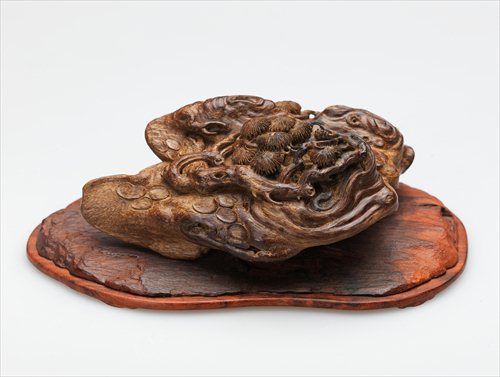
an agarwood craft;
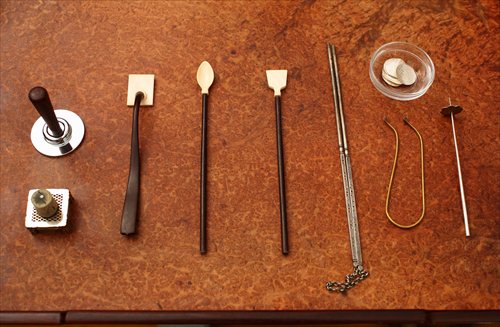
A set of tools for burning incense
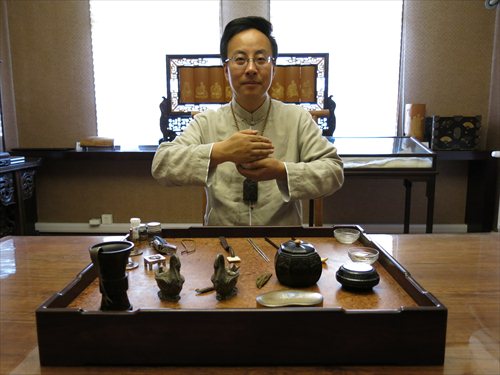
Ren Gang enjoys the aroma of argarwood. Photos: Du Qiongfang/GT and courtesy of Ren Gang
The process
The processing methods of agarwood incense were passed on from former generations of incense makers in Shanghai and were integrated with the processing methods from the Shaolin Temple.
The agarwood has to be cleaned to remove the useless parts. It is then boiled to alter its medicinal characteristics and improve how it smells when burned.
After it is boiled, it is ground into powder, mixed with clay or elm bark powder, then rainwater or well water. It is then repeatedly patted. Then producers add other aromatic materials such as ambergris, which is melted into water. Other aromatic ingredients such as sandalwood, frankincense or borneol are also added.
How to make the agarwood powder stick together when making line incense is an important production problem. "Today some incense makers use harmful materials that the ancient Chinese did not use," Ren said.
The method for agglutinating the powder while keeping the incense burning and maximizing its aroma is also really important.
Since ancient times, famous Chinese scholars and intellectuals all enjoyed burning agarwood incense. They burned incense before they read, wrote, drew and played musical instruments.
They also burned incense while drinking tea. Agarwood incense was part of their daily life. "The poet Li Qingzhao (1084-1155) also frequently mentioned in her verses that she could not live without agarwood incense. The aroma of agarwood has a calming effect. Modern people like agarwood so much because we are under a lot pressure from our fast-paced lives. Agarwood can help people calm down," Ren said.
The craft
Ren has been involved in agarwood incense production since 2001 when he discovered the popularity of agarwood crafts overseas and started to collect them.
In ancient China, some of the ancient officials' necklaces were made of agarwood. These necklaces were much more valuable than necklaces made of emerald and ivory. "According to pawnshop records from the Qing Dynasty (1644-1911), coral, emerald, and ivory necklaces were worth 1.5 kilograms to 2.5 kilograms of silver, but an agarwood necklace was worth 15 kilograms in silver. You can see the big price difference between agarwood crafts and crafts made of other materials," said Tang Yiqiang, a staff member from Yonghetang Agalloch Eaglewood Company.
Due to agarwood's texture, which is easy to break, it takes patience and skill to carve agarwood into fine crafts.
Raw agarwood comes in different shapes. Artists have to carve it according to its original shape while retaining as much as of wood as possible because it is so expensive. "Agarwood is a dead wood that has irregular shapes. It is easy to accidentally cut off its aromatic parts. Thus agarwood crafting is one of the most difficult kinds of art to create," Ren said.
Editor's Note
According to UNESCO's definition, an "intangible cultural heritage" includes traditions or living expressions inherited from our ancestors and passed on to our descendants, such as oral traditions, performing arts, social practices, rituals, festive events, knowledge and practices concerning nature and the universe or the knowledge and skills to produce traditional crafts. It has to be traditional, contemporary and living at the same time, inclusive, representative, and community-based. The safeguarding of intangible cultural heritage is an important factor in maintaining cultural diversity in the face of growing globalization. An understanding of the intangible cultural heritage of different communities helps with intercultural dialogue, and encourages mutual respect for other ways of life.
The Shanghai municipal government has designated 157 traditions as Shanghai's intangible cultural heritage.
The Global Times Metro Shanghai culture page will introduce one intangible culture heritage and interview their current inheritors every month.